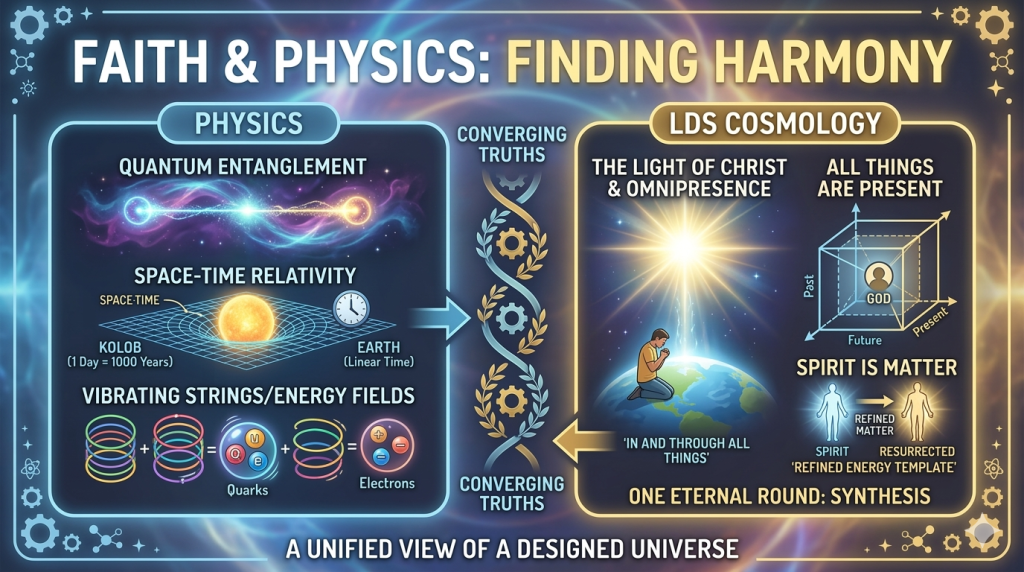
 The intersection of high-energy physics and the theology of the Restoration offers a striking perspective on the nature of reality. While 20th-century science began to dismantle the idea of a “clockwork” universe made of solid marbles, the revelations of Joseph Smith had already proposed a universe where matter is eternal, light is the source of life, and “intelligence” is the fundamental building block of all things.
Core Parallels
• The End of “Solid” Matter
In physics, the deeper we look into the atom, the more “stuff” disappears, replaced by wave functions and fields of probability. This aligns with the doctrine that “there is no such thing as immaterial matter” (D&C 131:7); rather, what we perceive as solid is simply matter vibrating at a specific frequency or “refined” state.
• The Governance of Law
Physics operates on the principle that the universe follows strict mathematical constants. Similarly, Latter-day Saint cosmology suggests that all blessings and physical realities are predicated on unchangeable laws (D&C 130:20-21).
• Intelligence as the Foundation
Where physics see a “dance of energy,” Restoration scripture describes a universe filled with “the Light of Christ,” a divine energy that proceeds from the presence of God to fill the immensity of space and gives life to all things.
It is a fascinating bridge to build. If you look at LDS cosmology—specifically the descriptions in the Book of Abraham and Doctrine and Covenants—you find a “pre-scientific” language that mirrors several concepts in modern physics.
While the theology is spiritual and the physics is mathematical, they both point toward a universe that is relative, interconnected, and dynamic.
1. Time Relativity: Kolob and Einstein
The idea that “one day is 1000 years” (Abraham 3:4) is perhaps the most direct parallel to General Relativity.
• The Physics: Einstein showed that time is not a universal constant. If you are near a massive object (like a black hole or a massive star) or traveling at extreme speeds, time literally slows down for you compared to someone else. This is called Time Dilation.
• The LDS Fit: If “Kolob” is a place of immense power or near the “throne of God” (a center of massive energy/gravity), the time difference isn’t just a metaphor; it’s a relativistic reality. For an observer in that high-energy state, our “1,000 years” could literally be experienced as a single “day.”
2. “All Things are Present”: The Block Universe
LDS scripture suggests that for God, “all things are present… both past, present, and future” (D&C 38:2).
• The Physics: In physics, this is known as the Block Universe theory. Because time is a fourth dimension, some physicists argue that the past and future aren’t “gone” or “not yet happened”—they exist as part of a giant 4D “loaf” of spacetime.
• The Connection: Just as you can see the beginning and end of a road from a helicopter, a being “outside” or “above” our 4D spacetime (as described in LDS thought) would see the entire timeline of Earth as a single, static map.
3. Matter and Spirit: The “No Non-Material” Rule
One of the most unique aspects of LDS cosmology is Doctrine and Covenants 131:7: “There is no such thing as immaterial matter. All spirit is matter.”
• The Physics Link: This is strikingly close to the modern view that everything is just different “densities” or “vibrations” of the same underlying fields.
• Refined Matter: In String Theory, an electron and a photon are the same “string” just vibrating differently. In LDS terms, “Spirit” might simply be matter vibrating at a frequency or “fineness” that our current instruments (and eyes) cannot yet detect. It moves the conversation from supernatural (outside nature) to exotic physics (part of nature we don’t understand yet).
4. The “Web” and “One Eternal Round”
LDS thought often describes the universe as a “One Eternal Round.” This fits the Bootstrap and String Theory idea that the universe is a self-sustaining system of energy.
• Intelligence: LDS theology posits that “Intelligence” (the core of a person) was not created, but has always existed.
• Conservation of Energy: This mirrors the First Law of Thermodynamics—energy cannot be created or destroyed, only transformed. Both views suggest a universe that has no absolute beginning in terms of “stuff,” only changes in “organization.”