 Forty years ago, in a world before the internet, I sat down with a copy of Fritjof Capra’s The Tao of Physics. Capra, a high-energy physicist, dared to suggest that our perceived “solid” world was a persistent illusion—that if you peered deep enough into the heart of the atom, you didn’t find “things,” you found a “dance of energy.”
Reading Capra again today as a member of The Church of Jesus Christ of Latter-day Saints, I notice striking parallels with key concepts in the theology of the Restoration. While I am neither a professional theologian nor a theoretical physicist, I believe there is an interesting intersection here – a bridge between the ancient “Light of Truth” and the modern “String.”
Beyond the Grain of Sand: The Search for “Stuff”
In the 19th century, scientists thought of matter like tiny grains of sand—solid, indivisible pellets of “stuff.” If you had a gold coin, you could theoretically keep cutting it into smaller and smaller pieces until you reached a single, solid atom of gold.
But modern physics has shattered that “solid” floor. We now know that if you zoom into an atom, you find a vast empty space with a nucleus at the center. If you zoom into that nucleus, you find protons and neutrons. And if you zoom into those, you find quarks.
But here is the shocking discovery: a quark isn’t a smaller “grain of sand.” It isn’t a “thing” at all. If you could look inside a quark, you wouldn’t find a smaller solid core; you would find a tiny, vibrating loop of energy.
The “Refined Matter” of the Restoration
This brings us to one of the most radical departures Joseph Smith made from 19th-century theology: his rejection of “immateriality.” Most religions of his day taught that the spirit was a ghostly, non-physical substance existing outside the realm of “real” things. Joseph countered this with a startlingly modern assertion:
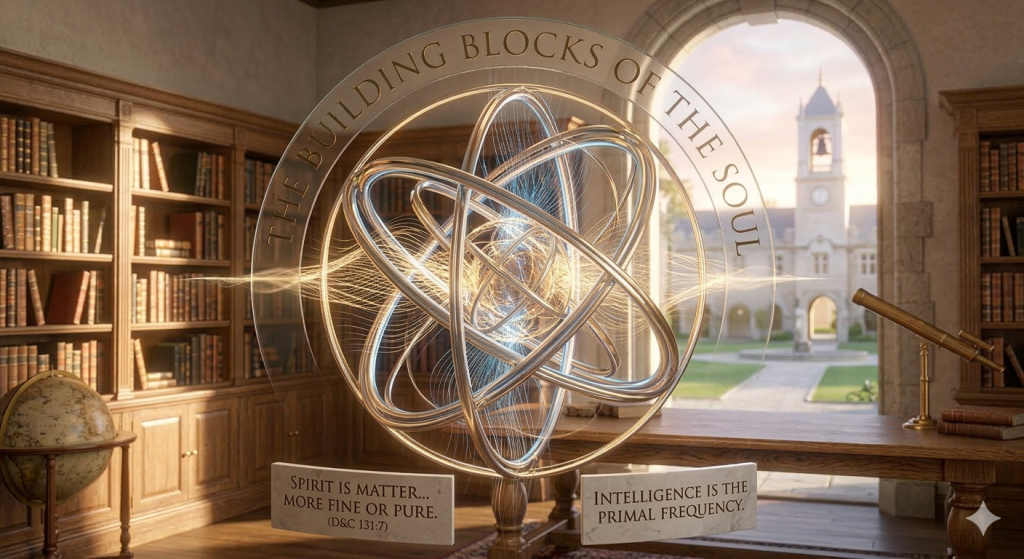
“There is no such thing as immaterial matter. All spirit is matter, but it is more fine or pure” (D&C 131:7).
In 1843, the scientific vocabulary simply didn’t exist to describe what he was seeing. Today, we call it String Theory.
In this framework, the difference between a “solid” rock and a “pure” spirit isn’t that one is real and the other isn’t. The difference is the vibration. Just as a cello string can produce a low, heavy ‘G’ or a high, piercing ‘E’ depending on its tension, the fundamental energy of the universe creates “coarse” physical matter or “refined” spirit matter depending on its frequency.
Intelligence: The Primal Frequency
LDS scripture takes this a step further into the eternal past. It tells us that “Intelligence, or the light of truth, was not created or made, neither indeed can be” (D&C 93:29).
If we apply this to modern physics, we realize that you are not like a ‘brick’ placed inside a ‘building’ called a body. You are more like a specific “song” being played by the universe. Your “Intelligence” is like the primal frequency—the uncreated vibration that has always existed.
In this light, God’s role as the Supreme Organizer becomes even more awe-inspiring. He didn’t “create” the music of your soul out of nothing; He organized it. He provided the “instrument”—the spirit and the physical body—so that your unique, eternal vibration could finally harmonize with the rest of His vast, organized creation.
Conclusion: The Grand Symphony
Forty years ago, I thought the Tao was about “losing oneself” in the vastness of the universe. Now, through the lens of the Restoration, I realize the Gospel is about finding oneself as a unique, eternal vibration that God is helping to reach its highest possible frequency.
We are not just passive observers of the “dance of energy.” We are the dancers, and the music is eternal. We are moving from the low-frequency static of a fallen world toward the high-frequency harmony of the heavens.