Innovation

“Progress is made by lazy men looking for easier ways to do things.” ― Robert A. Heinlein

Darwin, the World Wide Web, and the Phoenix Memo: The Role of Slow Hunches in Innovation

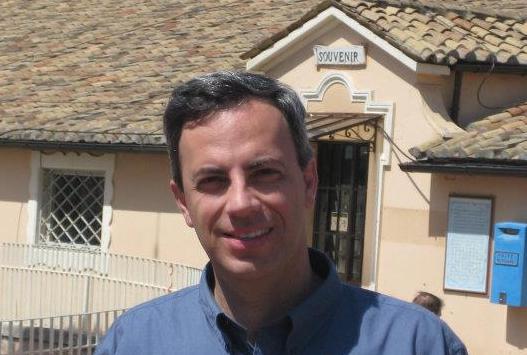
Berners-Lee speaking at the launch of the World Wide Web Foundation
Berners-Lee speaking at the launch of the World Wide Web Foundation

Chance favors the connected mind” says Steven B. Johnson to those looking for the next big idea in his book “Where Ideas Come From: The Natural History of Innovation”, a book that looks at the macro trends on how innovation evolves.

“It is easy to talk about great ideas as if they were light-bulb moments, sudden epiphanies where everything comes together at once…but that’s rarely how it works.”

Great Ideas Generally Evolve over Time as Slow Hunches Rather Than Sudden Breakthroughs

Johnson believes that good ideas don’t usually come from a lone genius working in a lab, but more often are the product of a connected environment, and are the result from interactions between geniuses, or even just normal people working together.

Although in retrospect great discoveries may seem like single eureka-moments, in most cases they are gradually maturing slow hunches, which need time and cultivation to bloom.

History’s famous eureka moments are overrated, and Johnson believes that half-baked ideas can often be the most powerful: half-baked ideas are Slow Hunches.

Basically, innovation comes from accumulated hunches over time, and more often than not, people don’t really know where the hunch is going to take them, they’re not sure why it’s important, but they’re drawn to it.

How to Foster an Environment that Nurtures Slow Hunches

“The snap judgements of intuition … are rarities in the history of world-changing ideas. Most hunches that turn into important innovations unfold over much longer time frames. They start with a vague, hard-to-describe sense that there’s an interesting solution to a problem that hasn’t yet been proposed, and they linger in the shadows of the mind, sometimes for decades, assembling new connections and gaining strength.”

Because these slow hunches need so much time to develop, they are fragile creatures, easily lost to the more pressing needs of day-to-day issues.

One of the problem of hunches is that they are the first things people forget, because there are so many things to do daily, like going to work, picking up children from school and so on. This is why is so important to write every random hunch down.

But to write them down is not enough. We need to revisit those hunches over time, because suddenly those hunches can combine with others, and spark a new idea or direction.

Darwin’s Natural Selection

HMS Beagle at Tierra del Fuego (painted by Conrad Martens)
HMS Beagle at Tierra del Fuego (painted by Conrad Martens)

Johnson also notices that many great inventors and scientists tend to forget or distort the history of their own discoveries. For example, according to Darwin, the theory of natural selection simply popped into his head when he was considering Malthus’ writings on population growth.

However, Darwin’s own notebooks show that a long time before his “sudden idea”, he had already described an almost complete theory of natural selection. In other words, his final theory was the product of slow hunches that matured over time.

Since Darwin’s idea seems so obvious in retrospect to many, then the conclusion is that it must have come in a flash of insight, but this is now how it happened.

The voyage of the Beagle, 1831–1836
The voyage of the Beagle, 1831–1836

The Creation of the World Wide Web

Another example of slow hunches is the way the World Wide Web was born. In his own account of the Web’s origins, differently from Darwin, Tim Berners-Lee makes no attempt to reduce the evolution of his marvelous idea into a single epiphany. The Web came into being as a classic slow hunch. It started first with a child’s exploration of a Victorian-era how-to book.

Tim Berners-Lee
Tim Berners-Lee

Tim was fascinated by the “portal of information” that he had found in the the old encyclopedia. Later, the idea grew thanks to a freelancer’s idle side project designed to help him keep track of his colleagues, and finally he started a deliberate attempt to build a new information platform that could connect computers across the planet. Berners-Lee’s idea needed time to mature. He said:

“Journalists have always asked me what the crucial idea was, or what the singular event was, that allowed the Web to exist one day when it hadn’t the day before. They are frustrated when I tell them there was no “Eureka!” moment . . . Inventing the World Wide Web involved my growing realization that there was a power in arranging ideas in an unconstrained, weblike way. And that awareness came to me through precisely that kind of process. The Web arose as the answer to an open challenge, through the swirling together of influences, ideas, and realizations from many sides, until, by the wondrous offices of the human mind, a new concept jelled. It was a process of accretion, not the linear solving of one problem after another.”

A Failure: The Phoenix Memo and 9/11

September 11 attacks: The Statue of Liberty with the towers burning in the background

The importance of the nurturing the proper environment, in our minds and in our work space, to help slow hunches to develop into breakthrough, can be also illustrated by a dramatic failure, like the Phoenix Memo in connection with the tragedy of September 11, 2001.

Because the ideas that led to Darwin’s natural selection theory and the creation of the World Wide Web were by definition successful ones, it’s easy to attribute their success to intrinsic causes: the brilliance of the idea itself, or the brilliance of the mind that came up with it.

But those intrinsic causes can easily overshadow the environmental role in the creation and spread of those ideas. This is why it is useful to look at the sparks that failed, the ideas that found their way to a promising region of the adjacent possible but somehow collapsed there.

Johnson writes:

“On July 10, 2001, an Arizona-based FBI field agent named Ken Williams filed an “electronic communication” with his superiors in Washington and New York, using the Bureau’s Automated Case Support system, the antiquated electronic repository through which the Bureau shared information about ongoing investigations. The six-page document began with this prophetic sentence: “The purpose of this communication is to advise the Bureau and New York of the possibility of a coordinated effort by USAMA BIN LADEN (UBL) to send students to the United States to attend civil aviation universities and colleges.” This was the now legendary “Phoenix memo,” a warning shot fired—and largely ignored—during the lazy summer months leading up to 9/11.”

Williams had been inspired to write the memo by a pattern he had detected over the preceding year: an “inordinate number” of people of “investigative interest” who had registered for various flight schools and other civil aviation colleges in Arizona.

Why was it ignored?

Because even if it had been addressed to several high-level offices, Williams’s memo quickly entered what investigators later called a “black hole” at FBI headquarters. It remained in limbo, until it was assigned to an analyst to who labeled it “routine” instead of “urgent.” Another agent called it “speculative and not very significant.”

But only a months after the Phoenix Memo was filed,

“Zacarias Moussaoui enrolled at Pan Am International Flight Academy on the outskirts of St. Paul, Minnesota, where he began training to fly a Boeing 747-400 on a simulator. Instructors and other employees at the flight school were immediately suspicious about their new pupil, who paid his entire $8,300 fee in cash. Moussaoui possessed an inordinate amount of interest in the operation of the cockpit doors and flight tour communications, despite the fact that he claimed no interest in ever flying a real plane. The Pan Am employees contacted the FBI, and after a quick background check, Moussaoui was arrested on immigration violations at a motel on August 16.”

Flight paths of the four planes used on September 11

Unfortunately, even if an interrogation convinced the field agents that Moussaoui posed an active threat and could be part of a wider conspiracy, the request to seek a search warrant for his laptop was formally denied on the grounds that the evidence for probable cause was “shaky.”

Connecting the dots between the Phoenix Memo and Moussaoui’s training could have certainly supplied enough probable cause to justify examining the contents of Zacarias Moussaoui’s laptop before it was too late: but it didn’t happen.

The Phoenix memo was precisely one of those failed sparks. It contained great wisdom and foresight, but that information proved to be ultimately useless, because the environment was not conducive to make the needed connections.

“The problem with Ken Williams’s hunch was environmental: instead of circulating through a dense network, the Phoenix memo was dropped into the black hole of the Automated Case Support system. Instead of seeking out new connections, the Phoenix memo was deposited in the equivalent of a locked file cabinet. Hunches that don’t connect are doomed to stay hunches.”

“The failed spark of the Phoenix memo suggests an answer to the mystery of superlinear scaling in cities and on the Web. A metropolis shares one key characteristic with the Web: both environments are dense, liquid networks where information easily flows along multiple unpredictable paths. Those interconnections nurture great ideas, because most great ideas come into the world half-baked, more hunch than revelation. Genuine insights are hard to come by…”

“And so, most great ideas first take shape in a partial, incomplete form. They have the seeds of something profound, but they lack a key element that can turn the hunch into something truly powerful. And more often than not, that missing element is somewhere else, living as another hunch in another person’s head. Liquid networks create an environment where those partial ideas can connect; they provide a kind of dating service for promising hunches. They make it easier to disseminate good ideas, of course, but they also do something more sublime: they help complete ideas.”

For more interesting details read Where Ideas Come From: The Natural History of Innovation

Liquid Networks Facilitate Innovation

The central premise of Steven Johnson’s “Where Do Ideas Come From: The Natural History of Innovation” is that, similarly to the principle of evolution in the theory of natural selection, hunches or ideas emerge within the realm of possibilities at any given stage and innovation gradually develops over time. In other words, ideas and innovations do not come from random lightbulbs moments, flashes, epiphanies, and so on, but from proper timing and when nurtured further in proper environments.

Johnson explains:

A good idea is a network. A specific constellation of neurons–thousands of them–fire in sync with each other for the first time in your brain, and an idea pops into your consciousness. A new idea is a network of cells exploring the adjacent possible of connections that they can make in your mind….an idea is not a single thing. Is is more like a swarm.” (p.45-46)

Everything that happens in our brain is technically a network but

“the creative brain behave differently from the brain that is performing a repetitive task. The neurons communicate in different ways… the question is how to push your brain toward these more creative networks” (p.47)

The answer is to place your mind in environments that enhance the innate brain’s capacity to make new links and associations.

“When you think about ideas in their native state of neural networks, two key preconditions become clear. First, the sheer size of the network: you can’t have an epiphany with only three neurons firing. The network needs to be densely populated. Your brain has roughly 100 billion neurons…but all those neurons would be useless for creating ideas …if they weren’t capable of making such elaborate connections with each other….

The second precondition is that the network be plastic, capable of adopting new configurations. A dense network incapable of forming new patterns is, by definition, incapable of change” (p.38-39)

The Edge of Chaos

Innovative systems have the tendency to gravitate toward the “edge of chaos”, that is an area between “too much order and too much anarchy”.

The computer scientist Christopher Langton sometimes uses the metaphor of different phases of matter—gas, liquid, solid—to describe these network states. Molecules in each of these three states behave differently.

In a gas, chaos rules; new configurations are possible, but they are constantly being disrupted and torn apart by the volatile nature of the environment. In a solid, the opposite happens: the patterns have stability, but they are incapable of change. But a liquid network creates a more promising environment for the system to explore the adjacent possible. New configurations can emerge through random connections formed between molecules, but the system isn’t so wildly unstable that it instantly destroys its new creations.”

The 100 billion neurons in your brain form another kind of liquid network: densely interconnected, constantly exploring new patterns, but also capable of preserving useful structures for long periods of time.

Cities as Liquid Networks

According to Steven Johnson, when people started living together in cities the possibilities of innovating increased exponentially, because cities created “liquid networks”.

For example, it is not a coincidence that Northern Italy was the most urbanized region in all of Europe during the fourteenth and fifteenth centuries when it experienced an explosion of commercial and artistic innovation and became the birthplace of the European Renaissance. The rise of urban networks triggered a dramatic increase in the flow of good ideas.

Moreover,

“the pattern of Renaissance innovation differs from that of the first cities: Michelangelo, Brunelleschi, and da Vinci were emerging from a medieval culture that suffered from too much order. If dispersed tribes of hunter-gatherers are the cultural equivalent of a chaotic, gaseous state, a culture where the information is largely passed down by monastic scribes stands at the opposite extreme. A cloister is a solid. By breaking up those information bonds and allowing ideas to circulate more freely through a wider, connected population, the great Italian innovators brought new life to the European mind.” (p. 44)

Capitalism and Double-Entry Accounting

Capitalism was one of the important elements that promoted the growth of the Italian cities, by creating extra wealth that was later used by the rich and powerful to support artists and architects.

“But markets should not be exclusively defined in terms of the profit motive. Consider the invention of one of capitalism’s key conceptual tools: double-entry accounting, which Goethe called one of the “finest inventions of the human mind.” (p. 45)

While it was codified by the Franciscan friar and mathematician Luca Pacioli in 1494, we do not really know if the the double-entry method originated in the mind of a single person, or whether the idea emerged simultaneously in the minds of multiple people, or whether it was passed on by Islamic entrepreneurs.

The technique first became commonplace in the merchant capitals of Italy—Genoa, Venice, and Florence—but what makes the history of double-entry so fascinating is the fact that no one seems to have claimed ownership of the technique, despite its enormous value. In other words,

“One of the essential instruments in the creation of modern capitalism appears to have been developed collectively, circulating through the liquid networks of Italy’s cities…Double-entry accounting illustrates a key principle in the emergence of markets… A society organized around marketplaces, instead of castles or cloisters, distributes decision-making authority across a much larger network of individual minds…Cities and markets recruit more minds into the collective project of exploring the adjacent possible. As long as there is spillover between those minds, useful innovations will be more likely to appear and spread through the population at large.” (p.46)

But networked innovation is not a “global brain,” or a “hive mind” because large collectives are rarely capable of true creativity or innovation. It’s not some “higher-level group consciousness”, but those cities

“simply widened the pool of minds that could come up with and share good ideas. This is not the wisdom of the crowd, but the wisdom of someone in the crowd. It’s not that the network itself is smart; it’s that the individuals get smarter because they’re connected to the network.” (p.47)

The Importance of Physical Locations

In the early 1990s, a psychologist named Kevin Dunbar decided to study idea formation in “the wild”, by actually watching scientists as they worked in their laboratories. He also conducted interviews in which the researchers described the latest developments in their experiments almost in real time.

These techniques allowed Dunbar to overcome one of the major problems of traditional studies that rely on retrospective interviews, where people tend to condense the origin stories of their best ideas into tidy narratives, forgetting the messy, complicated paths to inspiration that they actually followed.

“The most striking discovery in Dunbar’s study turned out to be the physical location where most of the important breakthroughs occurred. With a science like molecular biology, we inevitably have an image in our heads of the scientist alone in the lab, hunched over a microscope, and stumbling across a major new finding. But Dunbar’s study showed that those isolated eureka moments were rarities. Instead, most important ideas emerged during regular lab meetings, where a dozen or so researchers would gather and informally present and discuss their latest work.” (p.48)

“The lab meeting creates an environment where new combinations can occur, where information can spill over from one project to another….The social flow of the group conversation turns that private solid state into a liquid network.” (p.48)

Innovation: The Adjacent Possible by Steven Johnson

Visualization of two dimensions of a NK fitness landscape
By Randy Olson - Own work, CC BY-SA 3.0, File
Visualization of two dimensions of a NK fitness landscape
By Randy Olson – Own work, CC BY-SA 3.0, File

Steven Johnson uses the concept of the “adjacent possible” in his book “Where Good Ideas Come From: The Natural History of Innovation” to describe how new insights can be generated in previously unexplored areas.

Stuart Kauffman in 2002 introduced the “adjacent possible” theory that proposes that biological systems are able to morph into more complex systems by making incremental, relatively less energy consuming changes in their make up.

Steven Johnson uses Kauffmann’s logic in Where Good Ideas Come From, and applies the same logic to innovation. All future innovations, Johnson posited, require the possibilities that are available in the present—or the adjacent.

One relatively recent example of innovation through the Adjacent Possible is the creation of YouTube. Johnson explains that if Youtube founders had tried to create the same platform 10 years earlier, it would have failed because the early Web wasn’t able to support it.

Johnson looks at historical patterns from science and biological evolution to show how innovative ideas evolve and, eventually, rise.

Evolution and innovation usually happen in the realm of the adjacent possible

According to Kuffmann, four billion years ago, when life began, carbon atoms did not spontaneously arrange themselves into complex life forms like sunflowers or squirrels., but they had to first form simpler structures like molecules, polymers, proteins, and so on. But after each new step, new possibilities presented themselves for new combinations, expanding the realm of what was possible, until finally a carbon atom could reside in a sunflower.

Where Good Ideas Come From
Where Good Ideas Come From,

Similarly, Amazon could not have been created in the 1950s. First, someone had to invent computers, then the Internet, and so on.

Both evolution and innovation tend to happen within the bounds of the adjacent possible, that is the realm of possibilities available at any given moment.

Great leaps beyond the adjacent possible are rare and doomed to be short-term failures. The environment is simply not ready for them yet.

For example, the nineteen-century British scientist Charles Babbage designed two classes of engine, Difference Engines, and Analytical Engines.

Difference engines are so called because of the mathematical principle on which they are based, namely, the method of finite differences. They only use arithmetical addition and remove the need for multiplication and division which are more difficult to implement mechanically. Difference engines are strictly calculators. They crunch numbers the only way they know how – by repeated addition according to the method of finite differences. 

The Analytical Engines, on the other hand, are much more than a calculator but are a general-purpose computation machine. The Analytical Engine had many essential features found in the modern digital computer. It was programmable using punched cards.

Babbage in his life time wasn’t able to build either the difference engines or the analytical engines. But difference engines were built soon after his death, because they were in the bounds of the adjacent possible. On the other hand, the analytical engine was outside the bounds of the adjacent possible, being, at least on paper, the first programmable computer. But in Babbage’s days and for a long time after his death, there were no available parts to use to build such engine, nor available sufficient knowledge.

An interesting fact that has been observed is the predominance of multiples in innovation. A multiple occurs when several people independently make the same discovery almost simultaneously: this fact confirms that the adjacent possible is constrained by the available parts and knowledge.

For example, sunspots were discovered simultaneously by four scientists living in four different countries in 1611.

Top 25 Best Quotes from Thomas Edison

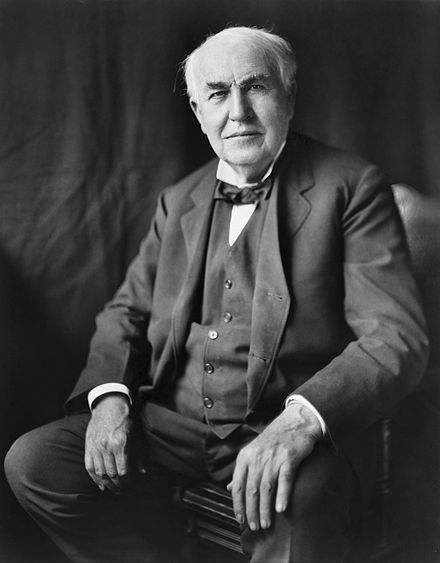
Inventor Thomas Edison

Thomas Alva Edison (1847 – 1931) was an American inventor and businessman, who many consider as America’s greatest inventor.

Some of his greatest inventions were the phonograph, the light bulb, the motion picture, the electrographic vote recorderthe quadruplex telegraph, the electric pen, the electric generator, the stock ticker, and the storage battery.

Edison was a savvy businessman, he held more than 1,000 patents for his inventions. He was one of the first inventors to apply the principles of organized science and teamwork to the process of invention, working with many researchers and employees. He established the first industrial research laboratory.

Thomas Edison's first successful light bulb model, used in public demonstration at Menlo Park, December 1879
Thomas Edison’s first successful light bulb model, used in public demonstration at Menlo Park, December 1879

Edison was raised in the American Midwest and early in his career he worked as a telegraph operator, which inspired some of his earliest inventions. In 1876, he established his first laboratory facility in Menlo Park, New Jersey, where many of his early inventions would be developed. He would later establish a botanic laboratory in Florida in collaboration with businessmen Henry Ford and Harvey Firestone, and a laboratory in West Orange, New Jersey that featured the world’s first film studio, the Black Maria. Edison married twice and had six children. He died of complications of diabetes.

A Few Interesting Facts About Thomas Edison

Photograph of Edison with his phonograph (2nd model),
Photograph of Edison with his phonograph (2nd model), 

At the age of seven, Edison attended school for only a short period of 12 weeks. Being a hyperactive child and prone to distraction, Edison’s teachers were not able to handle him. His mother then removed Thomas from school and tutored him at home until the age of 11. Therefore, Edison had very little formal education as a child, but the removal from school proved very beneficial for his career, because he developed self-learning skills with his growing interest for knowledge.

Thomas Edison even made a device to kill cockroaches with electricity.

The biggest failure of Edison’s life was trying to invent a method for separating ore from rock. Those failed experiments cost him millions of dollars.

Thomas Edison was the first person in the world to project successfully a motion picture. He did so on April 23, 1896.

Edison nicknamed two of his children he had with his first wife “Dot” and “Dash to remember his early telegraph days.

Thomas Edison didn’t just hold 1093 US patents in his name, but many more in other countries, including France, Germany, and the U.K.

Edison, about his hearing loss in 1885, wrote, “I haven’t heard a bird sing since I was twelve years old.”

Thomas Edison designed a battery for the self-starter for the Model T developed by Henry Ford.

Top 25 Quotes from Thomas Edison

“I have not failed. I’ve just found 10,000 ways that won’t work.” ― Thomas A. Edison

“Many of life’s failures are people who did not realize how close they were to success when they gave up.” ― Thomas A. Edison

“Five percent of the people think; ten percent of the people think they think; and the other eighty-five percent would rather die than think.” ― Thomas A. Edison

“We often miss opportunity because it’s dressed in overalls and looks like work” ― Thomas A. Edison

“Genius is one percent inspiration, ninety-nine percent perspiration.” ― Thomas A. Edison

Henry Ford, Thomas Edison, and Harvey Firestone, respectively. Ft. Myers, Florida, February 11, 1929
Henry Ford, Thomas Edison, and Harvey Firestone in 1929

“The three great essentials to achieve anything worthwhile are, first, hard work; second, stick-to-itiveness; third, common sense.” ― Thomas A. Edison

“To have a great idea, have a lot of them.” ― Thomas A. Edison

“If we all did the things we are really capable of doing, we would literally astound ourselves.” ― Thomas A. Edison

“When you have exhausted all possibilities, remember this – you haven’t.” ― Thomas Edison

“Our greatest weakness lies in giving up. The most certain way to succeed is always to try just one more time.” ― Thomas Edison

“To invent, you need a good imagination and a pile of junk.” ― Thomas A. Edison

“Negative results are just what I want. They’re just as valuable to me as positive results. I can never find the thing that does the job best until I find the ones that don’t.” ― Thomas A. Edison

“There are no rules here — we’re trying to accomplish something.” ― Thomas A. Edison

“Just because something doesn’t do what you planned it to do doesn’t mean it’s useless.” ― Thomas A. Edison

“To do much clear thinking a person must arrange for regular periods of solitude when they can concentrate and indulge the imagination without distraction.” ― Thomas A. Edison

“Unfortunately, there seems to be far more opportunity out there than ability…. We should remember that good fortune often happens when opportunity meets with preparation.” ― Thomas A. Edison

“Everything comes to him who hustles while he waits.” ― Thomas Edison

“I find out what the world needs. Then I go ahead and try to invent it” ― Thomas A. Edison

“I never did anything worth doing by accident, nor did any of my inventions come by accident; they came by work.” ― Thomas A. Edison

“I am proud of the fact that I never invented weapons to kill.” ― Thomas Edison

“The first requisite for success is the ability to apply your physical and mental energies to one problem incessantly without growing weary.” ― Thomas A. Edison

“Nearly every person who develops an idea works at it up to the point where it looks impossible, and then gets discouraged. That’s not the place to become discouraged.” ― Thomas Edison

“Being busy does not always mean real work. The object of all work is production or accomplishment and to either of these ends there must be forethought, system, planning, intelligence, and honest purpose, as well as perspiration. Seeming to do is not doing” ― Thomas A. Edison

“We will make electricity so cheap that only the rich will burn candles.” ― Thomas A. Edison

“There is no expedient to which a man will not go to avoid the real labor of thinking.” ― Thomas A. Edison


Top 52 Best Quotes from Albert Einstein

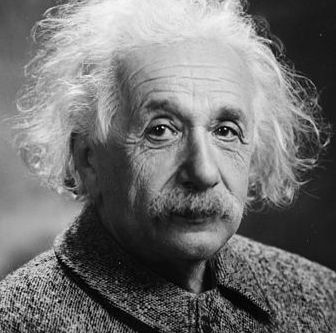
Albert Einstein
Albert Einstein

In almost all lists of the most famous or influential people of all times, Albert Einstein is among the top 10. He was the most influential physicist of the 20th century, and is probably the most famous scientist to have ever lived. He is particularly famous for his ground-breaking special theory of relativity and his famous equation, E = mc², which maintain that matter can be changed into energy. Since the time of Isaac Newton, no scientist had so profoundly changed our understanding of the universe.

For his contributions, Albert Einstein was awarded the Nobel Prize for Physics in 1921. He moved to the United States in 1933, because the Nazis were on the rise in his native Germany, and being a Jew, Einstein was in danger. In the United States he worked at Princeton University in New Jersey, where he became a central figure in the fight to restrict the use of the atom bomb, while also raising his voice against racism and nationalism.

Innovation Requires Work

Although the stories of him failing in math are apocryphal, Albert Einstein was not an exceptional student. Very few, if any, ever noticed anything exceptional about him when he was in school.

What made Einstein different was how long he was able to keep working on a problem in his mind. While certain genetic gifts may give people a head start, to accomplish anything of value, they still need to work diligently and intensely over a long period of time to develop their talent and be successful.

Top 52 Best Quotes

“Two things are infinite: the universe and human stupidity; and I’m not sure about the universe.” ― Albert Einstein

“There are only two ways to live your life. One is as though nothing is a miracle. The other is as though everything is a miracle.” ― Albert Einstein

“I am by heritage a Jew, by citizenship a Swiss, and by makeup a human being, and only a human being, without any special attachment to any state or national entity whatsoever.” ― Albert Einstein

“Not everything that can be counted counts, and not everything that counts can be counted.” ― Albert Einstein

Albert Einstein
Albert Einstein

“I am enough of an artist to draw freely upon my imagination. Imagination is more important than knowledge. Knowledge is limited. Imagination encircles the world.” ― Albert Einstein

“If you can’t explain it to a six year old, you don’t understand it yourself.” 
― Albert Einstein

“If you want your children to be intelligent, read them fairy tales. If you want them to be more intelligent, read them more fairy tales.” 
― Albert Einstein

“Logic will get you from A to Z; imagination will get you everywhere.” 
― Albert Einstein

“Life is like riding a bicycle. To keep your balance, you must keep moving.” 
― Albert Einstein

“Anyone who has never made a mistake has never tried anything new.” 
― Albert Einstein

“I speak to everyone in the same way, whether he is the garbage man or the president of the university.” ― Albert Einstein

“Never memorize something that you can look up.” ― Albert Einstein

“When you are courting a nice girl an hour seems like a second. When you sit on a red-hot cinder a second seems like an hour. That’s relativity.” ― Albert Einstein

“A clever person solves a problem. A wise person avoids it.” ― Albert Einstein

“Reality is merely an illusion, albeit a very persistent one.” ― Albert Einstein

“If we knew what it was we were doing, it would not be called research, would it?” ― Albert Einstein

“I have no special talents. I am only passionately curious.” ― Albert Einstein

Albert Einstein
Albert Einstein

“Any fool can know. The point is to understand.” ― Albert Einstein

“Try not to become a man of success. Rather become a man of value.” ― Albert Einstein

“The important thing is not to stop questioning. Curiosity has its own reason for existence. One cannot help but be in awe when he contemplates the mysteries of eternity, of life, of the marvelous structure of reality. It is enough if one tries merely to comprehend a little of this mystery each day. ― Albert Einstein

“If I were not a physicist, I would probably be a musician. I often think in music. I live my daydreams in music. I see my life in terms of music.” ― Albert Einstein

“I know not with what weapons World War III will be fought, but World War IV will be fought with sticks and stones.” ― Albert Einstein

“The most beautiful experience we can have is the mysterious. It is the fundamental emotion that stands at the cradle of true art and true science.” ― Albert Einstein

“You never fail until you stop trying.” ― Albert Einstein

“Great spirits have always encountered violent opposition from mediocre minds.” ― Albert Einstein

“Gravitation is not responsible for people falling in love.” ― Albert Einstein

“The measure of intelligence is the ability to change.” ― Albert Einstein

“It is not that I’m so smart. But I stay with the questions much longer.” ― Albert Einstein

“Creativity is intelligence having fun.”  ― Albert Einstein

“The world is a dangerous place to live, not because of the people who are evil, but because of the people who don’t do anything about it.” ― Albert Einstein

“If A is a success in life, then A equals x plus y plus z. Work is x; y is play; and z is keeping your mouth shut” ― Albert Einstein

“Black holes are where God divided by zero.” ― Albert Einstein

“Everything must be made as simple as possible. But not simpler.” ― Albert Einstein

“The best way to cheer yourself is to cheer somebody else up.” ― Albert Einstein

E = mc2 explained
E = mc2 explained

What is right is not always popular and what is popular is not always right.” ― Albert Einstein

“Whoever is careless with the truth in small matters cannot be trusted with important matters” ― Albert Einstein

“Peace cannot be kept by force; it can only be achieved by understanding.” ― Albert Einstein

“In the middle of difficulty lies opportunity” ― Albert Einstein

“The pursuit of truth and beauty is a sphere of activity in which we are permitted to remain children all our lives.” ― Albert Einstein

“Imagination is everything. It is the preview of life’s coming attractions.” ― Albert Einstein

“The important thing is not to stop questioning. Curiosity has its own reason for existing.” ― Albert Einstein

“Time is an illusion.” ― Albert Einstein

“I must be willing to give up what I am in order to become what I will be.” ― Albert Einstein

“It would be possible to describe everything scientifically, but it would make no sense; it would be without meaning, as if you described a Beethoven symphony as a variation of wave pressure.” ― Albert Einstein

“Love is a better master than duty.” ― Albert Einstein

“Blind belief in authority is the greatest enemy of truth.” ― Albert Einstein

“I never made one of my discoveries through the process of rational thinking” ― Albert Einstein

“We all know that light travels faster than sound. That’s why certain people appear bright until you hear them speak.” ― Albert Einstein

“Once we accept our limits, we go beyond them.” ― Albert Einstein

“Genius is 1% talent and 99% percent hard work…” ― Albert Einstein

“I’d rather be an optimist and a fool than a pessimist and right.” ― Albert Einstein

“If you want to live a happy life, tie it to a goal, not to people or things.”― Albert Einstein

Innovation Feeds

Innovation Photo by Joshua Sortino on Unsplash

Is Facebook Becoming the Big Brother? Plans for the New Cryptocurrency Libra Are Revealed

Facebook is already managing tons of our personal data. With the new cryptocurrency Libra it could extend its reach considerably, and potentially gain access to the financial data of billions of people.

Is the Big Brother, the fictional leader of the totalitarian state in George Orwell‘s novel “1984” becoming real through Facebook’s current and future “mass ‘data’ surveillance”?

Probably not, or at least Facebook is not alone in doing this, but in light of what is happening with our private data and how Facebook and other Internet technology companies are able to sort through all that we do online (and perhaps even offline with drones and more) we can at least joke about it, until it will become too serious.

George Orwell’s 1984: The Big Brother

Today the official announcement was made that Facebook has

plans for a new, global financial system with a broad group of partners from Visa Inc. to Uber Technologies Inc. on board to create a cryptocurrency it expects will one day trade much like the U.S. dollar and inject a new source of revenue.

Called Libra, the new currency will launch as soon as next year and be what’s known as a stablecoin–a digital currency that’s supported by established government-backed currencies and securities. The goal is to avoid massive fluctuations in value so Libra can be used for everyday transactions across Facebook in a way that more volatile cryptocurrencies, like Bitcoin, haven’t been. (See on Bloomberg: Facebook Wants Its Cryptocurrency to One Day Rival the Greenback)

“We view Facebook’s introduction of the Libra currency as a potential watershed moment for the company and global adoption of crypto,” wrote Mark Mahaney, an analyst at RBC Capital Markets. “In terms of scale and importance, we believe this new financial infrastructure could be viewed similar to Apple’s introduction of iOS to developers over a decade ago.”

There is already strong opposition to this plan, especially in Europe, starting with French Finance Minister Bruno Le Maire.

Facebook’s white paper on Project Libra

It is illuminto read the white paper about Project Libra, to understand the ultimate goals of this project. From the start, in the document’s Introduction we learn that:

Libra’s mission is to enable a simple global currency and financial infrastructure that empowers billions of people.

and later in section 3 of the white paper, The Libra Blockchain:

The goal of the Libra Blockchain is to serve as a solid foundation for financial services, including a new global currency, which could meet the daily financial needs of billions of people.

I cannot avoid noticing the words “billions of people” and “billions of accounts”

Finally from section 4, The Libra Currency and Reserve

We believe that the world needs a global, digitally native currency that brings together the attributes of the world’s best currencies: stability, low inflation, wide global acceptance, and fungibility. The Libra currency is designed to help with these global needs, aiming to expand how money works for more people around the world.

Libra is designed to be a stable digital cryptocurrency that will be fully backed by a reserve of real assets — the Libra Reserve — and supported by a competitive network of exchanges buying and selling Libra. 

For more detail you can read Facebook’s white paper on Project Libra here

It’s a very ambitious plan! The Vision, as articulated on their website states that:

Libra is a global, digitally native, reserve-backed cryptocurrency built on the foundation of blockchain technology. People will be able to send, receive, spend, and secure their money, enabling a more inclusive global financial system.

We need something to help simplify the many financial hurdles and unnecessary costs of transactions that exist today, especially when making payments between countries. We also need surely need a more inclusive global financial system and Facebook wants to position itself at the center of this amazing transformation and greatly profit from it.

King Zuckerberg. Credit: Nicole Gray

Facebook has already more users than the population of the U.S., China and Brazil combined, and its practices are already influencing the online social behavior of billions of people, and the financial success of countless businesses who depend on it. If Facebook starts using its own currency, it will really start looking more like a nation-state or, more appropriately, a global government with a global currency, global population, and global rules, and Mark Zuckerberg will be the Emperor!

I wonder what people like Jeff Bezos and Jack Ma are thinking of doing about this. Are they just going to sit and watch? And what about Elon Musk? He will probably need a payment system when he finally gets to Mars 🙂 . Or is he planning to buy back Paypal from eBay and use that instead? Are these guys going to leave all the fun for Mark Zuckerberg? Hopefully not.

Elon Musk and his plans to colonize Mars

Facebook is Entering the World of Cryptocurrency

Facebook never ceases to surprise me, but probably I shouldn’t be surprised anymore. Last month, Facebook registered a new financial technology company in Geneva, Switzerland, called “Libra Networks.” This company will “provide financial and technology services and develop related hardware and software.”

As of the first quarter of 2019, Facebook had 2.38 billion monthly active users, and during the same period 2.7 billion people were using at least one of the company’s core products (Facebook, WhatsApp, Instagram, or Messenger) each month. Facebook has more users than there are followers of Christianity.

Before Facebook, there was MySpace. MySpace was targeted at the same audience and was in the market a long time before Facebook. By almost all the criteria we look at start-ups, MySpace was the early winner and should have continued to dominate the social media space.

Thefacebook: What it looked like in 2005

But things didn’t turn out that way.  MySpace stagnated as Facebook exploded.  MySpace ended up giving up on its social media leadership and narrowed its focus to the niche of “social entertainment destination.”

Founded in 2004, Facebook, is currently the biggest social networking service based on global reach and total active users. Fifteen years ago CEO Mark Zuckerberg founded Facebook from his Harvard dormitory. Over this period, adding users, or “connecting the world”, has been the company’s mission. This amazing growth has come in spite of some setbacks that were reflected in big stock price drops. But until now, Facebook has been able to recover, in spite of the Cambridge Analytica scandal and other similar situations where Facebook failed to protect users’ privacy, or actually sold or even gave away for free users’ data.

Since its founding, Facebook has taken an aggressive strategy by acquiring different companies to eliminate competition: the most famous acquisitions were Instagram in 2012 and WhatsApp in 2014.

Facebook has also being growing its earnings through diversification. More recently, it has made acquisitions that go beyond what one would expect a social networking company to buy, including Oculus (Virtual Reality), Ascenta (drone-maker) and ProtoGeo Oy (fitness and health monitoring). 

Cryptocurrency

Now, on top of all the other initiatives, Facebook is planning to roll out its own cryptocurrency dubbed “GlobalCoin” in 2020, according to a report from the BBC. (The name is actually going to be Libra, according to updated information). The new digital currency could be used to make purchases on the internet, transfer money and other cash-related transactions without using a bank. The official cryptocurrency announcement could come as early as tomorrow.

Mark Zuckerberg
Mark Zuckerberg

Apparently, Facebook is planning to launch the cryptocurrency-based payments system in several countries by the first quarter of 2020 and is looking to start trials by the end of 2019.

Facebook, with its more than 2 billions users would be amazingly well positioned to profit from entering the cryptocurrency market, and should scare many competitors. Or perhaps Facebook’s cryptocurrency will be good for all cryptocurrencies because it will accelerate mass adoption. Since everything that Facebook does is highly scrutinized, it could lead to a better regulation in that space, something that would benefit everybody.

If Facebook coin launches next year, it would enable a new era of e-commerce and payments for the social network. Its users would be able to exchange currencies into its digital coins for purchases and money transfers.

It would also increase Facebook’s access to data about who buys what, and help the company in ad measurement and targeting, while allowing diversification of revenues that now depend mostly on advertising.

“Payments is one of the areas where we have an opportunity to make it a lot easier,” Zuckerberg said. “I believe it should be as easy to send money to someone as it is to send a photo.”

“We believe this may prove to be one of the most important initiatives in the history of the company to unlock new engagement and revenue streams,” RBC Capital Markets analyst Mark Mahaney said in a recent note to clients. “Facebook’s massive international scale provides an instant network for consumers and merchants to transact using a stable token with several benefits that crypto delivers.”

The involvement of Facebook may be the beginning of a massive change in cryptocurrencies’ adoption. I wonder what Warren Buffett may be thinking now, since he has repeatedly said that the world of cryptocurrency will come to a bad ending, soon or later. He may still be right, or maybe not.

How Digital Platforms Disrupt and Conquer Traditional Industries

The Internet Messenger by Buky Schwartz
Attribution: Dr. Avishai Teicher Pikiwiki Israel
CC BY 2.5
The Internet Messenger by Buky Schwartz
Attribution: Dr. Avishai Teicher Pikiwiki Israel
CC BY 2.5

The expression “creative destruction” was popularized by Joseph Schumpeter in his book Capitalism, Socialism and Democracy, first published in 1942. According to Schumpeter:

Capitalism […] is by nature a form or method of economic change and ….never can be stationary. […] The fundamental impulse that sets and keeps the capitalist engine in motion comes from the new consumers’ goods, the new methods of production or transportation, the new markets, the new forms of industrial organization that capitalist enterprise creates.

[… Capitalism requires] the perennial gale of Creative Destruction.

In Schumpeter’s vision, innovative entry by entrepreneurs was the disruptive force that sustained economic growth, even as it destroyed the value of established companies.

A famous example of creative destruction was the industrial revolution, when machinery and improvements to the manufacturing process, such as the assembly line, almost completely replaced the old way of producing goods, based on artisan production.

The Internet

On 6 August 1991, the World Wide Web went live for the first time. Most people didn’t even know what it was.

The first image was uploaded to the Internet in 1992. It was a picture of a French parodic rock group called Les Horribles Cernettes.

In 1993, CERN announced that the World Wide Web was free for everyone to use and develop.

Then in 1995, the large, government-controlled networks finally opened up for commercial use. Advanced Internet technologies spread rapidly in businesses across the country. The rest, they say, is history.

Software is Eating the World

“Software is eating the world” said Nestcape’s founder, Marc Andreessen in 2011, to explain how technology and particularly the internet, is transforming the world of business.

The pace of change, disruption and creative destruction has never been faster. Digital platforms are now part of a new accelerate chapter of disruption. But how do they create such disruption?

How Platforms Disrupt

BUY ON AMAZON

The idea of a platform is not new, it is simply a place where producers and consumers come together and interact creating value for both parties. Open air marketplaces were already doing it hundreds of years ago, but the addition of the digital technology created new opportunities and transformed local markets in truly global markets.

The disruption created by the internet so far, has occurred in two stages:

  1. Efficient pipelines ate inefficient pipelines. Most internet applications in the 1990s were creating highly efficient pipelines. They devised online systems for distributing good and services that were more efficient than those used by the traditional industries. These new online systems benefited from low marginal costs of distribution, and this allowed them to serve larger markets with smaller investments. Traditional media companies were the first to feel the pain of this new competition. Many newspapers were overcome by online news that could be distributed to a global audience without the traditional distribution costs.
  2. Platform eat pipelines. Now we have entered stage two of disruption, where platform eat pipelines. Stage two is happening in front of our eyes every single day. Think of Uber and Lyft disrupting local transportation, or Airbnb disrupting the hotel industry.

This second stage of transformation is happening because the Internet is not acting solely anymore as a distribution line or a pipeline, but it is also functionings as a creation infrastructure and a coordination mechanism.

Platforms are leveraging these new capabilities to create entire new business models. In addition, the physical and the digital are rapidly converging, enabling the Internet to connect and coordinate objects in the real world.

(Platform Revolution, p. 64)

Economic Advantages

Platforms have two economic advantages over traditional pipelines:

  1. They have a superior marginal economics of production and distribution. For example, if a hotel chain like Marriott wants to expand, they need to make a substantial investment in new buildings and staff. On the other hand, Airbnb, that owns no property, can expand without having to buy or build new real estate.
  2. The second advantage is the network effect. The network effect is the simple principle that the more users a network has, the more attractive it becomes for other people to join as well, because the usefulness of the network goes up with the number of users. This explains why, for example, Facebook has grown rapidly to its current astounding number of users.

The ecosystems that platforms create are a lot larger and include much more resources than most pipeline-type organizations can even dream of.

The Impact of Platform Disruption on Business Processes

The rise of platforms is also changing the business processes of value creation, value consumption, and quality control.

Value Creation: Platforms grow and transform markets when they can minimize the barriers to usage for their users. When they remove the barriers for the producers, they suddenly open up new sources of supply and increase value creation.

Platforms are constantly lowering barriers of entry for producers (suppliers) in many different markets. More suppliers naturally attract more buyers, and a virtuous feedback loop is put in motion.

Wikipedia, for example, opened up the floodgates of supply when devised a system that allows people to organize the world’s knowledge online. More interesting articles in Wikipedia attracted more readers, and potential writers, and so on.

Airbnb made possible for almost everybody to make some money out of their home by joining the hospitality industry. Many guests also become hosts on Airbnb, and the system keeps growing.

Value Consumption: Traditional consumer behavior is also changing. Platforms increase the opportunities of using products and services in new ways. New behaviors are created, like hopping into stranger’s cars (Uber, Lift) or accepting strangers in our homes (Airbnb, HomeAway), or dropping off our dogs in their homes (Rover).

Quality Control: When a new platform is launched there are some obstacles to be overcome, and one of the main ones is about the quality and reliability of what is being offered to the public.

When platforms open up a new source of supply, some undesirable effects come included. Youtube was initially filled with pirated videos and even pornography; Wikipedia articles sometimes listed living people as deceased.

However, over time, the successful platforms find a way to solve these problems by using some sort of curation mechanism. In other words, the platform needs to find a way to match the right consumers with high quality and relevant products and services.

Effective curation over time produces the result of encouraging the right behavior and weeding out the wrong ones from the platform. The rating and review system on Airbnb is an example of it and an effective way of improving effective matching between people and services.

The emergence of platforms, then, means not only the rise of new business organizations, but also the creation of new forms of value creation, value consumption, and quality control.

Structural Impact of Platform Disruption

Platform businesses transform the structure of the business environment in three specific ways: they de-link assets from value, re-intermediate, and aggregate markets.

De-linking assets from value

At this point it is clear how assets are de-linked from value in the case of business-to-consumer (B2C) like Uber, Amazon, etc.

The same can be done in the business-to-business (B2B) arena using the same principle: de-linking ownership of the physical asset from the value it creates.

This allows the use of the asset to be independently traded and applied to its best use–that is, the use that creates the greatest economic value—rather than being restricted to uses specific to the owner. As a result, efficiency and value rises dramatically.

Platform Revolution, p.69

For example, expensive health care equipment such as MRI machines can be used more efficiently if their usage is time-sliced and a market is created for slices among hospitals and clinics.

Re-intermediation

In the early days, many predicted that the Internet would foster a widespread disintermediation, or elimination of middlemen. But in reality platforms are re-intermediating markets and creating new types of middlemen, often automated ones.

The advantages of platform intermediaries is that they are usually more efficient and easier to scale, because they rely on automated tools and social feedback. This new intermediation is transforming industries creating new connections in very efficient ways.

For example, small businesses can use Google Adwords advertising campaign instead than traditional ad agencies or media channels. Platforms like Yelp and TripAdvisor have basically created new industries by certifying the quality of restaurants or guided tours.

Market aggregation

Platform also have the power to aggregate previously disorganized markets. These centralized market can serve highly dispersed individuals and organizations helping them to gain access to reliable information and products. For example, Amazon or Alibaba provide a marketplace where thousand of products from all around the world can be offered to all kind of customers, who may also reside anywhere.

_________________________________________________________

MORE ARTICLES ABOUT THE PLATFORM REVOLUTION:

How to Design a Successful Platform

Platform Revolution: How Networked Markets are Transforming the Economy

PLATFORM REVOLUTION ON AMAZON

How to Design a Successful Platform

How do you build a platform that foster participation while creating value for all the users? How do you provide tools that make it easy for consumers and producers to have positive and rewarding interactions?

Platforms are complex structures and deciding what to do and where to begin in designing a platform is not an easy task.

Interactions on platform are very similar to any other social or economic exchange, whether it happens in the physical world or in the virtual one. In every exchange, producers exchange three things: information, goods or services and currency.

Everything starts with information, because it is information that the involved parties need in order to decide whether they want to move forward, and how, in each interaction and exchange.

Sometimes, the exchange of information is the main purpose of the platform itself, like in news forum like Reddit; in other cases, the information is needed to move forward with the exchange of goods or services; but in all cases, the exchange of information needs to take place on the platform itself. That is a fundamental characteristic of platform business.

After information is exchanged, users can move forward to exchange their goods or services, whether they are products on Amazon or photos on Facebook. Finally, transactions are concluded using currency, in the form of money, Bitcoins or likes.

Core Interaction

According to the authors of the book Platform Revolution: How Networked Markets Are Transforming the Economy and How to Make Them Work for You, platform design should always start with the core interaction.

The core interaction is the single most important form of activity that takes places on a platform–the exchange of value that attracts most users to the platform in the first place. The core interaction involve three key components: the participants, the value unit and the filter. All three must be clearly identified and carefully designed to make the core interaction as easy, attractive, and valuable to users as possible. The fundamental purpose of the platform is to facilitate that core interaction.”

(pp. 38-39).

The Participants

There are usually two types of participants in a core interaction: the producers, who create value, and the consumers, who consume it. In certain platforms like Airbnb, for example, the same user can assume different roles in different interactions, and be a producer (host) or a consumer (guest).

The Value Unit

On Amazon, for example, the value unit is the product listed for sale. In most cases, the core interaction starts with the creation of the value unit.

The Filter

Filters are key to delivery only potentially useful information to the right consumer, to avoid flooding them with irrelevant value units. Poorly designed filters can be very frustrating for the customers. An example of a filter is a search query. When someone is looking for a Uber’s driver, the filter selects only those drivers who are close to the customer.

The basic structure of a core interaction is:

Participants + Value Unit + Filter -> Core Interaction

The Crucial Role of the Value Unit

Platforms, in most cases, don’t create value units, but they are mostly “information factories” that don’t control the inventory. They usually promote a culture of quality control and develop effective filters, but they don’t control the production process, like the traditional pipeline businesses do. However, it is important for a platform to determine how value units are created and by whom, and how they are integrated into the platform.

Pull, Facilitate, Match: The How of Platform Design

“The core interaction is the why of platform design”

To make core interaction possible and almost inevitable, the platform needs to be designed in a way that attract always more users by making sure that core interactions occur in significant numbers.

In order to accomplish it, a platform need to carry out three main functions to encourage an increase in total interactions: pullfacilitate and match. The platform needs to pull (attracts) users to the platform; then it needs to facilitate transactions by providing effective tools and rules; and finally it must match users properly, so that the right consumers will find the right producers.

The End-to-End Principle

A platform needs to evolve, it is impossible not to change over time and stay relevant, but changes should be planned carefully. In some cases they can be added as the platform evolves and new needs and opportunities are created or discovered. However, adding features increases complexity and if not done properly, it may end up disrupting the core interaction, with potentially negative effect for the entire platform.

Needless complexity can also create problems for the programmers and platform managers and lead to the so-called bloatware, a software environment that has become too complicated and inefficient.

The end-to-end principle may help guide platform developers to maintain a healthy balance between changing slowly the core platform while allowing the development of positive adaptations at the periphery of the system.

According to this principle, the more peripheral a feature is to the core mission, the more peripheral it should be on a network, or in this case, on the platform. If only some users need it, then it should be located at the edges of the network and not in the center. By following this principle, secondary functions don’t interfere with the core activities of the network or platform. This will make the system run more efficiently, and it allows growth without disrupting the core functions of a network or platform.

The failure of Microsoft’s operating system Vista is a good example of what not to do. The design team, in an effort to maintain backward compatibility with older computer systems, while at the same time adding new features needed in the systems of the new generation, added old and new features all together in the core platform, making Vista too complex and unstable, and very hard to work with for the developers who were trying to write code for it.

On the other hand, in a similar situation, Apple successfully “compartmentalized” the old code from the operating system OS 9 when incorporated the new technology acquired from NeXT to develop the new OS X. Because of this separation, the old code didn’t slow down or add complexity to the new environment.

Similarly the end-to-end principle can be used in the design of a platform.

In this case, the principle states that application-specific features should reside in the layer of process at the edge or on the top of the platform, rather than at the roots deep within the platform. Only the highest volume, highest value features that cut across apps should become part of the core platform

(p.54)

Modularity

While it can be worthwhile to get an integrated system up and running as quick as possible, the best way to build a platform in the long run is to use a modular approach. Modularity is a strategy for organizing complex products efficiently. Modules are designed separately, but they are built to work together as a coordinated whole. Modules need to have the same design rules so that they can be connected and can communicate through the use of standard interfaces (APIs).

Iterative Improvement

Platforms cannot be entirely planned; they also emerge

(p.58)

Careful attention to the principles of platform design will increase the chances of a successful product, but because the activity in a platform, differently from traditional business, is controlled mostly by the users, it is almost inevitable that they will use the platform in new ways. Therefore, it is important to be ready for organic and spontaneous change. For example, the use of hashtags, so important currently on Twitter to find content, were not an available feature initially, but they were suggested by an engineer at Google and then adopted by the platform.

——————————————————————————-

Link to the first part of this post:

Platform Revolution: How Networked Markets are Transforming the Economy – Book Review

I now use Airbnb when I travel, and I prefer it to hotels. Not only because it is usually cheaper, but especially because there is a lot more variety when choosing a place to stay, and those places have more “personality” and don’t look all the same, like hotel rooms. Even better, you don’t need to go through any annoying registration when you arrive. It is quick and easy.

Airbnb Website

Like Airbnb, other “platforms” are revolutionizing many industries by using technology to connect people, organizations, and resources in interactive ecosystems in which great amounts of value can be created and exchanged: it is a new business model. Uber, Facebook, Alibaba, YouTube, Amazon are just a few examples of “platforms”.

Platforms can connect several different types of users, like Amazon that connects sellers and buyers, or they can have one primary type of user, like Facebook’s community, where users interact with each other socially. What all of these platforms have in common is that they bring people and organizations together in one place where they can interact.

The Platform Revolution: How Networked Markets Are Transforming the Economy and How to Make Them Work for You is a book co-authored by Sangeet Choudary, Geoffrey Parker, and Marshall Van Alstyne that describes how platform businesses work, how they can be built and operated, and what is their impact on current society.

The authors explain that platforms businesses, when built properly, benefit from network effects, a phenomenon whereby a product or service gains additional value as more people use it. The network effect makes the value of a platform grow exponentially, because as more individuals join, the potential number of connections between individuals increase algorithmically, making the network more valuable. Think of Facebook, for example, the more people join it, the more value acquires.

“The network effect is a self-reinforcing loop of demand generating more demand.”

From Pipeline to Platform

Traditional businesses are mostly organized as pipelines. Pipeline businesses follow a linear value chain, where, for example, the materials from suppliers go through a series of steps (processes) that transform them into a finished product that is worth more. Pipeline businesses try to own and control every aspect of the production processes from manufacturing to sales.

In the old days, Apple was essentially a pipeline business. But then on January 9, 2007, Apple CEO Steve Jobs introduced the world to the new iPhone for the first time with the words: “Today Apple is going to reinvent the phone.”

At that moment in time, the five major mobile-phone manufacturers collectively controlled 90% of the industry’s global profits, but by 2015 the iPhone was generating 92% of global profits, while most of the former incumbents were not making any profit at all.

How can be explained the iPhone’s rapid domination of its industry, even accounting for its novel features and design? According to the authors, Apple (and Google with Android) completely changed the industry by exploiting the power of platforms. Platform businesses bring together producers and consumers in high-value exchanges, where the most important assets are information and interactions.

Apple changed the industry by making the iPhone and its operating system as something more than products. Apple organized them as a way to connect app developers on one side to app users on the other, while generating value for both groups at the same time. As the number of participants on each side grew, the value of being part of the “Iphone ecosystem” increased, thanks to the network effects.

Though they come in many forms, platforms all have an ecosystem with the same basic structure that comprises four types of participants. The owners of platforms who control their intellectual property and governance; the providers who serve as the platforms’ interface with users; the producers who create their offerings, and finally the consumers who use those offerings.

Disruption: How Platforms Conquer and Transform Traditional Industries

Platforms are like traditional marketplaces, where buyers and sellers can come together and transact business. However, the difference between traditional marketplaces and current platforms is that the digital technology allow communication all over the planet and instant transactions.

The internet can reduce costs and platforms are more efficient than pipelines because they can scale rapidly, faster than traditional businesses.

Platforms make it easier for producers to participate. For example, Airbnb makes it possible for hosts to rent out their spare rooms, and by so doing they find new sources of supply among people who probably wouldn’t have ever considered renting part of their home, without the benefits and easiness of connecting to the Airbnb platform.

Platforms also facilitate and sometimes even create new forms of consumer behavior. For example, people now jump into a stranger’s car when they use Uber. Platforms have the power to make this happen because they have built-in mechanisms that create trust between users, like reviews.

Finally, platforms exchange the traditional quality control coming from the business for user driven curation. Think for example of Wikipedia, where users curate the content for free instead of using professional writers and editors, like was the case with the failed Microsoft’s Encarta. In fact, the demise of Encarta has widely been attributed to the competition from Wikipedia.

There are three different types of platform disruption:

  • Separating assets from value. Ownership of assets can becomes separated from their value. For example, the same MRI machines can be used by different hospitals and clinics that don’t need to own them, but have acquired the right to use them part-time.
  • Re-intermediation. The Internet has not eliminated middlemen, but has created new kinds. For example, executives in the music industry now they can search YouTube to find new talents instead than relying primarily on agents.
  • Market aggregation. Disorganized markets can be combined and centralized. For example, Amazon and Alibaba have created unified platforms for wholesalers all over the world.

As mentioned before, pipeline businesses can restructure themselves to take advantage of platform economies, even if it is not a simple thing to do.

_____________________________________________________________

OTHER POSTS ABOUT THE PLATFORM REVOLUTION

HOW TO DESIGN A SUCCESSFUL PLATFORM

.

FamilySearch Celebrates 20 Years Online

May 24, 1999, marked the 20 year anniversary of FamilySearch.org. Twenty years ago, global nonprofit FamilySearch launched an innovative new website, a free internet genealogy service. Two decades later, FamilySearch is a leader in the rising tide of popular ancestry-related services online. During that time, FamilySearch has expanded and evolved its free mix of online offerings, holding true to its purpose to provide economical access to the world’s genealogical records and create fun family history discoveries.

When I read about this announcement for the first time, I took a trip back to memory lane, to remember where I was twenty years ago, when they launched FamilySearch. In those days, the end of May 1999, I didn’t even know what was FamilySearch.

I was still living in Brazil and studying hard preparing to take the GMAT at the end of the year, hoping to be accepted to the MBA program at Brigham Young University (BYU). A little less than a year later I was at BYU, and now I actually work at FamilySearch. It is amazing what has been accomplished at FamilySearch in this short time, and how the general technology development of these last years has helped this effort! 

Source: FamilySearch Celebrates 20 Years Online

Top 23 Best Quotes from “Steve Jobs” by Walter Isaacson

Based on more than forty interviews with Jobs conducted over two years—as well as interviews with more than a hundred family members, friends, adversaries, competitors, and colleagues—Walter Isaacson has written a fascinating story of the roller-coaster life and intense personality of Steve Jobs, a creative entrepreneur whose passion for perfection and ferocious drive revolutionized six industries.

While Steve Jobs said that he wouldn’t interfere with the writing of his biography, he carefully chose Isaacson to write it. Isaacson is the author of biographies about famous figures like Benjamin Franklin and Albert Einstein or men who changed history. Steve Jobs considered himself of the same caliber of those men and therefore Isaacson was the right choice for him.

Walter Isaacson’s biography of Steve Jobs is in some ways another Jobs’ carefully crafted product, because Steve Jobs is a book that seems to be narrated through the often discussed “reality distortion field” of Jobs himself.

My Favorite Top 23 Quotes from Steve Jobs by Walter Isaacson

“One way to remember who you are is to remember who your heroes are.”
― Walter Isaacson, Steve Jobs

“If you act like you can do something, then it will work.”
― Walter Isaacson, Steve Jobs

“People who know what they’re talking about don’t need PowerPoint.”
― Walter Isaacson, Steve Jobs

“Steve Jobs: “The best way to predict the future is to invent it.”
― Walter Isaacson, Steve Jobs

“I think different religions are different doors to the same house. Sometimes I think the house exists, and sometimes I don’t. It’s the great mystery. (Steve Jobs)” ― Walter Isaacson, Steve Jobs

“Picasso had a saying – ‘good artists copy, great artists steal’ – and we have always been shameless about stealing great ideas.”
― Walter Isaacson, Steve Jobs

I remember sitting in his backyard in his garden, one day, and he started talking about God. He [Jobs] said, “ Sometimes I believe in God, sometimes I don’t. I think it’s 50/50, maybe. But ever since I’ve had cancer, I’ve been thinking about it more, and I find myself believing a bit more, maybe it’s because I want to believe in an afterlife, that when you die, it doesn’t just all disappear. The wisdom you’ve accumulated, somehow it lives on.”Then he paused for a second and said, “Yea, but sometimes, I think it’s just like an On-Off switch. Click. And you’re gone.” And then he paused again and said, “ And that’s why I don’t like putting On-Off switches on Apple devices.”Joy to the WORLD! There IS an after-life!”
― Walter Isaacson, Steve Jobs

Buy at Amazon

“Some people say, “Give the customers what they want.” But that’s not my approach. Out job is to figure out what they’re going to want before they do. I think Henry Ford once said, “If I’d asked customers what they wanted, they would have told me, ‘A faster horse!'” People don’t know what they want until you show it to them.” ― Walter Isaacson, Steve Jobs

“Remembering that you are going to die is the best way I know to avoid the trap of thinking you have something to lose. You are already naked. There is no reason not to follow your heart.” ― Walter Isaacson, Steve Jobs

“On the day he unveiled the Macintosh, a reporter from Popular Science asked Jobs what type of market research he had done. Jobs responded by scoffing, “Did Alexander Graham Bell do any market research before he invented the telephone?” ― Walter Isaacson, Steve Jobs

“You should never start a company with the goal of getting rich. Your goal should be making something you believe in and making a company that will last.― Walter Isaacson, Steve Jobs

“What are the five products you want to focus on? Get rid of the rest, because they’re dragging you down. They’re turning you into Microsoft. They’re causing you to turn out products that are adequate but not great.”
― Walter Isaacson, Steve Jobs

“The people who invented the twenty-first century were pot-smoking, sandal-wearing hippies from the West Coast like Steve, because they saw differently,” he said. “The hierarchical systems of the East Coast, England, Germany, and Japan do not encourage this different thinking. The sixties produced an anarchic mind-set that is great for imagining a world not yet in existence.” ― Walter Isaacson, Steve Jobs

“Steve Jobs had a tendency to see things in a binary way: “A person was either a hero or a bozo, a product was either amazing or shit”
― Walter Isaacson, Steve Jobs

“The way we’re running the company, the product design, the advertising, it all comes down to this: Let’s make it simple. Really simple.” Apple’s design mantra would remain the one featured on its first brochure: “Simplicity is the ultimate sophistication.” ― Walter Isaacson, Steve Jobs

“Jobs insisted that Apple focus on just two or three priorities at a time. “There is no one better at turning off the noise that is going on around him,” Cook said. “That allows him to focus on a few things and say no to many things. Few people are really good at that.”
― Walter Isaacson, Steve Jobs

Buy at Amazon

“I think the biggest innovations of the twenty-first century will be the intersection of biology and technology. A new era is beginning, just like the digital one was when I was his age.”
― Walter Isaacson, Steve Jobs

“In the first 30 years of your life, you make your habits. For the last 30 years of your life, your habits make you.”
― Walter Isaacson, Steve Jobs

“Steve has a reality distortion field.” When Hertzfeld looked puzzled, Tribble elaborated. “In his presence, reality is malleable. He can convince anyone of practically anything. It wears off when he’s not around, but it makes it hard to have realistic schedules.”
― Walter Isaacson, Steve Jobs

“I discovered that the best innovation is sometimes the company, the way you organize a company. The whole notion of how you build a company is fascinating.” Steve Jobs”
Walter Isaacson, Steve Jobs

“Simplicity isn’t just a visual style. It’s not just minimalism or the absence of clutter. It involves digging through the depth of the complexity. To be truly simple, you have to go really deep.”
― Walter Isaacson, Steve Jobs

“The main thing in our design is that we have to make things intuitively obvious.”
― Walter Isaacson, Steve Jobs

“I began to realize that an intuitive understanding and consciousness was more significant than abstract thinking and intellectual logical analysis.”
― Walter Isaacson, Steve Jobs

Top 25 Best Quotes From The Lean Startup by Eric Reis

Eric Reis

The Lean Startup: How Today’s Entrepreneurs Use Continuous Innovation to Create Radically Successful Businesses is a book by Eric Reis that presents a method for developing and managing startups or new ventures in bigger organizations.

According to Reis, startups need to operate following their own methods in order to succeed. What works in established companies may actually damage the development of a startup. However, startups policies and procedures shouldn’t be created at random, but they should be the result of proper techniques and research. For more details see my post The Lean Startup by Eric Ries: Book Review

My Favorite Top 25 Quotes from The Lean Startup

1. “The only way to win is to learn faster than anyone else.”

― Eric Ries, The Lean Startup: How Today’s Entrepreneurs Use Continuous Innovation to Create Radically Successful Businesses

2. “We must learn what customers really want, not what they say they want or what we think they should want.”

― Eric Ries, The Lean Startup: How Today’s Entrepreneurs Use Continuous Innovation to Create Radically Successful Businesses

3. “As you consider building your own minimum viable product, let this simple rule suffice: remove any feature, process, or effort that does not contribute directly to the learning you seek.”

― Eric Ries, The Lean Startup: How Today’s Entrepreneurs Use Continuous Innovation to Create Radically Successful Businesses

4. “A startup is a human institution designed to create a new product or service under conditions of extreme uncertainty.”

5. “If you cannot fail, you cannot learn.”

6. “The big question of our time is not Can it be built? but Should it be built? This places us in an unusual historical moment: our future prosperity depends on the quality of our collective imaginations.”

Buy at Amazon

7. “Build-Measure-Learn feedback loop is at the core of the Lean Startup model.”

8. “Innovation is a bottoms-up, decentralized, and unpredictable thing, but that doesn’t mean it cannot be managed.”

9. “This is one of the most important lessons of the scientific method: if you cannot fail, you cannot learn.”

10. “The lesson of the MVP is that any additional work beyond what was required to start learning is waste, no matter how important it might have seemed at the time.”

11. “When in doubt, simplify.”

12. “When blame inevitably arises, the most senior people in the room should repeat this mantra: if a mistake happens, shame on us for making it so easy to make that mistake.”

13. “Customers don’t care how much time something takes to build. They care only if it serves their needs.”

Buy At Amazon

14. “Metcalfe’s law: the value of a network as a whole is proportional to the square of the number of participants. In other words, the more people in the network, the more valuable the network.”

15. “Success is not delivering a feature; success is learning how to solve the customer’s problem.”

16. “The point is not to find the average customer but to find early adopters: the customers who feel the need for the product most acutely. Those customers tend to be more forgiving of mistakes and are especially eager to give feedback.”

17. “If we do not know who the customer is, we do not know what quality is.”

18. “Leadership requires creating conditions that enable employees to do the kinds of experimentation that entrepreneurship requires.”

19. “The ability to learn faster from customers is the essential competitive advantage that startups must possess.”

20. “Ask most entrepreneurs who have decided to pivot and they will tell you that they wish they had made the decision sooner.”

21. “In the Lean Startup model, an experiment is more than just a theoretical inquiry; it is also a first product.”

22. “What if we found ourselves building something that nobody wanted? In that case what did it matter if we did it on time and on budget?”

23. “Peter Drucker said, “There is surely nothing quite so useless as doing with great efficiency what should not be done at all.”

24. “Failure is a prerequisite to learning.”

25. “Entrepreneurship should be considered a viable career path for innovators inside large organizations.”

Top 25 Best Quotes from Where Good Ideas Come from: The Natural History of Innovation by Steven Johnson

Where Good Ideas Come from: The Natural History of Innovation by Steven Johnson is a book about the space of innovation. Some environments squelch new ideas; some environments seem to breed them effortlessly.

The argument of this book is that a series of shared properties and patterns recur again and again in unusually fertile environments. The more we embrace these patterns — in our private work habits and hobbies, in our office environments, in the design of new software tools — the better we will be at tapping our extraordinary capacity for innovative thinking.

Steve Johnson gives us a broad historical outlook on how some ideas where born and then introduce each of his patterns and how they made that idea possible.

My Favorite Top 25 Quotes from Where Good Ideas Come from

“Chance favors the connected mind.” 

― Steven Johnson, Where Good Ideas Come from: The Natural History of Innovation

“The patterns are simple, but followed together, they make for a whole that is wiser than the sum of its parts. Go for a walk; cultivate hunches; write everything down, but keep your folders messy; embrace serendipity; make generative mistakes; take on multiple hobbies; frequent coffeehouses and other liquid networks; follow the links; let others build on your ideas; borrow, recycle; reinvent. Build a tangled bank.” 

― Steven Johnson, Where Good Ideas Come from: The Natural History of Innovation

“Bill Gates (and his successor at Microsoft, Ray Ozzie) are famous for taking annual reading vacations. During the year they deliberately cultivate a stack of reading material—much of it unrelated to their day-to-day focus at Microsoft—and then they take off for a week or two and do a deep dive into the words they’ve stockpiled. By compressing their intake into a matter of days, they give new ideas additional opportunities to network among themselves, for the simple reason that it’s easier to remember something that you read yesterday than it is to remember something you read six months ago.” 

― Steven Johnson, Where Good Ideas Come from: The Natural History of Innovation

“The trick to having good ideas is not to sit around in glorious isolation and try to think big thoughts. The trick is to get more parts on the table.” 

― Steven Johnson, Where Good Ideas Come from: The Natural History of Innovation

“This is not the wisdom of the crowd, but the wisdom of someone in the crowd. It’s not that the network itself is smart; it’s that the individuals get smarter because they’re connected to the network.” 

― Steven Johnson, Where Good Ideas Come from: The Natural History of Innovation

“Being right keeps you in place. Being wrong forces you to explore.” 

― Steven Johnson, Where Good Ideas Come from: The Natural History of Innovation

Buy at Amazon

“Old ideas can sometimes use new buildings. New ideas must use old buildings.” 

― Steven Johnson, Where Good Ideas Come from: The Natural History of Innovation

“Good ideas may not want to be free, but they do want to connect, fuse, recombine. They want to reinvent themselves by crossing conceptual borders. They want to complete each other as much as they want to compete” 

― Steven Johnson, Where Good Ideas Come from: The Natural History of Innovation

“Legendary innovators like Franklin, Snow, and Darwin all possess some common intellectual qualities—a certain quickness of mind, unbounded curiosity—but they also share one other defining attribute. They have a lot of hobbies.” 

― Steven Johnson, Where Good Ideas Come from: The Natural History of Innovation

“When you don’t have to ask for permission innovation thrives.” 

― Steven Johnson, Where Good Ideas Come from: The Natural History of Innovation

“the more disorganized your brain is, the smarter you are.” 

― Steven Johnson, Where Good Ideas Come from: The Natural History of Innovation

“when one looks at innovation in nature and in culture, environments that build walls around good ideas tend to be less innovative in the long run than more open-ended environments.” 

― Steven Johnson, Where Good Ideas Come from: The Natural History of Innovation

“So part of the secret of hunch cultivation is simple: write everything down.” 

― Steven Johnson, Where Good Ideas Come from: The Natural History of Innovation

“Babbage had most of this system sketched out by 1837, but the first true computer to use this programmable architecture didn’t appear for more than a hundred years.” 

― Steven Johnson, Where Good Ideas Come from: The Natural History of Innovation

“Keeping a slow hunch alive poses challenges on multiple scales. For starters, you have to preserve the hunch in your own memory,” 

― Steven Johnson, Where Good Ideas Come from: The Natural History of Innovation

“Berners-Lee was supremely lucky in the work environment he had settled into, the Swiss particle physics lab CERN. It took him ten years to nurture his slow hunch about a hypertext information platform.” 

― Steven Johnson, Where Good Ideas Come from: The Natural History of Innovation

“His research led him to one overwhelming conclusion, published in a seminal paper in 1975: big cities nurture subcultures much more effectively than suburbs or small towns.” 

― Steven Johnson, Where Good Ideas Come from: The Natural History of Innovation

“The wetland created by the beaver, like the thriving platform created by the Twitter founders, invites variation because it is an open platform where resources are shared as much as they are protected.” 

― Steven Johnson, Where Good Ideas Come from: The Natural History of Innovation

Buy at Amazon

“If there is a single maxim that runs through this book’s arguments, it is that we are often better served by connecting ideas than we are by protecting them.” 

“Her research suggests a paradoxical truth about innovation: good ideas are more likely to emerge in environments that contain a certain amount of noise and error.” 

“We have a natural tendency to romanticize breakthrough innovations, imagining momentous ideas transcending their surroundings, a gifted mind somehow seeing over the detritus of old ideas and ossified tradition. But ideas are works of bricolage; they’re built out of that detritus.” 

“A good idea is a network. A specific constellation of neurons—thousands of them—fire in sync with each other for the first time in your brain, and an idea pops into your consciousness.” 

“for a walk; cultivate hunches; write everything down, but keep your folders messy; embrace serendipity; make generative mistakes; take on multiple hobbies; frequent coffeehouses and other liquid networks; follow the links; let others build on your ideas; borrow, recycle, reinvent. Build a tangled bank.” 

“What Ruef discovered was a ringing endorsement of the coffeehouse model of social networking: the most creative individuals in Ruef’s survey consistently had broad social networks that extended outside their organization and involved people from diverse fields of expertise. Diverse, horizontal social networks, in Ruef’s analysis, were three times more innovative than uniform, vertical networks. In groups united by shared values and long-term familiarity, conformity and convention tended to dampen any potential creative sparks. The limited reach of the network meant that interesting concepts from the outside rarely entered the entrepreneur’s consciousness. But the entrepreneurs who built bridges outside their “islands,” as Ruef called them, were able to borrow or co-opt new ideas from these external environments and put them to use in a new context.” 

“When it first emerged, Twitter was widely derided as a frivolous distraction that was mostly good for telling your friends what you had for breakfast. Now it is being used to organize and share news about the Iranian political protests, to provide customer support for large corporations, to share interesting news items, and a thousand other applications that did not occur to the founders when they dreamed up the service in 2006. This is not just a case of cultural exaptation: people finding a new use for a tool designed to do something else. In Twitter’s case, the users have been redesigning the tool itself. The convention of replying to another user with the @ symbol was spontaneously invented by the Twitter user base. Early Twitter users ported over a convention from the IRC messaging platform and began grouping a topic or event by the “hash-tag” as in “#30Rock” or “inauguration.” The ability to search a live stream of tweets – which is likely to prove crucial to Twitter’s ultimate business model, thanks to its advertising potential – was developed by another start-up altogether. Thanks to these innovations, following a live feed of tweets about an event – political debates or Lost episodes – has become a central part of the Twitter experience. But for the first year of Twitter’s existence, that mode of interaction would have been technically impossible using Twitter. It’s like inventing a toaster oven and then looking around a year later and discovering that all your customers have, on their own, figured out a way to turn it into a microwave.” 

error

Enjoy this blog? Please spread the word :)