Tadd R. Callister: Teaching Principles Is More Important than Teaching Rules

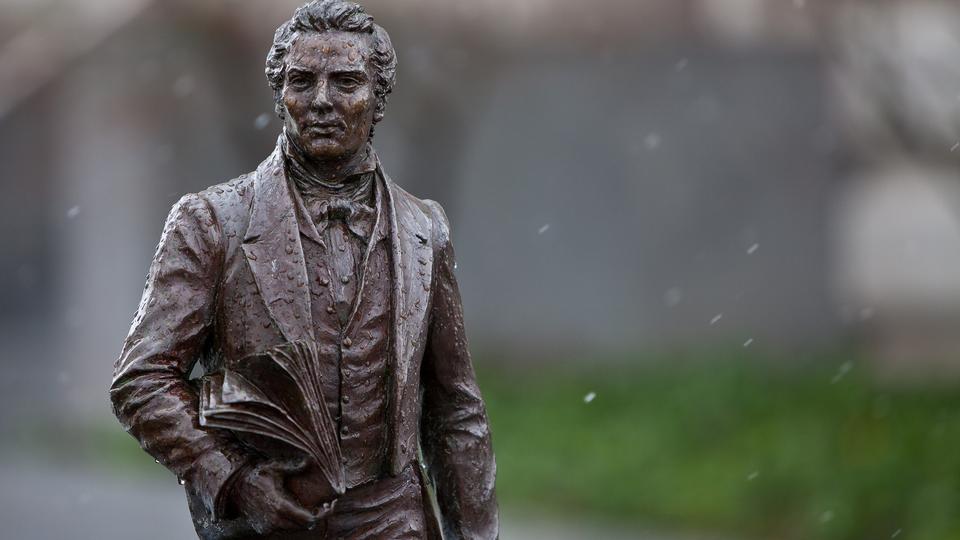
Joseph Smith stated: “I teach the people correct principles and they govern themselves.” That is a foundational truth of Church and home government: “And Zion cannot be built up unless it is by the principles of the law of the celestial kingdom” (Doctrine and Covenants 105:5).
Why is it more effective to teach principles than rules? There are at least two key reasons: First, rules are often limited to one or perhaps a few specific situations, while principles generally have much broader application. Second, principles create an environment that maximizes agency while rules tend to minimize agency by restricting, and sometimes even dictating our choices.
The law of Moses contained a set of 613 rules. It was given to Israel because of their unworthiness to abide by the greater law composed of principles, higher ordinances and the Melchizedek Priesthood. When the Savior came in the meridian of time, He replaced the lesser law of Moses with the higher law of Christ. The former was rule-driven; the latter was principle-driven.

President Russell M. Nelson gave this wise counsel: “Don’t answer a behavioral question with a behavioral answer. It is much better to give an answer based upon a principle, or even better, with a doctrinal answer, if you can.”
Principles are compatible with the higher law, rules with the lesser. Our constant focus should be to teach doctrinal principles. Why? Because principles have the greatest capacity to lift us to celestial heights, and in the end, principles — not rules — will govern in the celestial kingdom.
Come, Follow Me — For Individuals and Families, Book of Mormon, 2020 Study Helps from BYU Studies

This is an excellent resource for individual and family study of the Book of Mormon following the Come, Follow Me program in 2020.
For each week, they have listed relevant articles from BYU Studies Quarterly and other fine publications.
Follow the list of the articles chosen for next week, that include the story of Korihor
Alma 30 to 31 – “The Virtue of the Word of God”
Alma counters Korihor’s philosophy by logic and by an appeal to the power of God’s word.
“Countering Korihor’s Philosophy,” Gerald N. Lund, Ensign, July 1992
Lund approaches the story of Korihor from a philosophical angle in this Ensign article. He explains various fields of philosophy and shows how those different philosophies come out in Korihor’s theology. He also uses this discussion as a springboard into how we see these same philosophies at work in the world today, and how one can stay faithful in the gospel.
Chart 78: “The Teachings of Korihor in Alma 30” Charting the Book of Mormon
A summary of Korihor’s philosophy.
Chart 122: “Three Diverse Opponents of the Nephites” Charting the Book of Mormon
A chart summarizing the philosophies of Sherem, Nehor, and Korihor.
“An Anti-Christ in the Book of Mormon–The Face May Be Strange, but the Voice Is Familiar,” Gerald N. Lund, The Book of Mormon: Alma, the Testimony of the Word
Korihor’s teachings start with an epistemology based on strong empiricism, and perhaps Mormon included this section on an anti-Christ specifically for our benefit.
“The Trial of Korihor,” John W. Welch, Legal Cases in the Book of Mormon
The story of Korihor may be initially confusing for some readers, because it seems that Korihor is wrongfully being denied his freedom of speech when he is convicted. However, the trial of Korihor aligns well with ancient Israelite legal practices.
“Comparing Sherem, Nehor, and Korihor,” John W. Welch, Legal Cases in the Book of Mormon
Although the cases of Sherem, Nehor, and Korihor share certain features with one another, these three actions involving Nephite dissenters have less in common than one might assume.
“Cursing a Litigant with Speechlessness,” John W. Welch, Pressing Forward with the Book of Mormon: The FARMS Updates of the 1990s
The story of Korihor finds resonance with not only Mesoamerican culture, but also Greek culture.
“‘All Things Denote There is a God’: Seeing Christ in the Creation,” Bruce A. Roundy, Robert J. Norman, Religious Educator 6, no. 2
Using Alma 30:44 as a springboard, the authors dive into a discussion on how all things in the earth and in nature can be seen symbolically in testifying of God. Through the symbols of rocks, light, water, and vegetation, one can see how God has employed these powerful images throughout scripture to testify of his greatness and glory.
“Notes on Korihor and Language,” Robert E. Clark, Pressing Forward with the Book of Mormon: The FARMS Updates of the 1990s
Korihor artfully uses language to not declare what he believes as truth, but rather to epistomologically tear down the arguments of Alma.
“Nephite Insights into Israelite Worship Practices before the Babylonian Captivity,” A. Keith Thompson, Interpreter: A Journal of Mormon Scripture 3
The Book of Mormon speaks of synagogues, sanctuaries, and places of worship in a manner which suggests that Lehi and his party brought some form of synagogal worship with them when they left Jerusalem around 600 BC.
“The Zoramites and Costly Apparel: Symbolism and Irony,” Shon Hopkin, Parrish Brady, Journal of Book of Mormon Studies 22, no. 1
The Zoramite narratives of Alma 31–35 and Alma 43–44 are richly symbolic accounts woven with many subtle details regarding the importance of costly apparel and riches as an outward evidence of pride. This literary analysis focuses on how Mormon as editor structured the Zoramite narrative and used clothing as a metaphor to show the dangers of pride and the blessings afforded by humble adherence to God’s teachings and covenants.
The Garden of Eden, the New Jerusalem and The Church of Jesus Christ of Latter-day Saints’ Holding Near Jackson County, Missouri

Jackson County and Daviess County in Missouri are important locations for The Church of Jesus Christ of Latter-day Saints.
It is where, in the 1830s, Latter-day Saints suffered great persecution, culminating in 1838, when the Governor of Missouri ordered that “Mormons” must be “exterminated or driven from the state.”
Tom Spencer, history professor at Northwest Missouri State University, said the treatment of early Mormons here reflects a “noxious blend” of religious bigotry, land hunger, and cultural difference.
“If you ever believed that religious freedom existed in America in the 19th century, Mormons are a great counter-argument,” said Spencer, who edited a book on Mormons in Missouri.
When they first came to Missouri, Mormons settled in Jackson County, which, in the 1830s, was on the western frontier of the United States. But the new arrivals weren’t made welcome. For one thing, most Mormons were of Northern extraction, while other settlers in western Missouri came largely from the South.
“These were people who, while they didn’t really hold slaves, they believed in racial hierarchy and they believed in slavery,” said Spencer. So while slavery wasn’t the central issue in the conflict, it was one of many cultural differences. “I mean, the Mormons were an easy target. They were different. Their beliefs were different.”
In Jackson County, Missourians ransacked Mormon homes and businesses, tarred and feathered Mormon leaders, and finally drove them out, first to neighboring Clay County, and then, finally, to Caldwell and Daviess Counties, to the area around Adam-Ondi-Ahman…
…by the end of the year, Mormons had fled to Illinois, where Joseph Smith was later killed by a mob. From thence, the long trip over the Great Plains and Rocky Mountains to what is now Utah.
But now, the Mormon community in Daviess County is growing again. (Mormons returning to northwest Missouri, 174 years after ‘extermination order’)
The Garden of Eden and The New Jerusalem

In 1831, the prophet Joseph Smith declared that many of the righteous would gather in Independence, Missouri, to prepare for the Second Coming of Jesus Christ.
The New Jerusalem would be “a land of peace, a city of refuge, a place of safety for the saints” in a wicked world and would be built in Jackson County.
“And the glory of the Lord shall be there, and the terror of the Lord also shall be there,” … “insomuch that the wicked will not come unto it, and it shall be called Zion” (D&C 45:66–67).
The revelations declared also that a temple would be built on a lot in Independence, a few miles east of Kansas City, and would be the site of a gathering for the Second Coming of Jesus Christ.
According to Bruce A. Van Orden, associate professor of Church history, at Brigham Young University:
“the whole earth was paradisiacal before the Fall. The Garden of Eden was a center place. After the Fall, there was no Garden of Eden or paradisiacal status on earth. Yet relative to the locale of the site of the Garden of Eden, the Prophet Joseph Smith learned through revelation (D&C 57) that Jackson County was the location of a Zion to be and the New Jerusalem to come.
Brigham Young stated, “Joseph the Prophet told me that the garden of Eden was in Jackson [County] Missouri.” (Journal of Wilford Woodruff, vol. 5, 15 Mar. 1857). Heber C. Kimball said: “From the Lord, Joseph learned that Adam had dwelt on the land of America, and that the Garden of Eden was located where Jackson County now is.” (Andrew Jenson, Historical Record, 9 vols., Salt Lake City). Other early leaders have given the same information. (What do we know about the location of the Garden of Eden?)
According to the prophet Joseph Smith, after the Fall, Adam traveled east of Eden, to what is now Daviess County, to the spot “mormons” call Adam-Ondi-Ahman. The church now owns over 3,000 acres here, rolling farm land along the Grand River. Missionaries tend the grounds, and in the summer, many members of the Church of Jesus Christ of Latter-day Saints from around the country stop by.
Adam-Ondi-Ahman, between Highway 13 and the Grand River.
It wasn’t until May 1838 that revelation (D&C 116) identified Adam-ondi-Ahman, a site near the Garden of Eden, to be in Daviess County, Missouri, some seventy miles from present-day Kansas City. (Encyclopedia of Mormonism, 4 vols., New York City: Macmillan, 1992, 1:19–20.) Other revelations referring to Adam-ondi-Ahman were D&C 78:15–16 and D&C 107:53–57.
President Joseph Fielding Smith said: “In accord with the revelations given to the Prophet Joseph Smith, we teach that the Garden of Eden was on the American continent located where the City of Zion, or the New Jerusalem, will be built. When Adam and Eve were driven out of the Garden, they eventually dwelt at a place called Adam-ondi-Ahman, situated in what is now Daviess County, Missouri. … We are committed to the fact that Adam dwelt on [the] American continent.” (Doctrines of Salvation, 3 vols., comp. Bruce R. McConkie, Salt Lake City:Bookcraft, 1956, 3:74. Compare Answers to Gospel Questions, 5 vols., Salt Lake City: Deseret Book Co., 1957–75, 2:93–95, 4:19–24; and Alvin R. Dyer, in Conference Report, Oct. 1968, pp. 108–9.)
The history and the prophetic statements about the future of this area make this short article even more interesting.
Lee’s Summit is a city located within the counties of Jackson and Cass in the state of Missouri…
Lee’s Summit, MO and The Church of Jesus Christ of Latter-day Saints are discussing what to do with 6.55 square miles the church owns within city limits.
The Church of Jesus Christ of Latter-day Saints owns two properties — a 1,100-acre northern tract and a 3,100-acre southern one — in Lee’s Summit, Mo. It has partnered with the city to develop them.

According to one local MO land developer, The Church of Jesus Christ of Latter-day Saints owns more than 8,000 acres of land in Lee’s Summit making it one of the largest absentee landowners.
“No one seems to know the long-term plans of the church regarding this land,” Kenney said. “However, it is clear that if some or all of it is released to the public, it will greatly stimulate the local economy and provide opportunities for growth of every sort.”
City officials agreed.
“We don’t see any negatives about the church’s investments, other than when any large institution owns ground, they are not under the gun to develop it,” said Bob McKay, director of planning and development for Lee’s Summit. “A real advantage for the city is being able to work with just one owner to develop a master plan.”
Lee’s Summit is not too far away from Independence, Missouri.
Latter-day Saints Beliefs: Is God Just or Merciful?

Is God Just or Merciful?
Is God a God of justice or a God of mercy? Is it possible for Him to be both?
It’s hard for some people to understand that God can be just and merciful at the same time. Because they know that God is love, they may wrongly believe that whatever they do, He will accept it.
Members of The Church of Jesus Christ of Latter-day Saints, sometimes referred to as Mormons, believe God is both perfectly just and perfectly merciful.
God’s laws, or commandments, function like the laws of our societies and communities. Laws maintain order and prevent chaos. They involve choices and inevitable outcomes for those choices. Breaking societal laws brings consequences such as fines or jail time. Following or violating God’s laws also brings consequences: either blessings or punishments. This is justice.
God is holy, pure, and perfect. Disobeying God’s commandments makes us unworthy to live with Him again after this life. Since no one is perfect, all people would then be banned from His presence. That is where mercy—made possible by the Atonement of Jesus Christ—comes in. By sacrificing Himself for us, Christ met the demands of God’s law of justice. If we accept Christ’s Atonement, choose to have faith in Him, and repent when we make mistakes, we receive His mercy. God’s perfect love for all His children allows for both justice and mercy.
We are subject to the consequences of our actions but have also been given a Savior who promises to take away our sins if we will follow Him.
Apostles: Special Witnesses of Jesus Christ (Videos)

Apostles: Special Witnesses of Jesus Christ
Apostles are witnesses of Jesus Christ and testify to all the world of His divine mission. Christ himself ordained 12 apostles during his earthly ministry.
Today, 12 living apostles continue the same charge to teach and testify of Him.
Apostles serve as special witnesses of Jesus Christ, with a primary purpose to teach and testify of His divine role and mission. Jesus Christ chose and ordained twelve apostles during His earthly ministry to help share His message of truth and salvation with all people. Simon Peter was the first apostle Jesus called, and the leader of the twelve. Then there was Andrew, his brother, James and John, also brothers, then Philip, Bartholomew, Thomas, Matthew the publican, another apostle named James, Judas Thaddaeus, Simon Zelotes, a Canaanite, and last, Judas Iscariot, the traitor.
After Christ’s death and resurrection, the apostles continued to travel and teach, sharing the gospel of Jesus Christ with as many people as they could. They also endured persecution and were killed because of their teachings. Over time the foundation of the Church and the priesthood authority that Christ established was lost.
The divine return of The Church of Jesus Christ began in the early 1800s. Just as in Christ’s ancient church, the Restored Church was subsequently organized with twelve apostles, men who have the same authority and charge from Jesus Christ to “teach all nations,” and continue to take His gospel to all the world.
Apostles in The Church of Jesus Christ

“An ‘apostle’ is an ordained leader in the Melchizedek Priesthood in The Church of Jesus Christ of Latter-day Saints. Apostles are chosen through inspiration by the President of the Church, sustained by the general membership of the Church, and ordained by the First Presidency and Quorum of the Twelve Apostles by the laying on of hands. … In addition to serving as witnesses of Jesus Christ to all the world (Doctrine and Covenants 107:23), as Jesus’ apostles did, members of the current Quorum of the Twelve Apostles hold the keys of the priesthood—that is, the rights of presidency (Doctrine and Covenants 107:35; cf. 124:128)” (Encyclopedia of Mormonism [1992], 1:59–60).
Video: “The Living Christ: The Testimony of the Apostles”
Scriptures
Scripture References
- Matthew 10:1–4
- Ephesians 4:11–13
- Ephesians 2:19–20
- 1 Nephi 12:9–10
- Doctrine and Covenants 1:14
- Doctrine and Covenants 27:12
- Doctrine and Covenants 18:26–33
Scripture Study Resources
What do Latter-day Saints (Mormons) Believe about God?

What do Members of the Church of Jesus Chris of Latter-day Saints Believe about God?
Many of life’s fundamental questions are centered on the nature of God. Does He exist? Is He aware of us? What can He help us accomplish?
Mormons—properly referred to as Latter-day Saints or members of The Church of Jesus Christ of Latter-day Saints—believe that God does exist, that He is the literal Father of the spirits of all humanity, and that He loves us unconditionally.
All people, male and female, are created in the image of God. He has a body of flesh and bone as we do, although His is immortal. God is a separate and distinct being from His Son, Jesus Christ, and from the Holy Ghost, though all three work together with common purpose.
God is all-knowing, all-powerful, and all-loving. His greatest desire is for all His children to return to live with Him again.
OUR SPIRITUAL FATHER
Knowing what God is like is invaluable knowledge because when we learn about Him, we inevitably learn about ourselves. He is the Father of our spirits and He wants us to seek Him, know Him, and love Him. We are His literal spiritual offspring—His beloved children.
EARTHLY FATHER, HEAVENLY FATHER
The father figures in our lives can sometimes affect the way we perceive our Heavenly Father. It’s easy to project our mortal experiences onto our perception of Him. Some of us are blessed with loving, attentive fathers, and others end up with a distorted perception of the true nature of God because their experience with their earthly father has been less than perfect. We may struggle to believe that God loves us perfectly and accepts us completely because that may not be what we’ve experienced with our earthly father. Or maybe our earthly father has never been a part of our lives, so we have difficulty believing in the existence of God—or that we even need God. But no matter what we currently believe, when we find ourselves contemplating what our Heavenly Father is like, we must remember that He—unlike our earthly father—is perfect, which changes everything.
There are many things about our Heavenly Father that we are unable to understand while in this life. Isaiah, speaking as the Lord, said, “For my thoughts are not your thoughts, neither are your ways my ways.” Further explaining, he said, “For as the heavens are higher than the earth, so are my ways higher than your ways, and my thoughts than your thoughts” (Isaiah 55:8–9).
As our heavenly parent, God knows more than we do. Who better to lead and guide us through this challenging experience of life? This scripture can be a sweet reminder that our Heavenly Father is capable of a love that is more pure and incredible than anything we’ve experienced in our lives, and the beautiful truth is that we are the objects of that unfathomable love.
THE PERFECT PARENT
Our Heavenly Father is best described as the perfect parent. A perfect parent loves deeply and displays a selfless willingness to make sacrifices for their child’s welfare, which our Father did by giving us the gift of His Beloved Son, Jesus Christ. A perfect parent provides as many opportunities for a child’s growth as possible, while at the same time offering guidance and space for the child to learn on their own, which helps them gain confidence in their own ability. A perfect parent also provides appropriate boundaries for every stage of development to keep that child from harm. Our Father has done and continues to do all of these things for us.
Our Heavenly Father can be defined by every good word known to man: loving, kind, caring, compassionate, understanding, generous—and this is only the beginning. Our Father is good, loving, and unchanging—a fact we can take great comfort in. In this world of constant change, it’s a blessing to have a Heavenly Father who “is the same yesterday, today, and forever” (Mormon 9:9), one who can and always will serve as our spiritual North Star.
Joseph Smith and Masonry

Joseph Smith and Masonry
Joseph Smith, founder of The Church of Jesus Christ of Latter-day Saints, was a Freemason. Freemasonry is a centuries-old, worldwide group of fraternal organizations.
While some of its teachings are kept confidential, it promotes loyalty and morality and invites its members to seek knowledge and opportunities to serve others.
The early 19th century saw a surge of Freemasonry in the United States. Elected officials such as George Washington, Benjamin Franklin, and other signers of the Declaration of Independence were known Freemasons. As many as 1,500 members of the Church in Nauvoo, Illinois, were also listed as Masons.
In the years before he became a Mason, Joseph Smith received revelations about specific promises, or covenants, to be made between Church members and God. These covenants are presented to Church members in their holy temples through a ceremony known as the endowment.
Some similarities have been raised between Masonic ceremonies and the endowment ceremony. Ancient parallels may exist between the two ceremonies, as well as some similarities in instructional style.
However, the purposes of the two ceremonies stand distinct. The Freemason ceremonies promote self-improvement, brotherhood, and charity as a means to create a better society.
The endowment ceremony focuses on obeying God’s laws and using the Atonement of Jesus Christ to gain eternal exaltation. The most important distinction is that the endowment ceremony is purely the result of divine inspiration.
Today members of the Church are free to explore Freemasonry or any other organization which encourages good citizenship and uplifts and improves its members.
Freemasonry
Freemasonry, the teachings and practices of the secret fraternal (men-only) order of Free and Accepted Masons, the largest worldwide secret society. Spread by the advance of the British Empire, Freemasonry remains most popular in the British Isles and in other countries originally within the empire. Estimates of the worldwide membership of Freemasonry in the early 21st century ranged from about two million to more than six million.

Freemasonry evolved from the guilds of stonemasons and cathedral builders of the Middle Ages. With the decline of cathedral building, some lodges of operative (working) masons began to accept honorary members to bolster their declining membership. From a few of these lodges developed modern symbolic or speculative Freemasonry, which particularly in the 17th and 18th centuries adopted the rites and trappings of ancient religious orders and of chivalric brotherhoods. In 1717 the first Grand Lodge, an association of lodges, was founded in England.
(For more information about Freemasonry: https://www.britannica.com/topic/order-of-Freemasons)
LDS Beliefs: God Loves His Children

God loves His children, and that includes every person ever born. Each of us lived in the premortal world as a spirit before being born and gaining a physical body. God loves His children, which includes every person ever born. Each of us lived in a pre-mortal world as a spirit before being born and gaining a physical body.
God’s plan for every person is to come to Earth, make their own choices about what to do and what kind of person to be, and hopefully return to live with God again.

Because God is perfect and holy, nothing that is imperfect or unholy can exist in His presence. As all people are imperfect, that would make living with God again impossible. This is where God’s infinite love comes into play.
God loves His children so much that He provided a Savior, His Son Jesus Christ, as a perfect man who would come to Earth and take away our sins, if we choose to follow Him.

Members of The Church of Jesus Christ of Latter-day Saints, also known as Mormons, understand that God’s commandments are given as an expression of His love. God does want us to follow His commandments, but His love is not is earned.

God’s love is freely given to all of us no matter what choices we make, because we are His children. No one is past the point of receiving or feeling the love of God in their lives.
How the Church of Jesus Christ of Latter-day Saints Is Organized

How the Church of Jesus Christ of Latter-day Saints Is Organized
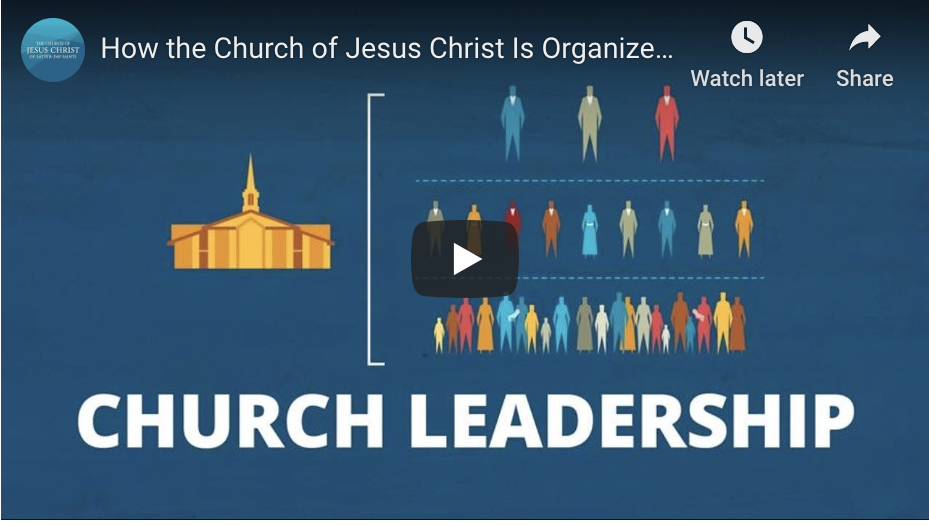
Jesus Christ is the head of The Church of Jesus Christ of Latter-day Saints. Prophets, apostles, and local leaders throughout the world work to serve Christ and assist all members as they develop stronger relationships with Him.
God has used the same basic organizational structure for His Church throughout history. During Old Testament times, prophets such as Adam, Noah, and Moses were appointed to lead the Church on the earth. When Christ Himself was on the earth, He assembled twelve Apostles and gave them the priesthood and the authority to act in His name.
After Christ’s death, the priesthood and the organizational structure of the Church were lost. They remained lost for many years, until the Church was restored in 1830. Joseph Smith Jr. became the first prophet of the Church in modern times, and there has been a constant succession of prophets ever since.
The prophet is assisted by twelve Apostles and other leaders who run specialized organizations for teaching different age groups and for giving service. Local leaders run individual congregations around the world in the same way—working in presidencies to support individual members and families as they follow Christ and His commandments.
Other Latter-day Saints Beliefs
What Is the Purpose and Meaning of Life? Video from the Church of Jesus Christ

What Is the Purpose and Meaning of Life?
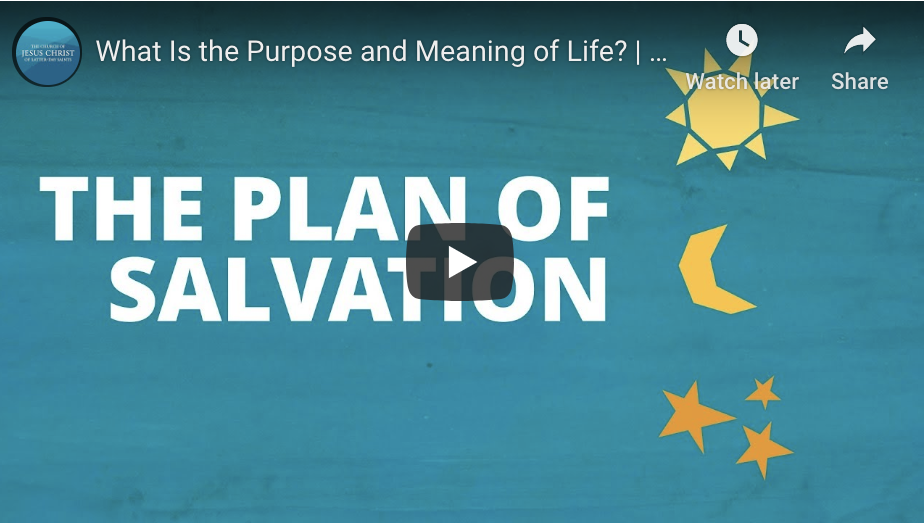
Where did we come from? Why are we here on earth? And where do we go after we die? We’ve all asked these questions hoping to discover the purpose of life. Mormons—more properly referred to as members of The Church of Jesus Christ of Latter-day Saints—believe that God has a plan for us. It’s called the plan of salvation, and it contains the answers to life’s questions. Jesus Christ is the central figure in God’s plan.
Before we were born on earth, we lived as spirit children of our Heavenly Father. He sent us to earth to receive a physical body and to learn and grow through life’s experiences. God wants us to learn to do good and follow His Son, Jesus Christ. One way we show our love for God is by obeying His commandments.
Of course, God knew we would make mistakes. As part of the plan of salvation, Jesus Christ would be born on earth. He would teach us, establish His Church, and suffer and die for our sins. Because He suffered all things, He can provide us relief from our sorrows and sufferings. Jesus Christ’s sacrifice enables us to repent and be forgiven of our sins and mistakes.