Leadership

The Law of Solid Ground states that trust is the foundation of leadership. This is the is the 6th of
The Law of E. F. Hutton is the fifth law in book The 21 Irrefutable Laws of Leadership by John
Those individuals whom we most love and respect as leaders are so regarded by us because they embody, the qualities
This is the second part of my post about the talk by President Spencer W. Kimball title Jesus: The Perfect
This article is a "classic" President Kimball, a wonderful inspiring article about true leadership. It is hard to make choices
The Law of Navigation is the 4th of The 21 Irrefutable Laws of Leadership by John Maxwell. It is about
Often people think that a worthy cause is all that is needed to rally people and motivate them, but people
The Law of Process is for me this is one of the best and more inspiring chapters in the book
The true measure of leadership is influence—nothing more, nothing less.
Leadership ability is the lid that determines a person’s level of effectiveness. The lower an individual’s ability to lead, the
Why certain leaders or companies are successful, and others are not? Because “people don’t buy what you do; they buy

The 21 Irrefutable Laws of Leadership: Law of Solid Ground (# 6)

President John F. Kennedy and McNamara, 1962
President John F. Kennedy and McNamara, 1962

The Law of Solid Ground states that trust is the foundation of leadership. This is the is the 6th of John Maxwell’s 21 Irrefutable Laws of Leadership.

It is hard to follow someone that you don’t trust. Leaders cannot break trust with people and expect to keep influencing them. Some leaders use their power and influence to force people into doing what they want them to do, but this strategy always backfires, because it doesn’t engender trust in the leader nor elicit loyalty from the followers.

A sad example of loss of trust in the leadership is what happened during the Vietnam War. Under President Kennedy and his secretary of defense, Robert McNamara, the United States became increasingly involved in the war.

Initially, the American people was supportive of that effort, in spite of the ever increasing number of casualties, but the Vietnam war was handled poorly. The worst mistake was that McNamara and the new President Lyndon Johnson weren’t honest with the people about was really happening. According to John Maxwell, they broke the law of solid ground by minimizing American losses and telling half-truths about the war.

The Importance of Character

Leadership is a potent combination of strategy and character.  But if you must be without one, be without strategy.

General H. Norman Schwarzkopf

Character and Leadership credibility always go hand in hand. John Maxwell in his Law of Solid Ground states that,

If your people don’t know what to expect from you as a leader, at some point they won’t look to you for leadership.

When it comes to leadership, we shouldn’t take shortcuts, no matter how long we’ve been leading people. Decisions need to be done the proper way.

Similarly to Steve Covey’s concept of the emotional bank account, an account of trust instead of money, John Maxwell compares trust to change in leaders’ pockets. Each time leaders make good leadership decisions, they earn more change, but each time they make poor decisions, it is like if they were paying out some of that change to the people. If leaders keep making poor decisions, they will end up without change in their pockets or, in other words, nobody will trust them anymore as leaders.

Leading is like taking a journey with people, and if the leader’s character is flawed, the longer the trip, the more unbearable it becomes for the followers.

So, how do leaders increase change in their pockets, or how do they increase trust?

Leaders should build their Character, because it quickly communicates many things to others.

Character Communicates Consistency. NBA great Jerry West said: “You can’t get too much done in life if you only work in the days in which you feel good.”

Character Communicates Potential. John Morley observed: “No man can climb beyond the limitations of his own character”. Craig Weatherup explains: “You don’t build trust by talking about it. You build it by achieving results, always with integrity and in a manner that shows real personal regard for the people with whom you work.” When a leader’s character is strong, people trust his ability of developing and releasing their potential. Weak character is limiting.

Character Communicates Respect. When you don’t have character within you, it is very difficult to earn respect from the outside world. So how do leaders earn respect? By making sound decisions, admitting their mistakes, and putting what’s best for their followers and the organization ahead of their personal agendas.

This is the Law of Solid Ground, the 6th Law of The 21 Irrefutable of Leadership.

The 21 Irrefutable Laws of Leadership by John C. Maxwell

The book is divided in 21 main chapters, one for each of the 21 leadership laws. Below are the links to the chapters that I have reviewed or that I will review later.

  1. THE LAW OF THE LID
  2. THE LAW OF INFLUENCE
  3. THE LAW OF PROCESS
  4. THE LAW OF NAVIGATION
  5. THE LAW OF E.F.HUTTON
  6. THE LAW OF SOLID GROUND
  7. THE LAW OF RESPECT
  8. THE LAW OF INTUITION
  9. THE LAW OF MAGNETISM
  10. THE LAW OF CONNECTION
  11. THE LAW OF THE INNER CIRCLE
  12. THE LAW OF EMPOWERMENT
  13. THE LAW OF THE PICTURE
  14. THE LAW OF BUY-IN
  15. THE LAW OF VICTORY
  16. THE LAW OF THE BIG MO
  17. THE LAW OF PRIORITIES
  18. THE LAW OF SACRIFICE
  19. THE LAW OF TIMING
  20. THE LAW OF EXPLOSIVE GROWTH
  21. THE LAW OF LEGACY

BUY ON AMAZON: The 21 Irrefutable of Leadership.

The 21 Irrefutable Laws of Leadership: Law of E. F. Hutton (#5)

The Law of E. F. Hutton is the fifth law in book The 21 Irrefutable Laws of Leadership by John Maxwell

The name of this law may be a little problematic, if one doesn’t know who this Mr. Hutton is. The name of the law comes from an old television commercial whose motto was “When E. F. Hutton speaks, people listen.” So, this is the meaning, as the law’s subtitle explains: When the Real Leader Speaks, People Listen.

In other words, sometimes the official leader is not the real leader, because the real leader holds the power, not just the position.

Inexperienced Leaders

Law of Hutton
Law of Hutton

“Young, inexperienced leaders often walk confidently into a room full of people only to discover that they have totally misjudged the leadership dynamics of the situation.” John Maxwell writes.

In his case, at his first job leading a church, he walked into his first meeting to discover that he was the youngest person.

He attended his first church board meeting as pastor with no agenda and no clue. He assumed that since he was the official leader, people would just follow him. He soon realized who the real leader was, Claude who determined the agenda and the following discussions.

In other words, the young John Maxwell had the title, but Claude was the real leader, because when he spoke, the people listened.

After that first meeting, the young John Maxwell was faced with a few potential solutions to his problem. He could have insisted that he was the leader and that the people should follow him; he could have removed Claude; or, he could enlist Claude’s help. Young Maxwell wisely opted for this final option, and Claude became an asset instead of a problem and threat.

Being in Power - Margareth Thatcher's quote
Being in Power

People listen not necessarily because of the truth being communicated in the message, but because of their respect for the speaker. Maxwell suggests this little experiment:

Go to a meeting with a group of people you’ve never met before and watch them for five minutes. You will know who the leader is. When somebody asks a question, who do people watch? Who do they wait to hear? The person they look to is the real leader.

Positional Leaders vs. Real leaders

This is the key to understand the difference between positional leaders and real leaders:

POSITIONAL LEADERS

  • Speak first
  • Need the influence of the real leader to get things done
  • Influence only the other positional leaders

REAL LEADERS

  • Speak later
  • Need only their influence to get things done
  • Influence everyone in the room

How do People Become the Real Leader?

According to Maxwell, over time, seven key areas become apparent in leaders’ lives that make them to step forwards as leaders:

Character – Who they are. Their inner person is key to their success as leaders.

Relationships – Who they know. They need to develop relationships with the people they lead.

Knowledge – What they know. Leaders are learners. They need to know the facts, and be able to think properly. Knowledge is vital to a leader.

Intuition – What they feel. They need to be able to deal with numerous intangibles.

Experience – Where they’ve been. The greater the challenges they have faced and overcome in the past, the credible they are.

Past Success – What they’ve done. Is their track record impressive?

Ability – What they can do. They must be good at what they do to convince people to follow them

What About You and Me?

After reading this chapter in The 21 Irrefutable Laws of Leadership by John Maxwell I had to ask myself the question. What about me? Do I need a position to feel like I can lead or am I able to lead independent of the official position I hold? What about you? Feel free to comment.

The 21 Irrefutable Laws of Leadership by John C. Maxwell

The book is divided in 21 main chapters, one for each of the 21 leadership laws. Below are the links to the chapters that I have reviewed or that I will review later.

  1. THE LAW OF THE LID
  2. THE LAW OF INFLUENCE
  3. THE LAW OF PROCESS
  4. THE LAW OF NAVIGATION
  5. THE LAW OF E.F.HUTTON
  6. THE LAW OF SOLID GROUND
  7. THE LAW OF RESPECT
  8. THE LAW OF INTUITION
  9. THE LAW OF MAGNETISM
  10. THE LAW OF CONNECTION
  11. THE LAW OF THE INNER CIRCLE
  12. THE LAW OF EMPOWERMENT
  13. THE LAW OF THE PICTURE
  14. THE LAW OF BUY-IN
  15. THE LAW OF VICTORY
  16. THE LAW OF THE BIG MO
  17. THE LAW OF PRIORITIES
  18. THE LAW OF SACRIFICE
  19. THE LAW OF TIMING
  20. THE LAW OF EXPLOSIVE GROWTH
  21. THE LAW OF LEGACY

BUY ON AMAZON: The 21 Irrefutable Laws of Leadership by John Maxwell

Jesus: The Perfect Leader (3)

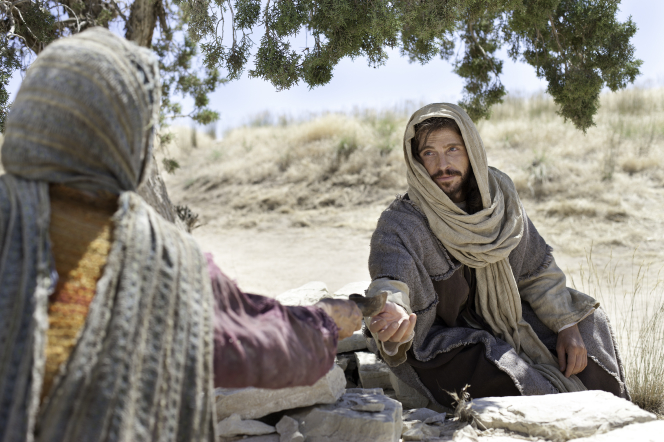
Jesus and the Woman at the Well

This post is about the last part of the talk by President Spencer W. Kimball Jesus: The perfect Leader . I divided it in three part to keep each post relatively short. This is the link to the first part of the post Jesus: The Perfect Leader and this is the link to the second part.

Secular leadership

Those individuals whom we most love, admire, and respect as leaders of the human family are so regarded by us precisely because they embody, in many ways, the qualities that Jesus had in his life and in his leadership.

Spencer W. Kimball

Ulisses S. Grant commanded the victorious Union army during the American Civil War (1861-1865) and served as the 18th U.S. president from 1869 to 1877. As the Civil War was reaching its end, and the Union was close to victory, Grant was worried that humiliating the South with harsh terms of surrender would have profound negative effects, and the eventual reunification of North and South would take much longer than necessary. Grant didn’t seek vengeance from his position of strength, but offered confederate soldiers the right to return home to care for their families, and officers were even allowed to keep their side arms and horses. General Lee, the defeated commander of the Southern Army commented that those terms “will have the best possible effect upon the men. It will be gratifying and will do much toward conciliating our people.”

Conversely, those leaders in history who have been most tragic in their impact on mankind were tragic precisely because they lacked to almost any degree the qualities of the Man of Galilee. Where Jesus was selfless, they were selfish. Where Jesus was concerned with freedom, they were concerned with control. Where Jesus was concerned with service, they were concerned with status. Where Jesus met the genuine needs of others, they were concerned only with their own needs and wants. Where Jesus was concerned with the development of his disciples, they sought to manipulate mortals. Where Jesus was filled with compassion balanced by justice, they have so often been filled with harshness and injustice.

Spencer W. Kimball

There is plenty of evil leaders to choose from in history. For example, there is the famous King John, considered by many the most evil monarch in Britain’s history, and the villain in the tales of Robin Hood. He was a depraved tyrant and a hopeless leader in war to the point that his subjects rose up and forced the Magna Carta on him. He tried to steal the throne from his brother, Richard the Lionheart. When his enemies tried to stop him, he threw them in a castle and starved them to death. In order to raise money for his military purposes, he heavily taxed the people of England, confiscated lands, and imprisoned and tortured Jews until they would pay him what he wanted.

Perhaps all of us would not be the perfect example of leadership, but all of us can make a serious effort toward approaching that great ideal.

Spencer W. Kimball
Miracles of Jesus: Healing the Blind Man

Most of us will never find ourselves in situations of great power and influence, like being kings and presidents of nations. However, in our more ordinary lives, we will have the opportunity to choose what kind of leader we want to be. We will be tempted to use people for our own selfish purposes, while at the same time we will be given opportunities to bless their lives. The more we learn to follow the Savior, even if we will never be perfect like him, the more we will experience true success as leaders.

Our potential

One of the great teachings of the Man of Galilee, the Lord Jesus Christ, was that you and I carry within us immense possibilities. In urging us to be perfect as our Father in Heaven is perfect, Jesus was not taunting us or teasing us. He was telling us a powerful truth about our possibilities and about our potential. It is a truth almost too stunning to contemplate. Jesus, who could not lie, sought to beckon us to move further along the pathway to perfection.

Spencer W. Kimball

I could say that it is only because I know that Jesus cannot lie that I believe the amazing truth that we can become perfect. However, even before learning about the truths of the Restored Gospel, I had a feeling and a hope inside me that had pushed me to do better, and especially to believe in the impossible, or that we can perfect ourselves. The Restored Gospel, as taught by the Church of Jesus Christ of Latter day Saints, however, helped me to understand that we absolutely need the Savior to be perfected, that we cannot reach that goal by our efforts alone. Even to become better leaders, we can turn to Jesus, the Perfect Leader, and ask for his help to become what we can our best selves.

Each of us has more opportunities to do good and to be good than we ever use. These opportunities lie all around us…

We must remember that those mortals we meet in parking lots, offices, elevators, and elsewhere are that portion of mankind God has given us to love and to serve. It will do us little good to speak of the general brotherhood of mankind if we cannot regard those who are all around us as our brothers and sisters…We need to remember the parable Jesus gave us in which he reminded us that greatness is not always a matter of size or scale, but of the quality of one’s life.

Spencer W. Kimball
Miracles of Jesus: the Widow's son
Miracles of Jesus: the Widow’s son

Many young people tend to be idealist, and so usually are also converts to a new faith. Many of them want to do great things, and “save the world” or share their faith in visible ways; they pray for all the little hungry children of the world, or they want to raise to positions of prominence. There is nothiong wrong with those desires, but with age or maturity, many realize that if we want to save the world, we need to do well the little things, we need to start looking around us, but closer, to those people who are in our circle of influence.

The scriptures contain many marvelous case studies of leaders who, unlike Jesus, were not perfect but were still very effective. It would do us all much good if we were to read them—and read them often. We forget that the scriptures present us with centuries of experience in leadership, and, even more importantly, the fixed principles upon which real leadership must operate if it is to succeed. The scriptures are the handbook of instructions for the would-be leader.

Spencer W. Kimball

I think of the Apostles Peter or Paul, for example. We learn of their limitations as men, but we also learn of their great works and even miracles. With the help of the Lord they were transformed in great spiritual leaders, similar to the Master.

The perfect leader

I make no apology for giving something of the accomplishments of Jesus Christ to those who seek success as leaders

If we would be eminently successful, here is our pattern. All the ennobling, perfect, and beautiful qualities of maturity, of strength, and of courage are found in this one person. As a large, surly mob, armed to the teeth, came to take him prisoner, he faced them resolutely and said, “Whom seek ye?”

The mob, startled, mumbled his name, “Jesus of Nazareth.”

“I am he,” answered Jesus of Nazareth with pride and courage—and with power: the soldiers “went backward, and fell to the ground.”

A second time he said, “Whom seek ye?” and when they named him, he said, “I have told you that I am he: if therefore ye seek me, let these [his disciples] go their way.” (John 18:4–8).

Spencer W. Kimball

Even in this extreme situation, as later, even on the cross, the Perfect Leader was worried about the well-being of His followers. No selfishness in Him was to be found until the end. What an example!

Jesus…really does embody all those virtues and attributes the scriptures tell us of. If we can come to know that, we then know the central reality about man and the universe. If we don’t accept that truth and that reality, then we will not have the fixed principles or the transcendent truths by which to live out our lives in happiness and in service. In other words, we will find it very difficult to be significant leaders unless we recognize the reality of the perfect leader, Jesus Christ, and let him be the light by which we see the way!

Spencer W. Kimball

Jesus: The Perfect Leader (2)

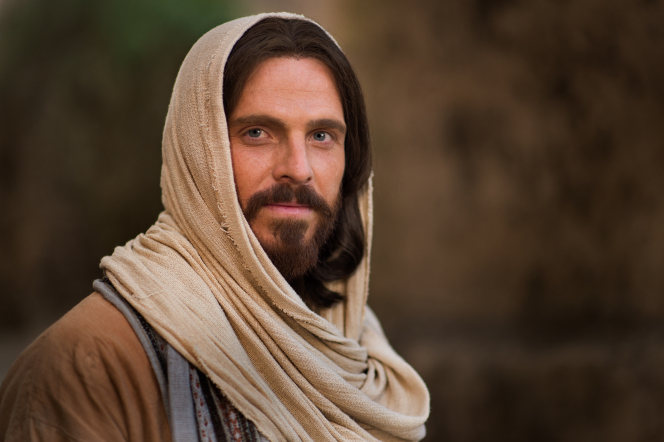
Jesus Christ
Jesus Christ

This is the second part of my post about the talk by President Spencer W. Kimball title Jesus: The Perfect Leader. This is the link to the first part of the talk and this is the link to the third part. In this second part I will review the three more segments of President Kimball’s talk, under the titles of Responsibility, Accountability, and Wise Use of Time.

Responsibility

Jesus knew how to involve his disciples in the process of life. He gave them important and specific things to do for their development. Other leaders have sought to be so omnicompetent that they have tried to do everything themselves, which produces little growth in others. Jesus trusts his followers enough to share his work with them so that they can grow. That is one of the greatest lessons of his leadership. If we brush other people aside in order to see a task done more quickly and effectively, the task may get done all right, but without the growth and development in followers that is so important. Because Jesus knows that this life is purposeful and that we have been placed on this planet in order to perform and grow, growth then becomes one of the great ends of life as well as a means.

Spencer W. Kimball

From my first days as a member of the Church of Jesus Christ of Latter-day Saints I have seen this principle in action, sometimes with better applications and results than in others, but it is a constant principle of action in His Church. People are given responsibilities and opportunities to grow through assignments and callings who allow them to develop, while serving others.

While it may seem easier and more effective to take things into our hands, when we lead, instead than providing challenging opportunities of growth to others, the way the Savior moves His work forward is by trusting His servants and giving them appropriate responsibilities. He surely could do the work by himself, but he chooses to let us participate.

I think of the young missionaries who, at the age of 18 or 19, go into the world to share the message of the Gospel. The Church does not use professional religious teachers for that work, but following the instructions of the Savior, sends these young missionaries to do His work. While they work in the Lord’s vineyard, they grow spiritually, socially, emotionally in ways that wouldn’t have been possible had they stayed home.

Similarly, bishops and other leaders in the congregations of the Church of Jesus Christ of Latter- day Saints are chosen among people who are not professional clergymen. Through their service, however, over time, they come to learn how to be more effective and Christlike.

Sermon on the Mount
Sermon on the Mount

Jesus was not afraid to make demands of those he led. His leadership was not condescending or soft. He had the courage to call Peter and others to leave their fishing nets and to follow him, not after the fishing season or after the next catch, but now! today! Jesus let people know that he believed in them and in their possibilities, and thus he was free to help them stretch their souls in fresh achievement. So much secular leadership is condescending and, in many ways, contemptuous of mankind because it treats people as if they were to be coddled and cocooned forever. Jesus believed in his followers, not alone for what they were, but for what they had the possibilities to become. While others would have seen Peter as a fisherman, Jesus could see him as a powerful religious leader—courageous, strong—who would leave his mark upon much of mankind. In loving others, we can help them to grow by making reasonable but real demands of them.

Spencer W. Kimball

To envision how people can become and help them get there is one of the most important skills of a great leader. The Savior is demanding, but not for His own glory, but to help His followers, and for the glory of the Father. He is demanding because He is not offering us to simply follow Him forever, but he is teaching us to become like Him, and this supreme goal cannot be achieved easily.

Many leaders don’t really trust their own followers, and they simply want to keep them happy, to exploit their support for their own personal gains. In all of this, there is no real concern and love for their followers, but only expediency.

Accountability

Jesus taught us that we are accountable not only for our actions but also for our very thoughts. This is so important for us to remember. We live in an age that stresses “no-fault insurance”—and “no fault” in other human behavior as well. Accountability is not possible, of course, without fixed principles. A good leader will remember he is accountable to God as well as to those he leads. By demanding accountability of himself, he is in a better position, therefore, to see that others are accountable for their behavior and their performance. People tend to perform at a standard set by their leaders.

Spencer W. Kimball
Christ raises the daughter of Jairus from death while her family looks on in gratitude.
Christ raises the daughter of Jairus from death

In our age of relativism, where principles change at will and for convenience, many leaders don’t feel accountable for what they think and do, and similarly don’t hold their followers accountable. There is always a justification or excuse for changing position or for inappropriate behavior. Unstable leaders attract unstable followers. As Jesus said,

Let them alone: they be blind leaders of the blind. And if the blind lead the blind, both shall fall into the ditch.

Matthew 15:14

Wise Use of Time

Jesus also taught us how important it is to use our time wisely. This does not mean there can never be any leisure, for there must be time for contemplation and for renewal, but there must be no waste of time. How we manage time matters so very much, and we can be good managers of time without being frantic or officious. Time cannot be recycled. When a moment has gone, it is really gone. The tyranny of trivia consists of its driving out the people and moments that really matter. Minutia holds momentous things hostage, and we let the tyranny continue all too often. Wise time management is really the wise management of ourselves.

Spencer W. Kimball

If we are responsible for our lives and in order to help others to be successful with theirs, we need to properly value and use time. The older I become, the more aware I am that I need to constantly make choices and establish priorities about how to use my time. It is not anymore simply a decision between a good and a bad use of my time, but it is the more complicated evaluation of what constitute a good, or a better or the best use of my time.

As Elder Dallin H. Oaks said in his talk Good, Better, Best,

We should begin by recognizing the reality that just because something is good is not a sufficient reason for doing it. The number of good things we can do far exceeds the time available to accomplish them. Some things are better than good, and these are the things that should command priority attention in our lives.

Dallin H. Oaks

At the same time, we should not become so consumed with what we do that we don’t learn to stop and relax, and take the needed breaks from our activities, to recharge and live a fulfilling life with our loved ones. Not many people at the end of their lives say “I just didn’t spend enough time with my job.” Good leaders should also recognize these needs in their followers and not require them to do extreme sacrifices of time and energies only to gratify the leader’s pride and selfish goals.

-(to be continued – Jesus: The Perfect Leader – link to the third part)

Jesus: The Perfect Leader

I am interested in the topic of leadership, and I have reviewed a few books and chapters about leadership in this blog before, all from secular sources or from Christian leadership writers.

Jesus calling His Apostles
Jesus Calling His Apostles

Yesterday I thought about looking for something different, something more spiritual, and decided to do a search in the website churchofjesuschrist.org (old lds.org). I searched for the keywords “Jesus” and “leader”, and on the top of the list I found a powerful article from a prophet of God.

It is titled Jesus: The Perfect Leader by President Spencer W. Kimball. It is an article created from an address delivered to the Young Presidents organization, Sun Valley, Idaho, on 15 January 1977. It is an old article, but it’s timeless.

President Spencer W. Kimball

This article is a “classic” President Kimball, a wonderful inspiring article about true leadership. It is hard to make choices about what to include and what to comment about, but I will try. I invite those who are interested, should read the full talk, ponder it, and try to apply its ideas in their own lives. I will split my article in three parts, since there is so much value in this talk and I want to keep each post relatively short. This is the first part.  This is the link to the second part  and this is the link to the third part. All quotes without specific attribution are from President Kimball.

Fixed principles

Jesus knew who he was and why he was here on this planet. That meant he could lead from strength rather than from uncertainty or weakness.


We are mortal, and while we are also children of God, we are not “the” Son of God. Our understanding of who we are and what exactly is our mission on this earth is limited and comes to us in baby steps. Therefore, when we lead, our position is never as strong as Jesus’.

We all have at least some uncertainty or weakness. Even prophets, of future prophets, feel this uncertainty at times. Elder Wendell J. Ashton in his talk Unchanging Principles of Leadership said the following about Elder Hinckley, when he was not yet the President of the Church, but already a seasoned General Authority:

Last week several of us were in the office of my former missionary companion, Elder Gordon B. Hinckley, shortly after he had received his notice from the First Presidency as to when he would speak at this great conference.

Elder Hinckley turned serious and almost wan, then said, “You know, this frightens me terribly. It does every time general conference approaches.”

Elder Hinckley has been coming up here twice a year and performing ably for thirteen years. But can you see how one of us feels coming to this world-conference pulpit for the first, and perhaps only, time?

If Elder Hinckley after 13 years of speaking a General Conference was still frightened, then we should not be surprised if we are never completely free of uncertainty and weakness. But if we study, pray and live righteously, over time, we can also grow in the understanding of “who we are and why we are here on this planet”, and obtain enough strength and self-understanding to become better leaders, and guide others from a better position.

Jesus operated from a base of fixed principles or truths rather than making up the rules as he went along. Thus, his leadership style was not only correct, but also constant. So many secular leaders today are like chameleons; they change their hues and views to fit the situation.

How needed is this principle! Since President Kimball gave his talk I think that things have gotten even worse in the political arena and in other areas. But what is most useful for us is not pointing out other people’s weaknesses, but our own. How many time we are like chameleons? Leaders who want to emulate Jesus are not guided by political expediency or by the desire to keep power at all costs.

Jesus said several times, “Come, follow me.” His was a program of “do what I do,” rather than “do what I say.” His innate brilliance would have permitted him to put on a dazzling display, but that would have left his followers far behind. He walked and worked with those he was to serve.

There is more than just the obvious reason for a leader to do what he asks his followers to do. Not only he shows humility, honesty and consistency by doing what he asks others to do, but he also help them by “don’t leaving his followers behind”. By accepting to work together with them as an equal, putting himself at their same level, and not just pontificating from a high pedestal, he shows true charity for his followers.

Understanding others

Jesus was a listening leader. Because he loved others with a perfect love, he listened without being condescending. A great leader listens not only to others, but also to his conscience and to the promptings of God.

In an effort to be successful, many leaders start chasing praises and popularity instead of what is right. By so doing, they cease to be effective leaders and they show that their ultimate goal is not the good of their followers, but mostly their own.

Because Jesus loved his followers, he was able to level with them, to be candid and forthright with them. He reproved Peter at times because he loved him, and Peter, being a great man, was able to grow from this reproof.

 Jesus Ministering
Jesus Ministering

It is wise but hard to correct and be corrected. The Savior exemplifies in His life how to lovingly correct when is needed. We may feel that it is harder for us sometimes to correct others, since we are not perfect like Him, and so “who are we to judge others?”, or we may be afraid of making a mistake. I believe that it happens to many of us to wonder what to do in certain circumstances. We often allow our insecurities or desire to be loved to interfere with the needed correction, but He has shown us how to do it. Being inspired by the Holy Ghost is the key to make the right calls, as we read in Doctrine and Covenants 121:43,

Reproving betimes with sharpness, when moved upon by the Holy Ghost; and then showing forth afterwards an increase of love toward him whom thou hast reproved, lest he esteem thee to be his enemy;

Selfless leadership

The Savior’s leadership was selfless. He put himself and his own needs second and ministered to others beyond the call of duty, tirelessly, lovingly, effectively. So many of the problems in the world today spring from selfishness and self-centeredness in which too many make harsh demands of life and others in order to meet their demands. This is a direct reversal of the principles and practices pursued so perfectly by that perfect example of leadership, Jesus of Nazareth.

Since the early days when I became a member of the Church of Jesus Christ of Latter-day Saints, I began to learn about this important principle. Not that I hadn’t heard about it before, but only after my baptism I started to understand the principle better. Jesus said it beautifully and simply,

If any man desire to be first, the same shall be last of all, and servant of all.

Mark 9:35 – Holy Bible

As president Kimball explains, this is a reversal, where the leader becomes the servant and not the lord over those who are assigned to his care. The Savior was so willing to be the servant of all who gave his life for us. We can surely learn from Him the true meaning of selfless leadership.

Jesus’ leadership emphasized the importance of being discerning with regard to others, without seeking to control them. He cared about the freedom of his followers to choose. Even he, in those moments that mattered so much, had to choose voluntarily to go through Gethsemane and to hang on the cross at Calvary. He taught us that there can be no growth without real freedom. One of the problems with manipulative leadership is that it does not spring from a love of others but from a need to use them. Such leaders focus on their own needs and desires and not on the needs of others.

Jesus Raising Lazarus

To be in a position of leadership and power is tempting. History is full of tyrants who dominated by terror or brute force. But even better people, leaders of organizations who honestly try to be good leaders, may easily overstep their boundaries, and become controlling and manipulative in open or subtle ways. President Kimball identifies clearly that our motivation is what will make the difference: do we love people and are we trying to help them? Or do we just want to advance our careers, and take advantage of our role, to get what we want from those who work for us?

Jesus had perspective about problems and people. He was able to calculate carefully at long range the effect and impact of utterances, not only on those who were to hear them at the moment, but on those who would read them 2,000 years later. So often, secular leaders rush in to solve problems by seeking to stop the present pain, and thereby create even greater difficulty and pain later on.

This is one more thing that only the Savior could do perfectly. What we say or do is so limited by our present knowledge and circumstances that we can barely assess the short-term effect on people and situations. Many times we want to solve problems right away because we want the uncertainty or pain to go away, but it is not always possible. Our best option is to rely not only on our best judgment or on good counselors, but especially on inspiration and revelation through the power of the Holy Ghost, who can elevate and perfect what we say or do and get us a little closer to the Perfect Leader.

(to be continued)

The 21 Irrefutable Laws of Leadership: Law of Navigation (#4)

image of a n old map and ship
The Law of Navigation

The Law of Navigation is the fourth of The 21 Irrefutable Laws of Leadership by John Maxwell and is about the importance for a leader to plan ahead, remain focused and control the direction of the trip (his endeavor or mission), and not being controlled by it. In other words,

Anyone Can Steer the Ship, but It Takes a Leader to Chart the Course.

To introduce the Law of Navigation John Maxwell uses a dramatic story, a life-and-death illustration, about the two groups of explorers who in 1911 set out on a mission to be the first in history to reach the South Pole.

One of them was led by the Norwegian explorer Roald Amundsen, who carefully charted his course. The other group was led by Robert F. Scott, a British Naval Officer who, on the other hand, violated the Law of Navigation.

The final result of those two missions was dramatically different: Amundsen and his group arrived to the South Pole more than a month before Scott’s team, while Scott and his team died along the way on their return trip, still 150 miles from their base.

But why this happened? According to John Maxwell, true “navigators” (effective leaders) envision the whole trip before they even leave the dock. They have a plan, they have a vision of what they need to do to reach their goal, and they understand what it takes to get to destination. They also consider what kind of people they need on their team to be successful, and they are aware of the obstacles they may encounter on the trip, a long time before they actually appear over the horizon.

To Be Successful, the Leader/Navigator Should:

  • See the whole trip in his mind before leaving the dock
  • Draw on past experience and learn from it
  • Listen to what others have to say. Know that don’t have all the answers
  • Examine conditions before making commitments. Have faith, but also be realistic

See the Trip Ahead

Effective leaders need to control the direction of the trip, they need a vision and a plan. The larger the organization, the more clearly the leader need to be able to see ahead, because corrections are more difficult, and they take more time. Think of the Titanic, the captain and his crew could not see far enough ahead to correct the problem and avoid the iceberg.

Draw on Past Experience

Those who cannot remember the past are condemned to repeat it.

George Santayana

Learn from past mistakes and failure, and also from successes. As a leader, your experience and other people’s experience should guide you to avoid past mistakes and improve your performance.

Listen to What Others Have to Say

The past, however, will never tell you exactly what to do in the present. This is why you should gather information from many sources. Learn to listen from people inside and outside your organization.

Where no counsel is, the people fall: but in the multitude of counsellors there is safety

-Proverbs 11:14, Holy Bible, King James Version

Examine conditions: have faith, but also be realistic

It’s difficult to balance optimism and realism, intuition and planning, faith and fact.  But that’s what it takes to be effective as a navigating leader.

John Maxwell

Good navigators analyze the costs before committing to a course of action. They don’t minimize challenges. Bill Easum said, “Realistic leaders are objective enough to minimize illusions. They understand that self-deception can cost them their vision.”

Charting the Course

The secret of the Law of Navigation is preparation, tell us Dr. Maxwell. If you prepare well, you increase your ability to lead and to be trusted. Leaders who are good navigators can take their people almost anywhere.

What are some example in your life, when your preparation helped you to lead your team successfully?

The 21 Irrefutable Laws of Leadership by John C. Maxwell

The book is divided in 21 main chapters, one for each of the 21 leadership laws. Below are the links to the chapters that I have reviewed or that I will review later.

  1. THE LAW OF THE LID
  2. THE LAW OF INFLUENCE
  3. THE LAW OF PROCESS
  4. THE LAW OF NAVIGATION
  5. THE LAW OF E.F.HUTTON
  6. THE LAW OF SOLID GROUND
  7. THE LAW OF RESPECT
  8. THE LAW OF INTUITION
  9. THE LAW OF MAGNETISM
  10. THE LAW OF CONNECTION
  11. THE LAW OF THE INNER CIRCLE
  12. THE LAW OF EMPOWERMENT
  13. THE LAW OF THE PICTURE
  14. THE LAW OF BUY-IN
  15. THE LAW OF VICTORY
  16. THE LAW OF THE BIG MO
  17. THE LAW OF PRIORITIES
  18. THE LAW OF SACRIFICE
  19. THE LAW OF TIMING
  20. THE LAW OF EXPLOSIVE GROWTH
  21. THE LAW OF LEGACY

BUY ON AMAZON: The 21 Irrefutable Laws of Leadership by John Maxwell

The 21 Irrefutable Laws of Leadership: Law of Buy-In (#14)

Often people think that a worthy cause is all that is needed to rally people and motivate them. But John Maxwell believes this to be a mistake. In The Law of Buy-In, the 14th law in his book The 21 Irrefutable Laws of Leadership, he explains,

Many people who approach the area of vision in leadership have it all backward. They believe that if the cause is good enough, people will automatically buy into it and follow. But that’s not how leadership really works. People don’t at first follow worthy causes. The follow worthy leaders who promote causes that can believe in. People buy into the leader first, then the leader’s vision.”

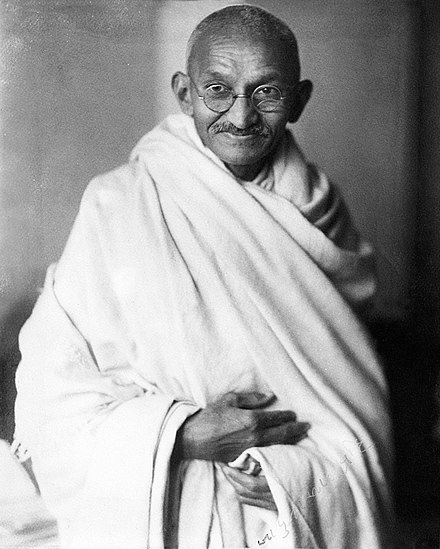
Mahatma Gandhi's picture
Mahatma Gandhi

Mahatma Gandhi

Dr. Maxwell uses the example of Mahatma Gandhi to make his point. Gandhi was an activist in South Africa fighting for the rights of Indians and other minorities for many years before he returned to India. When he arrived in India in 1914, the people rallied to him because he was already well known and respected.

Before he became an important leader in India, his people used violence in their efforts to obtain what they wanted, including riots against the British rulers. Gandhi’s vision for a new order in India, however, was based on nonviolent civil disobedience.

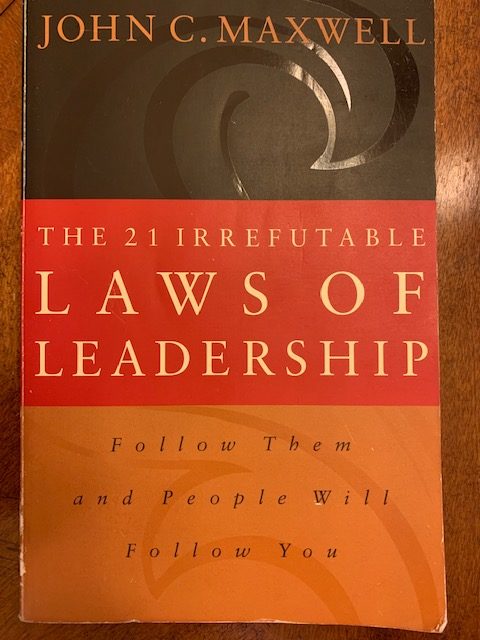
The 21 Irrefutable Laws of Leadership book
The 21 Irrefutable Laws of Leadership

He challenged Indians to face British oppression with peaceful disobedience and noncooperation and while the struggle for independence was slow and painful, people finally embraced Gandhi’s vision of nonviolence because they had bought into him as a leader.

In other words, the Indian people to bought into Gandhi’s vision because they had already bought into this leadership.

The leader finds the dream and then the people. The people find the leader and then the dream

John Maxwell

The Leader is the Message

Every message is filtered through the messenger. Gandhi was credible and then people followed him. When advertisers want to sell a product, they hire people who are credible, to promote these products. This is why Nike shoes hired Michael Jordan for their ads. People have already bought into Michael Jordan, so it become easier to sell those shoes.

Once people have bought into someone, they are willing to give his vision a chance.

John Maxwell

It’s not an either/ or Proposition

You cannot separate the leader from the cause he promotes. The two always go together. The following table shows how people react to a leader and his vision under different circumstances

LEADER                    +             VISION                 =      RESULT

Don’t Buy in                           Don’t Buy in               Get Another Leader

Don’t Buy In                           Buy In                         Get Another Leader

Buy In                                     Don’t Buy In               Get Another Vision

Buy In                                     Buy In                         Get Behind the Leader

In the first case, people obviously don’t follow the leader. The second case may be surprising, but if people don’t like the leader, even if they like the vision, they will still look for a better leader.

In the third case, when followers like the leader, but don’t like the vision, the will still give the leader another chance to find a better vision, or perhaps over time they will warm up to the leader’s vision. A respected leader can buy time for people to buy into his vision. Finally, in the last case, when the followers believe in the leader and the vision, they will follow him even through hardship, as the Indian people did with Gandhi.

The Law of Buy-In is the 14th law of the 21 Irrefutable Laws of Leadership and one of my favorite. I strongly agree with his idea. What do you think? Feel free to add your comment!

The 21 Irrefutable Laws of Leadership by John C. Maxwell

The book is divided in 21 main chapters, one for each of the 21 leadership laws. Below are the links to the chapters that I have reviewed or that I will review later.

  1. THE LAW OF THE LID
  2. THE LAW OF INFLUENCE
  3. THE LAW OF PROCESS
  4. THE LAW OF NAVIGATION
  5. THE LAW OF E.F.HUTTON
  6. THE LAW OF SOLID GROUND
  7. THE LAW OF RESPECT
  8. THE LAW OF INTUITION
  9. THE LAW OF MAGNETISM
  10. THE LAW OF CONNECTION
  11. THE LAW OF THE INNER CIRCLE
  12. THE LAW OF EMPOWERMENT
  13. THE LAW OF THE PICTURE
  14. THE LAW OF BUY-IN
  15. THE LAW OF VICTORY
  16. THE LAW OF THE BIG MO
  17. THE LAW OF PRIORITIES
  18. THE LAW OF SACRIFICE
  19. THE LAW OF TIMING
  20. THE LAW OF EXPLOSIVE GROWTH
  21. THE LAW OF LEGACY

The 21 Irrefutable Laws of Leadership: The Law of Process (#3)

The Law of Process is for me this is one of the best and more inspiring chapters in the book The 21 Irrefutable Laws of Leadership by author John Maxwell

The 21 Irrefutable Laws of Leadership: The Law of Process

You don’t make your fortune in a single day, betting all of your money in one stock. Similarly, you need to invest intentionally and wisely in your leadership development, over a long period of time, trusting that the “compound” effect will multiply your initial investment.

Effective leadership need time to develop, because it is a collection of different skills that need to be learned and improved constantly. Leaders need to be “seasoned”.

Leaders are Learners

Successful leaders are learners. According to leadership experts Warren Bennis and Burt Nanus,

It is the capacity to develop and improve their skills that distinguishes leaders from their followers.

As a leader, you should make it a practice to read or listen audio books, attend seminars and conferences, and “whenever you come across a golden nugget of truth or a significant quote, file it away for the future.”

The five phases of leadership growth

Phase 1: I Don’t Know What I Don’t Know – Not many think of themselves as leaders. They don’t realize that leadership is influence and we all influence someone. But “As long as a person doesn’t know what he doesn’t know, he isn’t going to grow.” (John C. Maxwell)

Phase 2: I Know That I Need to Know – It may happen that we are placed in a position of leadership and suddenly we realize that we don’t really know what to do. When we learn that we don’t know how to do something, we have two options: we can give up or we can decide to decide to learn and improve ourselves.

Phase 3: I Know What I Don’t Know – English Prime Minister Benjamin Disraeli said, “To be conscious that you are ignorant of the facts is a great step to knowledge”. If we want to become better leaders, we need to develop a plan for personal growth.

Phase 4: I Know and Grow and It Starts to Show – Growth doesn’t happen overnight, but if we persist in the daily discipline, exciting things start to happen. We get better and people even start noticing it.

Phase 5: I Simply Go Because of What I Know – When we have put enough efforts and practice, for long enough, finally our ability to lead will start becoming almost automatic and instinctive. This is when the payoff becomes larger than life.

Theodore Roosevelt

The chapter The Law of Process ends with the impressive story of Theodore Roosevelt, who served as the 26th president of the United States from 1901 to 1909. His philosophy of life is expressed with his famous quote,

The credit belongs to the man who is actually in the arena, whose face is marred by dust and sweat and blood; who strives valiantly; who errs, who comes short again and again, because there is no effort without error and shortcoming; but who does actually strive to do the deeds; who knows great enthusiasms, the great devotions; who spends himself in a worthy cause; who at the best knows in the end the triumph of high achievement, and who at the worst, if he fails, at least fails while daring greatly…

Roosevelt was a man of action and a fighter. His Vice President Marshall said that

Death had to take him in his sleep, for if he was awake there’d have been a fight.

But Roosevelt was also a learner. When they removed the body from the bed where he had died, they found a book under the pillow.

The 21 Irrefutable Laws of Leadership by John C. Maxwell

The book is divided in 21 main chapters, one for each of the 21 leadership laws. Below are the links to the chapters that I have reviewed or that I will review later.

  1. THE LAW OF THE LID
  2. THE LAW OF INFLUENCE
  3. THE LAW OF PROCESS
  4. THE LAW OF NAVIGATION
  5. THE LAW OF E.F.HUTTON
  6. THE LAW OF SOLID GROUND
  7. THE LAW OF RESPECT
  8. THE LAW OF INTUITION
  9. THE LAW OF MAGNETISM
  10. THE LAW OF CONNECTION
  11. THE LAW OF THE INNER CIRCLE
  12. THE LAW OF EMPOWERMENT
  13. THE LAW OF THE PICTURE
  14. THE LAW OF BUY-IN
  15. THE LAW OF VICTORY
  16. THE LAW OF THE BIG MO
  17. THE LAW OF PRIORITIES
  18. THE LAW OF SACRIFICE
  19. THE LAW OF TIMING
  20. THE LAW OF EXPLOSIVE GROWTH
  21. THE LAW OF LEGACY

BUY ON AMAZON: The 21 Irrefutable Laws of Leadership by author John Maxwell

The 21 Irrefutable Laws of Leadership: The Law of Influence (#2)

INFLUENCE=LEADERSHIP

If you don’t have Influence, you will never be able to lead

John C. Maxwell

The second law of the  21 Irrefutable Laws of Leadership is The Law of Influence).

(Read Leadership Law #1 – The Law of the Lid).

The Law of Influence states that

The true measure of leadership is influence—nothing more, nothing less.

John C. Maxwell

Princess Diane and Mother Teresa both died in 1997, a few days from each other. Both where women of tremendous influence. Maxwell doesn’t say much about Mother Teresa in this chapter but he shows how influential was Princess Diane.

In the beginning, Diane’s title had merely given her a platform to address others, but she soon became a true person of influence, influence that kept growing even after her divorce. For Maxwell, Diane was a leader, because she was an influencer, and leadership is influence, nothing more and nothing less.

There are many misconceptions about leadership, and we naturally assume that someone who has the proper title or has a leadership position is automatically a leader. This is not the case, according to John C. Maxwell.

The Law of Influence in the 21 Irrefutable Laws of Leadership debunks five common myths about leadership

  • Management Myth – leading and managing are not the same thing. Management focuses on maintaining systems and processes, but they can’t change direction, while a leader influence people to follow.
  • Entrepreneur Myth – While many entrepreneurs are skilled at finding opportunities and exploit them, not all of them are good with people, and if you can’t influence people, you can’t lead.
  • Knowledge Myth – A high IQ or many degrees don’t make anybody a leader. “Knowledge is power” but knowledgeable people are not always leaders.
  • Pioneer Myth – Not everybody who is in front of the crowd is a leader. You may be first and still not be a leader. A true leader also has people intentionally coming behind him
  • Position Myth – “it’s not the position that makes the leader; it’s the leader that makes the position.” (Stanley Huffty). A leader doesn’t need a position to lead.

True leadership cannot be awarded, appointed, assigned, or mandated. It comes only from influence.

John C. Maxwelll

If you want to test your influence as a leader try to lead a voluntary team. Followers in voluntary organizations cannot be forced: they will only follow you, if you have influence on them.

The chapter ends with a proverb: “He who thinks he leads, but has no followers, is only taking a walk”

I don’t agree completely with John C. Maxwell about influencers being necessarily leaders. For me a leader does more than just influence others, but he is right when he says that a true leader needs to be an influencer, and not just have a title.

However, a marketer is also an influencer, and this does not make him or her necessarily a leader. Leadership requires having more than just influence. It requires also to motivate and direct people. But still, influence is absolutely essential to leadership, and to have a leadership position doesn’t guarantee true leadership.

The 21 Irrefutable Laws of Leadership by John C. Maxwell

The book is divided in 21 main chapters, one for each of the 21 leadership laws.

  1. THE LAW OF THE LID
  2. THE LAW OF INFLUENCE
  3. THE LAW OF PROCESS
  4. THE LAW OF NAVIGATION
  5. THE LAW OF E.F.HUTTON
  6. THE LAW OF SOLID GROUND
  7. THE LAW OF RESPECT
  8. THE LAW OF INTUITION
  9. THE LAW OF MAGNETISM
  10. THE LAW OF CONNECTION
  11. THE LAW OF THE INNER CIRCLE
  12. THE LAW OF EMPOWERMENT
  13. THE LAW OF REPRODUCTION
  14. THE LAW OF BUY-IN
  15. THE LAW OF VICTORY
  16. THE LAW OF THE BIG MO
  17. THE LAW OF PRIORITIES
  18. THE LAW OF SACRIFICE
  19. THE LAW OF TIMING
  20. THE LAW OF EXPLOSIVE GROWTH
  21. THE LAW OF LEGACY

BUY ON AMAZON: 21 Irrefutable Laws of Leadership

The 21 Irrefutable Laws of Leadership: The Law of the Lid (#1)

Laws of Leadership: book by John C. Maxwell
Laws of Leadership: John C. Maxwell

A couple of years ago I discovered the book The 21 Irrefutable Laws of Leadership by John C. Maxwell, and I really enjoyed it. I learned useful principles of leadership in this book and I decided to share them in a series of blog posts. The book was published several years ago, but the principles are still valid.

The first law described in the book is the Law of the Lid. The Law of the Lid helps people understand the value of leadership. 

This is the law according to Maxwell: 

Leadership ability is the lid that determines a person’s level of effectiveness. The lower an individual’s ability to lead, the lower the lid on his potential. The higher the individual’s ability to lead, the higher the lid on his potential. 

Since “Leadership is influence” (Maxwell), if you are ever in a role of influence, you are a leader.  The question is, how well do you lead?  Are you putting a lid on your effectiveness or the potential of those around you?

John C. Maxwell uses this example to help understand the Law of the Lid 

if your leadership rates an 8, then your effectiveness can never be greater than a 7. If your leadership is only a 4, then your effectiveness will be no higher than a 3. Your leadership ability—for better or for worse—always determines your effectiveness and the potential impact of your organization.

Leadership multiplies the results of your efforts. If you work alone on something, you can achieve good results, if you put enough effort, but there is a limit. You simply have a limited number of hours in a day. But if you organize and lead others, your influence and results can grow exponentially. Think of Jeff Bezos or Steve Jobs and many others like them.

Laws of Leadership: John C. Maxwell's book
Laws of Leadership: John C. Maxwell

In my own experience, my most relevant results were always obtained when I was leading a team, and not when I was working alone. 

Therefore, to increase your effectiveness, you need to learn to lead others, not just to increase your personal efforts.

For example, if your dedication to success is an 8 on a scale of 1-10, but your leadership ability is a 1, then your overall effectiveness will remain quite low — no matter how much you want to succeed, as illustrated by the image below:

However, if you learn to lead better, then you may increase your level of influence and success. For example, if you can increase your leadership ability to a 6 or even a 7, your results will be multiplied, as you can see in the image below:

In other words, by increasing your leadership skills, without increasing the number of hours you work and your dedication, you can increase your original effectiveness by 600%. 

Your influence as a leader has a multiplying effect if you learn how to influence and build the strength and effectiveness of those around you.

To illustrate the Law of the Lid, in his first chapter, Maxwell tells the story of the McDonald brothers.

The McDonald Brothers

In 1937, two young brothers named Dick and Maurice opened a small drive-in restaurant in Pasadena, California. Their tiny drive-in restaurant was a great success, and in 1940, they decided to move the operation to San Bernardino. Their business exploded. Annual sales reached $200,000.

In 1948, their intuition told them that times were changing, and they made modifications to their restaurant business. They streamlined everything. They reduced their menu and focused on selling hamburgers. Their kitchen became like an assembly line. The goal was to fill each customer’s order in thirty seconds or less. And they succeeded. By the mid-1950s, annual revenue hit $350,000.

The McDonald brothers’ genius was in customer service and kitchen organization, but when in 1952 they tried marketing the McDonald’s concept, their effort failed. 

Maxwell believes that the reason of their failure was that they lacked the leadership necessary to make a larger enterprise effective. They were good single-restaurant owners. They were efficient managers, but they were not leaders. Their thinking patterns placed a lid on what they could become. At the height of their success, Dick and Maurice found themselves limited by the Law of the Lid.

The story continues and we learn that in 1954, the McDonalds connected with Ray Kroc. When he saw the store, he understood the potential. He soon made a deal with the McDonalds, and in 1955, he formed McDonald’s Systems, Inc. (later called the McDonald’s Corporation).

Between 1955 and 1959, Kroc succeeded in opening 100 restaurants. Four years after that, there were 500 McDonald’s. In 1961 Kroc bought the exclusive rights to McDonald’s from the brothers, and he proceeded to turn it into an even great success.

Maxwell’s example in his first chapter has been criticized by some who have suggested that the McDonalds’ failure in growing the franchise business didn’t happen because they lacked leadership ability. They didn’t necessarily have a “low lid”, since in the very beginning of their business they were successful. The reason why they failed should be attributed to their limited experience with franchising. It was not necessarily a problem of leadership ability.

But this doesn’t really matter from my point of view. Nobody can perfectly judge a situation like this with certainty anyway. I believe that this example still helps to understand the importance and limitations that are imposed on the growth of a company when the people in leadership positions are not effective as they could be.

In conclusion, Maxwell’s message in his first law of his book The 21 Irrefutable Laws of Leadership is that we can work hard to increase our level of leadership, and by doing it, we can increase our effectiveness by a great amount, because leadership has a multiplying effect.

The 21 Irrefutable Laws of Leadership by John C. Maxwell

The book is divided in 21 main chapters, one for each of the 21 leadership laws. Below are the links to the chapters that I have reviewed or that I will review later.

  1. THE LAW OF THE LID
  2. THE LAW OF INFLUENCE
  3. THE LAW OF PROCESS
  4. THE LAW OF NAVIGATION
  5. THE LAW OF E.F.HUTTON
  6. THE LAW OF SOLID GROUND
  7. THE LAW OF RESPECT
  8. THE LAW OF INTUITION
  9. THE LAW OF MAGNETISM
  10. THE LAW OF CONNECTION
  11. THE LAW OF THE INNER CIRCLE
  12. THE LAW OF EMPOWERMENT
  13. THE LAW OF REPRODUCTION
  14. THE LAW OF BUY-IN
  15. THE LAW OF VICTORY
  16. THE LAW OF THE BIG MO
  17. THE LAW OF PRIORITIES
  18. THE LAW OF SACRIFICE
  19. THE LAW OF TIMING
  20. THE LAW OF EXPLOSIVE GROWTH
  21. THE LAW OF LEGACY

ON AMAZON: The 21 Irrefutable Laws of Leadership

Start with Why by Simon Sinek: Book Review

This is my review of the book, Start with Why by Simon Sinek.

Simon Sinek’s TED Talk Start with Why is now the 3rd most watched TED talk of all times, with more than 30 million views, but reading the book is absolutely worthwhile

Why certain leaders or companies are successful, and others are not? Because “people don’t buy what you do; they buy why you do it.” It’s a simple idea but it carries important consequences, if you believe in it. Said in other words, it means that why you do something is a lot more important than what you do or even how you do it. Only the Why can inspire people to follow you or buy your products. “

Simon Sinek explains in the preface of his book that he “discovered” the importance of WHY at a time when he had fallen out of love with his work. It may have happened to you at some point in your life also. But then, the discovery of the WHY, he says, “Changed my view of the world and … restored my passion to a degree multiple times greater than at any other time in my life”. 

This sounds like a life calling, Simon found his purpose in life, apparently. Surely without passion it is hard to find meaning in what we do, and if we are not passionate about what we do, and we are not inspired, we will also not be inspiring to others.

How to be an inspiring leader, according to Sinek, can be learned, it is not limited to “natural-born leaders”. If we learn to start with the WHY, and we are disciplined, we can all become inspiring leaders, or at least this is what Sinek tell us in his book.

There are only two ways to influence human behavior: you can manipulate it, or you can inspire it”. When companies want to sell a product by using manipulation, they may drop the price, run a promotion, use fear, peer pressure or aspirational messages. Manipulation works to a degree, but there are trade-offs: it does not breed loyalty. Over time, it costs more and more. The gains are only short-term, and it does not build loyalty.

So, what’s the solution? If you are a leader who wants to try a different approach, you can take advantage of a  “natural occurring pattern” that Simon Sinek calls The Golden Circle

The Golden Circle starts with WHY in the middle. The next layer is HOW and the final layer is WHAT. The idea is that“The Golden Circle provides compelling evidence of how much more we can achieve if we remind ourselves to start everything we do by first asking why”. 

TED Talk: Start with Why, Simon Sinek

Sinek believes that these principles are not an opinion, but that they are grounded in biology. The newest area of the human brain is the neurocortex, that is responsible for rational and analytical thought and language (the what). The part of the brain that controls our feelings, the limbic brain, on the other hand, is responsible for behavior and decision-making processes, but does not control language.

The problem of communicating from the outside in (the what first) is that while the rational part of the brain understands the information, it has no capacity of driving behavior.

However, it is better to communicate from the inside out, first making appeal to the limbic brain (with the WHY) and then to the neurocortex, (with the HOW and WHAT). If we follow the inside out approach, we will have a higher probability of being successful and even create loyalty.

This is why Apple, didn’t start its marketing messages with “We make great computers. They are beautifully designed, simple to use and user-friendly” (WHAT AND HOW) but with “Everything we do, we believe in challenging the status quo. We believe in thinking differently” (WHY).

Similarly, when Martin Luther King put in motion a movement to change America with the civil rights movement, he didn’t start with “I have a plan” but with “I have a dream”. Others would then follow giving structure to the dream (HOW and WHAT) because, “no matter how charismatic or inspiring the leader is, if there are not people in the organization inspired to bring that vision to reality, to build an infrastructure with systems and processes, then at best, inefficiency reigns, and at worst, failure results.” 

But everything starts with the WHY. 

I loved the book, Start with Why. We surely live better lives and are more productive if we know why we do what we do, and if we believe in that particular “why”.

Just a side note, not everybody agrees with Simon Sinek, or only agrees partially. For example, in a Forbes’s article by Ken Krogue, the author affirms that “great salespeople always start with Who. Then they move to Why, What, and How. And then eventually to When, and How Much”.  

It sounds to me just an excuse to attract readers more than anything else, but this may be the topic for another day.

BUY ON AMAZON: START WITH WHY


error

Enjoy this blog? Please spread the word :)