These past days in California—Los Angeles especially—have been heavy with unrest. ICE raids stirred fear and resistance in immigrant communities, while protests quickly flared into riots. Freeways blocked, rocks thrown, tear gas fired. National Guard and Marines deployed by presidential order. California’s governor objecting in court.
It’s strange to watch this unfold—not far-off news, but real streets, real people, real decisions. The word “compassion” is everywhere, but its meaning seems stretched thin. Some shout for mercy, others demand order. Both claim to care.
While America argues, protests, and politicizes its borders, the rest of the world acts decisively. No drama. No riots. No national shame.
| Country | Immigration Enforcement Reality |
|---|---|
| Japan 🇯🇵 | Illegal migrants are detained and deported immediately. No protests. |
| Australia 🇦🇺 | Unauthorized arrivals are turned back or held offshore without apology. |
| China 🇨🇳 | Illegal foreigners are detained, fined, expelled—period. |
| Russia 🇷🇺 | Street checks and rapid deportation are standard policy. |
| India 🇮🇳 | Cracks down on illegal migrants without international outcry. |
| Mexico 🇲🇽 | Quietly deports Central Americans by the thousands each year. |
| Germany 🇩🇪 | Deports failed asylum seekers after fair legal review—though political debate continues. |
| UK 🇬🇧 | New laws to deport illegal entrants to Rwanda or their home countries. |
| Italy 🇮🇹 | Ports closed to migrant boats; deportation prioritized. |
| South Korea 🇰🇷 | Overstayers and illegals removed swiftly—no debate. |
| France 🇫🇷 | Cracks down on camps and unauthorized migrants despite controversy. |
In these nations, border enforcement is not political warfare. It is common sense governance.
What makes the U.S. immigration debate so uniquely bitter, confused, and unending?
It’s not simply about borders or laws. Nearly every country on earth enforces its immigration rules without shame. China, Russia, Australia, Israel, Mexico—even Canada—expect borders to mean something. Illegal entry brings real consequences. Nations defend the integrity of citizenship because it protects the rights of their own people.
But in America, especially in states like California, compassion itself has become political currency. And this changes everything.
Consider the facts:
Since 2021, the U.S. has faced over 6 million migrant encounters at the southern border—the highest in American history (CBP reports, 2024).
Human smuggling networks and drug cartels profit enormously from this flow. In 2022 alone, cartels made an estimated $13 billion smuggling migrants into the U.S., up from $500 million in 2018 (Homeland Security data).
Over 100 individuals on the terror watchlist have been arrested at the border in recent years—a sharp rise compared to previous decades.
These are not guesses. These are official numbers.
And yet, despite this, calls to enforce immigration law are often condemned as cruel, unchristian, even “anti-immigrant.” Compassion language is stretched far beyond its proper use—sometimes to excuse lawbreaking, sometimes to silence debate.
But compassion, real compassion, cannot survive without order. Without lawful process, families suffer. Vulnerable migrants—especially women and children—are exploited by criminal gangs. Border chaos means more fentanyl deaths, more human trafficking, more instability for cities and states asked to absorb populations they cannot support.
This is why most other nations—left, right, or center—never allow immigration to become such a politicized battlefield. They enforce borders not because they lack mercy, but because they understand that law and compassion depend on each other.
What is the price when compassion is politicized and law dismissed?
For Americans: overstressed cities, rising crime risks, overwhelmed social services, and political division.
For migrants: dangerous crossings, broken promises, abuse by traffickers, years of legal limbo.
For national security: greater risks of infiltration by hostile actors or terrorists.
Even former President Obama—no enemy of immigration reform—once said:
“We are a nation of immigrants. But we’re also a nation of laws. And those laws must be enforced.”
(Speech on immigration, 2014)
America’s founding as a “nation of immigrants” conflicts with its modern need for strict enforcement. The result? Moral confusion.
Democrats play the “compassion” card, hoping to rally Latino and progressive voters—even if chaos grows.
Republicans demand security and rule of law—but are painted as cruel or racist for it.
Both parties fear alienating Hispanic voters, many of whom have family or emotional ties to immigration issues.
Unlike other nations, American media demonize enforcement, framing ICE actions as cruelty instead of simple law enforcement.
This is not compassion. This is national self-harm. Here are the hard truths rarely discussed:
Drug and human smuggling cartels now control vast stretches of the U.S.-Mexico border. Every migrant crossing enriches their empire.
Known terror suspects have been caught at the southern border. How many got through unnoticed?
China, Russia, Iran—they are pleased to watch America weaken from within, distracted by domestic chaos instead of focusing on global threats.
Thousands of women and children are trafficked each year across a border that was supposed to protect them. Weak borders enable human suffering—not reduce it.
For those who care about the moral and spiritual health of a nation, these questions are not only political.
Scripture reminds us that leaders are called to protect their people, uphold justice, and restrain wrongdoing—not merely to seek popularity or political gain.
“For rulers hold no terror for those who do right, but for those who do wrong… They are God’s servants, agents of wrath to bring punishment on the wrongdoer.”
—Romans 13:3-4
In ancient Israel, even the people of God guarded their borders. Jesus Himself warned of thieves who climb over the wall instead of entering through the gate (John 10:1)—because order and security protect the vulnerable.
Perhaps the same timeless wisdom applies today:
Without order, there can be no justice. Without justice, there is no real compassion.
This tension—between mercy and order—is not Republican or Democrat. It is human. But when either side weaponizes compassion or law for political gain, the results are suffering, chaos, and fear.
Genuine compassion—both personal and national—requires:
These principles are not new; they reflect moral truths found in Scripture, history, and common sense alike.
This is not to condemn any leader or party, but to share a concern drawn from wisdom much older than any modern debate:
“Where there is no vision, the people perish: but blessed is the one who keeps the law.”
—Proverbs 29:18
If a nation loses its will to secure its borders and defend its people, it risks not only political trouble—but deeper moral confusion.
The call is not merely for enforcement—but for wise, just, and courageous leadership that protects both the nation’s security and its soul.
A nation that cannot control its borders eventually loses trust, safety, and peace. But a nation that shows no mercy loses its soul.
The real answer is not “open borders” or “shut the gates.” It is firm, consistent, lawful process—combined with human dignity and fairness.
America’s immigration system is broken not because compassion and law are in conflict—but because they have been torn apart and set against each other by politics.
It does not have to stay this way.

A bishop is the leader of a local congregation (known as a ward) with duties similar to those of a pastor, priest or rabbi. He has overall responsibility for ministering the temporal and spiritual affairs of the congregation. In The Church of Jesus Christ of Latter-day Saints, this position is unpaid.
Each bishop is assisted by two counselors. Together, this bishopric oversees the spiritual and social needs of their ward members. The bishop helps each member of his congregation in their efforts to follow Jesus Christ. In addition to spiritual matters, a bishop helps members who are struggling financially or in other ways to become self-reliant through welfare assistance. A bishop also oversees practical matters such as records, reports, finances and the meetinghouse where members meet.
Bishops typically serve for about five years. Bishops report to stake presidents, and these local leaders have a significant amount of local autonomy to make decisions regarding the members in their wards and stakes.
A branch president is a leader of a “branch” congregation of The Church of Jesus Christ of Latter-day Saints (LDS Church). The calling of branch president is very similar to the calling of bishop, except that instead of presiding over a ward, the branch president presides over a branch.
Ideally, a branch will grow in numbers and strength and eventually become a ward. A ward is created when there are sufficient numbers and strength of members to carry out the full program of the Church. A ward does not have to have been a branch first. If there are enough members in an area, a ward can be created.
Personal sacrifice is vital to the religious faith of members of The Church of Jesus Christ of Latter-day Saints. Members volunteer their time to serve in various positions in tens of thousands of congregations throughout the world. Their service is critical at the local level because the Church has no full-time paid clergy.
Elder M. Russell Ballard of the Church’s Quorum of Twelve Apostles spoke on the concept of an unpaid volunteer ministry:
“The Lord in His infinite wisdom has designed His Church to operate with a lay ministry. That means we have been charged to watch over one another and to serve one another. We are to love one another as our Father in Heaven and the Lord Jesus Christ love us. Our callings and circumstances change from time to time, providing us with different and unique opportunities to serve and to grow.”
In addition to serving in the Church, bishops have their own careers and families to look after. While there is no stipulated period of service, it is common for a bishop to serve his congregation for about five years, at which time he returns to the body of the congregation or is assigned another responsibility elsewhere such as teaching a youth class, helping others find employment or even directing a choir.

The Laws of Human Nature by Robert Greene, is “the definitive book on decoding the behavior of the people around you“.
Even though we are all human, we often don’t understand what drives people to feel and behave the way they do. In The Laws of Human Nature Robert Greene looks at several laws that explain certain irrational behaviors, like why we self-sabotage, behave differently in groups, want the wrong things, and so on.
Drawing from the ideas and examples of Pericles, Queen Elizabeth I, Martin Luther King Jr, and many others, Greene shows how to detach ourselves from our own emotions and master self-control, how to develop the empathy that leads to insight, how to look behind people’s masks, and how to resist conformity to develop our singular sense of purpose. Whether at work, in relationships, or in shaping the world around you, The Laws of Human Nature offers brilliant tactics for success, self-improvement, and self-defense.
Robert Greene is the #1 New York Times-bestselling author of The 48 Laws of Power.
“In nineteenth-century India, under British colonial rule, authorities decided there were too many venomous cobras in the streets of Delhi, making life uncomfortable for the British residents and their families. To solve this they offered a reward for every dead cobra residents would bring in. Soon enterprising locals began to breed cobras in order to make a living from the bounty. The government caught on to this and canceled the program. The breeders, resentful of the rulers and angered by their actions, decided to release their cobras back on the streets, thereby tripling the population from before the government program.” ― Robert Greene
“we tend to think of our behavior as largely conscious and willed. To imagine that we are not always in control of what we do is a frightening thought, but in fact it is the reality.” ― Robert Greene
“The ability to gauge people’s true worth, their degree of loyalty and conscientiousness, is one of the most important skills you can possess, helping you avoid the bad hires, partnerships, and relationships that can make your life miserable. ” ― Robert Greene
“We have a continual desire to communicate our feelings and yet at the same time the need to conceal them for proper social functioning.” ― Robert Greene
“Like everyone, you think you are rational, but you are not. Rationality is not a power you are born with but one you acquire through training and practice. ” ― Robert Greene
“Feeling superior and beyond it is a sure sign that the irrational is at work.” ― Robert Greene
“In the end, people want to hear their own ideas and preferences confirmed by an expert opinion. They will interpret what you say in light of what they want to hear; and if your advice runs counter to their desires, they will find some way to dismiss your opinion, you so-called expertise. The more powerful the person, the more they are subject to this form of the confirmation bias. ” ― Robert Greene
“Man will only become better when you make him see what he is like. —Anton Chekhov” ― Robert Greene
“Whenever you experience unusual gains or losses, that is precisely the time to step back and counterbalance them with some necessary pessimism or optimism. Be extra wary of sudden success and attention–they are not built on anything that lasts and they have an addictive pull. And the fall is always painful.” ― Robert Greene
“He increasingly spoke of himself in the third person, as if he had become an impersonal revolutionary force, and as such he was infallible. If he happened to mispronounce a word in a speech, every subsequent speaker from then on would have to pronounce it that way. “If I’d said it right,” confessed one of his top lieutenants, “Stalin would have felt I was correcting him.” And that could prove suicidal.” ― Robert Greene
“Because we are not really relating to women and men as they are, but rather to our projections, we will eventually feel disappointed in them, as if they are to blame for not being what we had imagined. The relationship will often tend to fall apart from the misreading and miscommunications on both sides, and not aware of the source of this, we will go through precisely the same cycle with the next person.” ― Robert Greene
“Throughout history we witness continual cycles of rising and falling levels of the irrational. The great golden age of Pericles, with its philosophers and its first stirrings of the scientific spirit, was followed by an age of superstition, cults, and intolerance. This same phenomenon happened after the Italian Renaissance. That this cycle is bound to recur again and again is part of human nature.” ― Robert Greene
“Your eyes must be on the larger trends that govern events, on that which is not immediately visible. Never lose sight of your long-term goals. With an elevated perspective, you will have the patience and clarity to reach almost any objective.” ― Robert Greene
“In the backgrounds of almost all deep narcissists we find either abandonment or enmeshment. The result is that they have no self to retreat to, no foundation for self-esteem, and are completely dependent on the attention they can get from others to make them feel alive and worthy. ” ― Robert Greene
“when people overtly display some trait, such as confidence or hypermasculinity, they are most often concealing the contrary reality.” ― Robert Greene
“Nonverbal communication cannot be experienced simply through thinking and translating thoughts into words but must be felt physically as one engages with the facial expressions or locked positions of other people. It is a different form of knowledge, one that connects with the animal part of our nature and involves our mirror neurons. ” ― Robert Greene
“If people with natural gifts also possess a good work ethic and have some luck in life, envy will follow them wherever they go.” ― Robert Greene
“Take notice of people who praise or flatter you without their eyes lighting up. This could be a sign of hidden envy. ” ― Robert Greene
“It is impossible to not have our inclinations and feelings somehow involved in what we think. Rational people are aware of this and through introspection and effort are able, to some extent, to subtract emotions from their thinking and counteract their effect. Irrational people have no such awareness. They rush into action without carefully considering the ramifications and consequences.” ― Robert Greene
“People with consummate acting skills can better navigate our complex social environments and get ahead.” ― Robert Greene
“We often notice a similar sensation of confusion and helplessness when it comes to ourselves and our own behavior. For instance, we suddenly say something that offends our boss or colleague or friend—we are not quite sure where it came from, but we are frustrated to find that some anger and tension from within has leaked out in a way that we regret.” ― Robert Greene
“People will tend to leak out more of their true feelings, and certainly hostile ones, when they are drunk, sleepy, frustrated, angry, or under stress. They will later tend to excuse this, as if they weren’t themselves for the moment, but in fact they are actually being more themselves than ever. ” ― Robert Greene
“We are continually judging other people. We want others to think and act a certain way. Usually, the way we think and act. Because this is impossible, we continually get upset. Instead, we should see other people as phenomena, as neutral as comets or planets. They come in all varieties, which makes like rich and interesting.” ― Robert Greene
“Since your success depends on the people you work with and for, make their character the primary object of your attention. You will spare yourself the misery of discovering their character when it is too late. ” ― Robert Greene
“In knowing yourself, you accept your limits. You are simply one person among many in the world, and not naturally superior to anyone.” ― Robert Greene
“Nobody likes to believe that they are operating under some kind of compulsion beyond their control. It is too disturbing a thought. ” ― Robert Greene
“The Relentless Rebel: At first glance such people can seem quite exciting. They hate authority and love the underdog. Almost all of us are secretly attracted to such an attitude; it appeals to the adolescent within us, the desire to snub our nose at the teacher. They don’t recognize rules or precedents. Following conventions is for those who are weak and stodgy. These types will often have a biting sense of humor, which they might turn on you, but that is part of their authenticity, their need to deflate everyone, or so you think. But if you happen to associate with this type more closely, you will see that it is something they cannot control; it is a compulsion to feel superior, not some higher moral quality.” ― Robert Greene
“But it would be wise to practice instead the opposite, what the philosopher Friedrich Nietzsche called Mitfreude—“joying with.” As he wrote, “The serpent that stings us means to hurt us and rejoices as it does so; the lowest animal can imagine the pain of others. But to imagine the joy of others and to rejoice at it is the highest privilege of the highest animals.” ― Robert Greene
“The quality of attachment that we had in our earliest years will create deep tendencies within us, in particular the way we use relationships to handle or modulate our stress. ” ― Robert Greene
“As Abraham Lincoln said, “I don’t like that man. I must get to know him better.” ― Robert Greene
“People will never do something just once. They might try to excuse themselves, to say they lost their heads in the moment, but you can be sure they will repeat whatever foolishness they did on another occasion, compelled by their character and habits. In fact, they will often repeat actions when it is completely against their self-interest, revealing the compulsive nature of their weaknesses. ” ― Robert Greene
“It is estimated that over 65 percent of all human communication is nonverbal but that people pick up and internalize only about 5 percent of this information.” ― Robert Greene
“So often we think that power has changed people, when in fact it simply reveals more of who they are. ” ― Robert Greene
“What if we could find out what causes us to lie about who we are, or to inadvertently push people away?” ― Robert Greene
“Another realm to examine is how people behave in moments away from work. In a game or sport they might reveal a competitive nature that they cannot turn off. They have a fear of being overtaken in anything, even when they are driving. They must be ahead, out in front. This can be channeled functionally into their work, but in off hours it reveals deep layers of insecurities. ” ― Robert Greene
“Everything we’ve got, or so we think, comes from natural talent and hard work. But with other people, we are quick to ascribe to them all kinds of Machiavellian tactics. This allows us to justify whatever we do, no matter the results.” ― Robert Greene
“Once you understand you are dealing with someone of the other variety than yourself, you must reassess their character and not foist your own preferences on them. ” ― Robert Greene
“We imagine we’re acting of our own free will, unaware of how deeply our susceptibility to the emotions of others in the group is affecting what we do and how we respond.” ― Robert Greene
“People of real strength are as rare as gold, and if you find them, you should respond as if you had discovered a treasure. ” ― Robert Greene
“Our continual connection to social media makes us prone to new forms of viral emotional effects. These are not media designed for calm reflection.” ― Robert Greene
“Instead of focusing on what you want and covet in the world, you must train yourself to focus on others, on their repressed desires and unmet fantasies. ” ― Robert Greene
“Be extra careful in the work environment with those who like to maintain their position through charm and being political, rather than by getting things done.” ― Robert Greene
“More and more people have come to believe that others should simply desire them for who they are. This means revealing as much as they can about themselves, exposing all of their likes and dislikes, and making themselves as familiar as possible. They leave no room for imagination or fantasy, and when the man or woman they want loses interest in them, they go online to rant at the superficiality of men or the fecklessness of women. ” ― Robert Greene
“If they come from another culture, it is all the more important to understand this culture from within their experience.” ― Robert Greene
“If you are observing someone you naturally dislike, or who reminds you of someone unpleasant in your past, you will tend to see almost any cue as unfriendly or hostile. You will do the opposite for people you like. In these exercises you must strive to subtract your personal preferences and prejudices about people.” ― Robert Greene
“Instead of constantly chasing after the latest trends and modeling our desires on what others find exciting, we should spend our time getting to know our own tastes and desires better, so that we can distinguish what is something we truly need or want from that which has been manufactured by advertisers or viral effects. ” ― Robert Greene
“Related to this is what is known as Othello’s error. In the play Othello by Shakespeare, the main character, Othello, assumes that his wife, Desdemona, is guilty of adultery based on her nervous response when questioned about some evidence. In truth Desdemona is innocent, but the aggressive, paranoid nature of Othello and his intimidating questions make her nervous, which he interprets as a sign of guilt. What happens in such cases is that we pick up certain emotional cues from the other person—nervousness, for instance—and we assume they come from a certain source. We rush to the first explanation that fits what we want to see. But the nervousness could have several explanations, could be a temporary reaction to our questioning or the overall circumstances. The error is not in the observing but in the decoding.” ― Robert Greene
“Avoid deep contact with those whose time frame is narrow, who are in continual react mode, and strive to associate with those with an expanded awareness of time. ” ― Robert Greene
“Keep in mind that there are generally more extroverts than introverts in the world.” ― Robert Greene
“Put the focus on others. Let them do the talking. Let them be the stars of the show. Their opinions and values are worth emulating. The causes they support are the noblest. Such attention is so rare in this world, and people are so hungry for it, that giving them such validation will tower their defenses and open their minds to whatever ideas you want to insinuate. ” ― Robert Greene
“Ït is always better to praise people for their effort, not their talent. ” ― Robert Greene
“Pay attention to those above you for signs of insecurity and envy. They will inevitably have a track record of firing people for strange reasons. They will not seem particularly happy with that excellent report you turned in. Always play it safe by deferring to bosses, making them look better, and earning their trust. Couch your brilliant ideas as their ideas. Let them get all the credit for your hard work. Your time to shine will come,” ― Robert Greene
“People often won’t do what others ask them to do, because they simply want to assert their will. ” ― Robert Greene
“Our continual connection to social media makes us prone to new forms of viral emotional effects. These are not media designed for calm reflection. With their constant presence, we have less and less mental space to step back and think.” ― Robert Greene
“When it comes to the ideas and opinions you hold, see them as toys or building blocks that you are playing with. Some you will keep, others you will knock down, but your spirit remains flexible and playful. ” ― Robert Greene
“After all, you might argue, we are now so sophisticated and technologically advanced, so progressive and enlightened; we have moved well beyond our primitive roots; we are in the process of rewriting our nature. But the truth is in fact the opposite—we have never been more in the thrall of human nature and its destructive potential than now. And by ignoring this fact, we are playing with fire.” ― Robert Greene
“The world simply exists as it is–things or events are not good or bad, right or wrong, ugly or beautiful. It is we with our particular perspectives who add color to or subtract it from things and people. ” ― Robert Greene
‘You are not a pawn in a game controlled by others; you are an active player who can move the pieces at will and even rewrite the rules. ” ― Robert Greene
“To this day, we humans remain highly susceptible to the moods and emotions of those around us, compelling all kinds of behavior on our part—unconsciously imitating others, wanting what they have, getting swept up in viral feelings of anger or outrage.” ― Robert Greene
‘How to view the world: See yourself as an explorer. With the gift of consciousness, you stand before a vast and unknown universe that we humans have just begun to investigate. ” ― Robert Greene
“Although adversity and pain are generally beyond your control, you have the power to determine your response and the fate that comes from that. ” ― Robert Greene
“The first step toward becoming rational is to understand our fundamental irrationality. There are two factors that should render this more palatable to our egos: nobody is exempt from the irresistible effect of emotions on the mind, not even the wisest among us; and to some extent irrationality is a function of the structure of our brains and is wired into our very nature by the way we process emotions. Being irrational is almost beyond our control.” ― Robert Greene
“We want to learn the lesson and not repeat the experience. But in truth, we do not like to look too closely at what we did; our introspection is limited. Our natural response is to blame others, circumstances, or a momentary lapse of judgment.” ― Robert Greene
“In order for enviers to feel entitled to take harmful action, they must create a narrative: everything the other person does reveals some negative trait; they do not deserve their superior positions. ” ― Robert Greene
“Gratitude is the best antidote to envy. ” ― Robert Greene
“We want to feel significant in some way, to protest against our natural smallness, to expand our sense of self. What we experienced at the age of three or four unconsciously haunts us our entire lives. We alternate between moments of sensing our smallness and trying to deny it. This makes us prone to finding ways to imagine our superiority. ” ― Robert Greene
“On the internet, it is easy to find studies that support both sides of an argument. In general, you should never accept the validity of people’s ideas because they have supplied “evidence.” Instead, examine the evidence yourself in the cold light of day, with as much skepticism as you can muster. Your first impulse should always be to find the evidence that disconfirms your most cherished beliefs and those of others. That is true science.” ― Robert Greene
“Weakness comes from the inability to ask questions and to learn. Lower your self-opinion. You are not as great or skilled as you imagine. This will spur you to actually improve yourself. ” ― Robert Greene
“Experimenting with the skills and options related to your personality and inclinations is not only the single most essential step in developing a high sense of purpose, it is perhaps the most important step in life in general. ” ― Robert Greene
“If necessary, manufacture reasonably tight deadlines to intensify your sense of purpose. ” ― Robert Greene
“Always break tasks into smaller bites. Each day or week you must have microgoals. This will help you focus and avoid entanglements or detours that will waste your energy. ” ― Robert Greene
“No matter the type of culture, or how disruptive it might have been in its origins, the longer a group exists and the larger it grows, the more conservative it will become. This is an inevitable result of the desire to hold on to what people have made or built, and to rely on tried-and-true ways to maintain the status quo. This creeping conservatism will often be the death of the group, because it slowly loses the ability to adapt. ” ― Robert Greene
“We are all self-absorbed, locked in our own worlds. It is a therapeutic and liberating experience to be drawn outside ourselves and into the world of another.” ― Robert Greene
“Today, in our modern sophisticated world, you will notice this very ancient dynamic continually at play: any group will reflexively focus on some hated enemy, real or imagined, to help bring the tribe together. ” ― Robert Greene
“One faction to pay particular attention to is the one that is formed by those in the higher echelons, which we can identify as the elites in the group. Although elites themselves sometimes split into rival factions, more often than not, when push comes to shove, they will unite and work to preserve their elite status. The clan tends to look after its own, all the more so among the powerful. ” ― Robert Greene
“You can recognize deep narcissists by the following behavior patterns: If they are ever insulted or challenged, they have no defense, nothing internal to soothe them or validate their worth. They generally react with great rage, thirsting for vengeance, full of a sense of righteousness. This is the only way they know how to assuage their insecurities. In such battles, they will position themselves as the wounded victim, confusing others and even drawing sympathy. They are prickly and oversensitive. Almost everything is taken personally. They can become quite paranoid and have enemies in all directions to point to.” ― Robert Greene
“We must understand the fundamental task of any leader–to provide a far-reaching vision, to see the global picture, to work for the greater good of the group and maintain its unity. That is what people crave in their leaders. ” ― Robert Greene
“Learn to question yourself: Why this anger or resentment? Where does this incessant need for attention come from? Under such scrutiny, your emotions will lose their hold on you. You will begin to think for yourself instead of reacting to what others give you.” ― Robert Greene
“As the leader, you must be seen working as hard as or even harder than everyone else. You set the highest standards for yourself. You are consistent and accountable. If there are sacrifices that need to be made, you are the first to make them for the good of the group. This sets the proper tone. ” ― Robert Greene
“You have a responsibility to contribute to the culture and times you live in. ” ― Robert Greene
“We see people not as they are, but as they appear to us. And these appearances are usually misleading.” ― Robert Greene
“Human aggression stems from an underlying insecurity, as opposed to simply an impulse to hurt or take from others. ” ― Robert Greene
“If you come across any special trait of meanness or stupidity . . . you must be careful not to let it annoy or distress you, but to look upon it merely as an addition to your knowledge—a new fact to be considered in studying the character of humanity. Your attitude towards it will be that of the mineralogist who stumbles upon a very characteristic specimen of a mineral. —Arthur Schopenhauer” ― Robert Greene
“We must see this hypersensitivity to criticism as a sign of great inner weakness. A person who is truly strong from within can endure criticism and open discussion without feeling personally threatened. ” ― Robert Greene
“If you stop focusing on people’s words and the facade they present, and concentrate on their actions and their nonverbal cues, you can almost sense the level of aggressiveness they emanate. ” ― Robert Greene
“The denial is stronger than ever–it is always the other person, the other side, the other culture that is more aggressive and destructive. We must finally come to terms with the fact that it is not the other but ourselves, all of us, no matter the time or the culture. We must own this fact of our nature before we can even begin to consider moving beyond it. It is only in our awareness that we can start to think of progress. ” ― Robert Greene
“In general, be wary about people’s promises and never completely rely on them. With those who fail to deliver, it is more likely a pattern, and it is best to have nothing more to do with them. ” ― Robert Greene
“The more clearly you see what you want, the likelier you are to realize it. You ambitions may involve challenges, but they should not be so far above your capacity that you only set yourself up for failure. ” ― Robert Greene
“this is so important to the human animal, people will do almost anything to get attention, including committing a crime or attempting suicide. Look behind almost any action, and you will see this need as a primary motivation.” ― Robert Greene,
“What makes anger toxic is the degree to which it is disconnected from reality. People channel their natural frustrations into anger at some vague enemy or scapegoat, conjured up and spread by demagogues. They imagine grand conspiracies behind simply inescapable realities, such as taxes or globalism or the changes that are part of all historical periods. They believe that certain forces in the world are to blame for their lack of success or power, instead of their own impatience and lack of effort. There is no thought behind their anger, and so it leads nowhere or it becomes destructive. ” ― Robert Greene
“We think we are judging the younger generation in an objective manner, but we are merely succumbing to an illusion of perspective. It is also true that we are probably experiencing some hidden envy of their youth and mourning the loss of our own.” ― Robert Greene
“Think of yourself as the enemy of the status quo, whose proponents must view you in turn as dangerous. See this task as absolutely necessary for the revitalization of the human spirit and the culture at large, and master it. ” ― Robert Greene
“Some people have even come to entertain the idea that through technology we can somehow overcome death itself, the ultimate in human denial. In general, technology gives us the feeling that we have such godlike powers that we can prolong life and ignore the reality for quite a long time. In this sense, we are no stronger than our most primitive ancestors. We have simply found new ways to delude ourselves. ” ― Robert Greene
“You like to imagine yourself in control of your fate, consciously planning the course of your life as best you can. But you are largely unaware of how deeply your emotions dominate you. They make you veer toward ideas that soothe your ego. They make you look for evidence that confirms what you already want to believe. They make you see what you want to see, depending on your mood, and this disconnect from reality is the source of the bad decisions and negative patterns that haunt your life. Rationality is the ability to counteract these emotional effects, to think instead of react, to open your mind to what is really happening, as opposed to what you are feeling. It does not come naturally; it is a power we must cultivate, but in doing so we realize our greatest potential.” ― Robert Greene
“By connecting to the reality of death, we connect more profoundly to the reality and fullness of life. By separating death from life and repressing our awareness of it, we do the opposite. ” ― Robert Greene
“Let the awareness of the shortness of life clarify our daily actions. We have goals to reach, projects to get done, relationships to improve. This could be our last such project, our last battle on earth, given the uncertainties of life, and we must commit completely to what we do. ” ― Robert Greene
Robert Greene (born May 14, 1959) is an American author known for his books on strategy, power, and seduction. He has written six international bestsellers: The 48 Laws of Power, The Art of Seduction, The 33 Strategies of War, The 50th Law (with rapper 50 Cent), Mastery, and The Laws of Human Nature.
BUY ON AMAZON: The Laws of Human Nature
Top 30 Best Quotes from “The Organized Mind”
The Organized Mind: Thinking Straight in the Age of Information Overload is a bestselling popular science book written by the McGill University neuroscientist Daniel J. Levitin, PhD, and first published in the United States and Canada in 2014. It is…
In his book, Together: The Healing Power of Human Connection in a Sometimes Lonely World, former Surgeon General of the United States, Vivek Murthy argues that loneliness is the basis of the current crisis in mental wellness and is responsible for the increase in…
Top 50 Best Quotes from “Permanent Record” by Edward Snowden
Permanent Record, Book by Edward Snowden Revealing state secrets is hard, but revealing yourself in a memoir might be even harder. As Edward Snowden writes in the preface of “Permanent Record”: “The decision to come forward with evidence of government wrongdoing was…
Top 25 Quotes From The Ride of a Lifetime by Robert Iger
Robert Iger’s book The Ride of a Lifetime is a memoir of his career, leadership and success. It became the #1 New York Times Bestseller. Throughout the book, The Ride of a Lifetime, Iger shares the ideas and values he embraced during his fifteen years as Disney CEO, leading its 200,000 employees, while reinventing one of the world’s most beloved companies. Robert Iger was nominated Time’s 2019 businessperson of the year.
John P. Kotter’s Top 48 Best Quotes
“Most US corporations today are over-managed and under-led. They need to develop their capacity to exercise leadership.”
Top 85 Best Quotes from “Quiet: The Power of Introverts”
In her book Quiet: The Power of Introverts in a World That Can’t Stop Talking, Susan Cain argues that we dramatically undervalue introverts and shows how much we lose in doing so
Top 40 Quotes from The Coddling of the American Mind
In The Coddling of the American Mind: How Good Intentions and Bad Ideas Are Setting Up a Generation for Failure by Jonathan Haidt and Greg Lukianoff, the authors make the case that our culture has embraced three Great Untruths in the past ten years or so: The Untruth…
6 Interesting Facts and Best 40 Quotes From Martin Luther King Jr.
6 Things You May Not Know About Martin Luther King Jr. 1. King’s birth name was Michael, not Martin. Martin Luther original name was Michael King Jr. In 1934, however, his father, a Baptist pastor, traveled to Germany and was inspired by the life of…
60 Insightful Quotes From The Fifth Discipline by Peter Senge
Peter Senge is the author of the book “The Fifth Discipline: The Art and Practice of the Learning Organization.” The Fifth Discipline is focused on group problem solving using the systems thinking method to convert companies into learning organizations.
100 Powerful Quotes From President Russell M. Nelson
“Over my nine and a half decades of life, I have concluded that counting our blessings is far better than recounting our problems.” – Russell M. Nelson
The 90 Best Warren Buffett Quotes
Warren Edward Buffett is considered one of the most successful investors in the world and has a net worth of over US $78.9 billion as of August 2020, making him the world’s fourth-wealthiest person. Buffett was born…

“Think Again is a must-read… In an increasingly divided world, the lessons in this book are more important than ever.” –Bill and Melinda Gates
Think Again: The Power of Knowing What You Don’t Know is about the ability to rethink and unlearn. In our daily lives, we tend to favor the comfort of conviction over the discomfort of doubt. We prefer to listen to opinions that confirm our own and that make us feel good, instead of ideas that challenge us. We often treat disagreement as a threat rather than as an opportunity to learn. We keep surrounding ourselves with people who agree with our beliefs and reasoning, instead than actively looking for those who may challenge our thinking process and ideas. The consequence of this behavior is that our beliefs become rigid and impede our progress. Being bright doesn’t solve the problem. On the contrary, there’s evidence that being good thinkers can make us worse at rethinking.
When people reflect on what it takes to be mentally fit, the first idea that comes to mind is usually intelligence. The smarter you are, the more complex problems you can solve—and the faster you can solve them. Intelligence is traditionally viewed as the ability to think and learn. Yet in a turbulent world, there’s another set of cognitive skills that might matter more: the ability to rethink and unlearn.“
“Questioning ourselves makes the world more unpredictable. It requires us to admit that the facts may have changed, that what was once right may now be wrong. Reconsidering something we believe deeply can threaten our identities, making it feel as if we’re losing part of ourselves.” – Adam Grant
“You can be confident in your ability to achieve a goal in the future while maintaining the humility to question whether you have the right tools in the present.” – Adam Grant
“Great thinkers don’t harbor doubts because they’re imposters. They maintain doubts because they know we’re all partially blind and they’re committed to improving their sight.” – Adam Grant
“In a heated argument, you can always stop and ask, ‘What evidence would change your mind?’ If the answer is ‘nothing,’ then there’s no point in continuing the debate.” – Adam Grant
“People gain humility when they reflect on how different circumstances could have led them to different beliefs.” – Adam Grant
“When we’re reading, listening, or watching, we can learn to recognize complexity as a signal of credibility.” – Adam Grant
“Rethinking liberates us to do more than update our knowledge and opinions—it’s a tool for leading a more fulfilling life.” – Adam Grant
We’re mental misers: we often prefer the ease of hanging on to old views over the difficulty of grappling with new ones. –– Adam Grant
Even our great governing document, the U.S. Constitution, allows for amendments. What if we were quicker to make amendments to our own mental constitutions? – Adam Grant
A hallmark of wisdom is knowing when it’s time to abandon some of your most treasured tools – and some of the most cherished parts of your identity. – Adam Grant
We live in a rapidly changing world, where we need to spend as much time rethinking as we do thinking. – Adam Grant
We need to question our beliefs more readily than ever before. This is not an easy task. As we sit with our beliefs, they tend to become more extreme and more entrenched. I’m still struggling to accept that Pluto may not be a planet. – Adam Grant
Vintage records, classic cars, and antique clocks might be valuable collectibles, but outdated facts are mental fossils that are best abandoned. – Adam Grant
The brighter you are, the harder it can be to see your own limitations. Being good at thinking can make you worse at rethinking. – Adam Grant

If we can’t learn to find occasional glee in discovering we were wrong, it will be awfully hard to get anything right. – Adam Grant
Every time we encounter new information, we have a choice. We can attach our opinions to our identities and stand our ground in the stubbornness of preaching and prosecuting. Or we can operate more like scientists, defining ourselves as people committed to the pursuit of truth – even if it means proving our own views wrong. – Adam Grant
We learn more from people who challenge our thought process than those who affirm our conclusions. Strong leaders engage their critics and make themselves stronger. Weak leaders silence their critics and make themselves weaker. – Adam Grant
Although I’m terrified of hurting other people’s feelings, when it comes to challenging their thoughts, I have no fear. In fact, when I argue with someone, it’s not a display of disrespect – it’s a sign of respect. It means I value their views enough to contest them. If their opinions didn’t matter to me, I wouldn’t bother. I know I have chemistry with someone when we find it delightful to prove each other wrong. – Adam Grant
What set great presidents apart was their intellectual curiosity and openness. They read widely and were as eager to learn about developments in biology, philosophy, architecture, and music as in domestic and foreign affairs. They were interested in hearing new views and revising their old ones. They saw many of their policies as experiments to run, not points to score. –– Adam Grant
If knowledge is power, knowing what we don’t know is wisdom. – Adam Grant
Who you are should be a question of what you value, not what you believe. –– Adam Grant
Changing your mind doesn’t make you a flip-flopper or a hypocrite. It means you were open to learning. – Adam Grant
When we’re trying to persuade people, we frequently take an adversarial approach. Instead of opening their minds, we effectively shut them down or rile them up. They play defense by putting up a shield, play offense by preaching their perspectives and prosecuting ours, or play politics by telling us what we want to hear without changing what they actually think. – Adam Grant
A good debate is not a war. It’s not even a tug-of-war, where you can drag your opponent to your side if you pull hard enough on the rope. It’s more like a dance that hasn’t been choreographed, negotiated with a partner who has a different set of steps in mind. If you try too hard to lead, your partner will resist. If you can adapt your moves to hers, and get her to do the same, you’re more likely to end up in rhythm. – Adam Grant
Many of our beliefs are cultural truisms: widely shared, but rarely questioned. If we take a closer look at them, we often discover that they rest on shaky foundations. – Adam Grant
Stereotypes don’t have the structural integrity of a carefully built ship. They’re more like a tower in the game of Jenga – teetering on a small number of blocks, with some key supports missing. To knock it over, sometimes all we need to do is give it a poke. The hope is that people will rise to the occasion and build new beliefs on a stronger foundation.– Adam Grant
At the turn of the last century, the great hope for the internet was that it would expose us to different views. But as the web welcomed a few billion fresh voices and vantage points into the conversation, it also became a weapon of misinformation and disinformation. – Adam Grant
In a productive conversation, people treat their feelings as a rough draft. Like art, emotions are works in progress. It rarely serves us well to frame our first sketch. As we gain perspective, we revise what we feel. Sometimes we even start over from scratch. – Adam Grant
Good teachers introduce new thoughts, but great teachers introduce new ways of thinking. – Adam Grant
Our convictions can lock us in prisons of our own making. The solution is not to decelerate our thinking – it’s to accelerate our rethinking. – Adam Grant
In driver’s training we were taught to identify our visual blind spots and eliminate them with the help of mirrors and sensors. In life, since our minds don’t come equipped with those tools, we need to learn to recognize our cognitive blind spots and revise our thinking accordingly. – Adam Grant
Arrogance leaves us blind to our weaknesses. Humility is a reflective lens: it helps us see them clearly. Confident humility is a corrective lens: it enables us to overcome those weaknesses. – Adam Grant
We’re all wrong more often than we’d like to admit, and the more we deny it, the deeper the hole we dig for ourselves. – Adam Grant
It’s a sign of wisdom to avoid believing every thought that enters your mind. It’s a mark of emotional intelligence to avoid internalizing every feeling that enters your heart. – Adam Grant
Focusing on results might be good for short-term performance, but it can be an obstacle to long-term learning. – Adam Grant
As we think and talk, we often slip into the mindsets of three different professions: preachers, prosecutors, and politicians. In each of these modes, we take on a particular identity and use a distinct set of tools. We go into preacher mode when our sacred beliefs are in jeopardy: we deliver sermons to protect and promote our ideals. We enter prosecutor mode when we recognize flaws in other people’s reasoning: we marshal arguments to prove them wrong and win our case. We shift into politician mode when we’re seeking to win over an audience: we campaign and lobby for the approval of our constituents…but there’s a fourth way to think, and that is the mode of a scientist. – Adam Grant
The most effective leaders score high in both confidence AND humility. Although they have faith in their strengths, they’re also keenly aware of their weaknesses. They know they need to recognize and transcend their limits if they want to push the limits of greatness.”“Two kinds of detachment are particularly useful [for clear thinking]: detaching your present from your past and detaching your opinions from your identity. –– Adam Grant
We all have notions of who we want to be and how we hope to lead our lives. They’re not limited to careers; from an early age, we develop ideas about where we’ll live, which school we’ll attend, what kind of person we’ll marry, and how many kids we’ll have. These images can inspire us to set bolder goals and guide us toward a path to achieve them. The danger of these plans is that they can give us tunnel vision, blinding us to alternative possibilities. We don’t know how time and circumstances will change what we want and even who we want to be, and locking our life GPS onto a single target can give us the right directions to the wrong destination. – Adam Grant
Choosing a career isn’t like finding a soul mate. It’s possible that your ideal job hasn’t even been invented yet. Old industries are changing, and new industries are emerging faster than ever before: it wasn’t that long ago that Google, Uber, and Instagram didn’t exist. Your future self doesn’t exist right now, either, and your interests might change over time. – Adam Grant
When we’re searching for happiness, we get too busy evaluating life to actually experience it. Instead of savoring our moments of joy, we ruminate about why our lives aren’t more joyful. – Adam Grant
It takes humility to reconsider our past commitments, doubt to question our present decisions, and curiosity to reimagine our future plans. What we discover along the way can free us from the shackles of our familiar surroundings and our former selves. Rethinking liberates us to do more than update our knowledge and opinions – it’s a tool for leading a more fulfilling life. – Adam Grant
Top 26 Quotes from “Originals: How Non-Conformists Move the World” by Adam M. Grant
Think Again: The Power of Knowing What You Don’t Know
When you form an opinion, ask yourself what would have to happen to prove it false. Then keep track of your views so you can see when you were right, when you were wrong, and how your thinking has evolved. — Adam Grant
In a heated argument with someone else, you can always stop and ask: ‘What evidence would change your mind?’ If the answer is ‘nothing,’ then there’s no point in continuing the debate. — Adam Grant
When we come across simplifying headlines, we can fight our tendency to accept binaries by asking what additional perspectives are missing between the extremes?…’How do you know?’ It’s a question we need to ask more often, both of ourselves and others. The power lies in its frankness. It’s nonjudgmental—a straightforward expression of doubt and curiosity that doesn’t put people on the defensive.”“Multiple experiments have shown that when experts express doubt, they become more persuasive. When someone knowledgeable admits uncertainty, it surprises people, and they end up paying more attention to the substance of their argument. – Adam Grant

Adam M. Grant (born August 13, 1981) is an American psychologist and author who is currently a professor at the Wharton School of the University of Pennsylvania specializing in organizational psychology. He received academic tenure aged 28, making him the youngest tenured professor at the Wharton School. As an organizational psychologist, Adam Grant is an expert on opening other people’s minds–and our own. As the #1 New York Times bestselling author of Originals and Give and Take, one of his guiding principles is to argue like he’s right but listen like he’s wrong.
AMAZON: “Originals: How Non-Conformists Move the World” by Adam M. Grant
AMAZON: Think Again: The Power of Knowing What You Don’t Know by Adam M. Grant

Robert Iger’s book The Ride of a Lifetime is a memoir of his career, leadership and success. It became the #1 New York Times Bestseller. Throughout the book, The Ride of a Lifetime, Iger shares the ideas and values he embraced during his fifteen years as Disney CEO, leading its 200,000 employees, while reinventing one of the world’s most beloved companies. Robert Iger was nominated Time’s 2019 businessperson of the year.
Besides being recognized as the CEO of Disney, Robert Iger is a media executive, film producer, author, and businessman. In 2005, he became the CEO of The Walt Disney Company during a difficult time.
“Optimism. One of the most important qualities of a good leader is optimism, a pragmatic enthusiasm for what can be achieved. Even in the face of difficult choices and less than ideal outcomes, an optimistic leader does not yield to pessimism. Simply put, people are not motivated or energized by pessimists.” ― Robert Iger
“True authority and true leadership come from knowing who you are and not pretending to be anything else.” ― Robert Iger
“Don’t be in the business of playing it safe. Be in the business of creating possibilities for greatness.” ― Robert Iger
“If leaders don’t articulate their priorities clearly, then the people around them don’t know what their own priorities should be. Time and energy and capital get wasted.” ― Robert Iger
“And I tend to approach bad news as a problem that can be worked through and solved, something I have control over rather than something happening to me.” ― Robert Iger
“At its essence, good leadership isn’t about being indispensable; it’s about helping others be prepared to possibly step into your shoes—giving them access to your own decision making, identifying the skills they need to develop and helping them improve, and, as I’ve had to do, sometimes being honest with them about why they’re not ready for the next step up.” ― Robert Iger
“Empathy is a prerequisite to the sound management of creativity, and respect is critical.” ― Robert Iger
“When hiring, try to surround yourself with people who are good in addition to being good at what they do. Genuine decency—an instinct for fairness and openness and mutual respect—is a rarer commodity in business than it should be, and you should look for it in the people you hire and nurture it in the people who work for you.” ― Robert Iger
“If you approach and engage people with respect and empathy, the seemingly impossible can become real.” ― Robert Iger
“The path to innovation begins with curiosity” ― Robert Iger
“Don’t start negatively, and don’t start small. People will often focus on little details as a way of masking a lack of any clear, coherent, big thoughts. If you start petty, you seem petty.” ― Robert Iger
“Innovate or die, and there’s no innovation if you operate out of fear of the new or untested.” ― Robert Iger
“optimism in a leader, especially in challenging times, is so vital. Pessimism leads to paranoia, which leads to defensiveness, which leads to risk aversion. Optimism sets a different machine in motion. Especially in difficult moments, the people you lead need to feel confident in your ability to focus on what matters, and not to operate from a place of defensiveness and self-preservation. This isn’t about saying things are good when they’re not, and it’s not about conveying some innate faith that “things will work out.” It’s about believing you and the people around you can steer toward the best outcome, and not communicating the feeling that all is lost if things don’t break your way. The tone you set as a leader has an enormous effect on the people around you. No one wants to follow a pessimist.” ― Robert Iger
“You have to hear out other people’s problems and help find solutions. It’s all part of being a great manager.” ― Robert Iger
“PEOPLE SOMETIMES SHY AWAY from taking big swings because they assess the odds and build a case against trying something before they even take the first step. One of the things I’ve always instinctively felt—and something that was greatly reinforced working for people like Roone and Michael—is that long shots aren’t usually as long as they seem.” ― Robert Iger
“I learned from them that genuine decency and professional competitiveness weren’t mutually exclusive. In fact, true integrity, a sense of knowing who you are and being guided by your own clear sense of right and wrong is a kind of secret weapon. They trusted in their own instincts. They treated people with respect. And over time, the company came to represent the values they live by.” ― Robert Iger
“Chronic indecision is not only inefficient and counterproductive, but it is deeply corrosive to morale.” ― Robert Iger
“You have to ask the questions you need to ask, admit without apology what you don’t understand, and do the work to learn what you need to learn as quickly as you can. There’s nothing less confidence-inspiring than a person faking a knowledge they don’t possess. True authority and true leadership come from knowing who you are and not pretending to be anything else.” ― Robert Iger
“A few solid pros are more powerful than dozens of cons,” Steve said. “So what should we do next?” Another lesson: Steve was great at weighing all sides of an issue and not allowing negatives to drown out positives, particularly for things he wanted to accomplish. It was a powerful quality of his. ― Robert Iger
“It’s so simple that you might think it doesn’t warrant mentioning, but it’s surprisingly rare: Be decent to people. Treat everyone with fairness and empathy. This doesn’t mean that you lower your expectations or convey the message that mistakes don’t matter. It means that you create an environment where people know you’ll hear them out, that you’re emotionally consistent and fair-minded, and that they’ll be” ― Robert Iger
“Theodore Roosevelt’s “The Man in the Arena” speech, which has long been an inspiration: “It is not the critic who counts; not the man who points out how the strong man stumbles, or where the doer of deeds could have done them better. The credit belongs to the man who is actually in the arena, whose face is marred by dust and sweat and blood.”” ― Robert Iger
“Courage. The foundation of risk-taking is courage, and in ever-changing, disrupted businesses, risk-taking is essential, innovation is vital, and true innovation occurs only when people have courage. This is true of acquisitions, investments, and capital allocations, and it particularly applies to creative decisions. Fear of failure destroys creativity.” ― Robert Iger
“You don’t expect to develop such close friendships late in life, but when I think back on my time as CEO – at the things I’m most grateful for and surprised by – my relationship with Steve (Jobs) is one of them.” ― Robert Iger
“IN JUNE 2016 I made my fortieth trip to China in eighteen years, my eleventh in the past six months. I was there to oversee the final preparations before the opening of Shanghai Disneyland. I’d been CEO of the Walt Disney Company for eleven years at that point, and my plan was to open Shanghai and then retire. It had been a thrilling run, and the creation of this park was the biggest accomplishment of my career. It felt like the right time to move on, but life doesn’t always go the way you expect it will. Things happen that you can’t possibly anticipate. The fact that I’m still running the company as I write this is a testament to that.” ― Robert Iger
“We had endless negotiations over land deals and partnership splits and management roles, and considered things as significant as the safety and comfort of Chinese workers and as tiny as whether we could cut a ribbon on opening day. The creation of the park was an education in geopolitics, and a constant balancing act between the possibilities of global expansion and the perils of cultural imperialism. The overwhelming challenge, which I repeated to our team so often it became a mantra for everyone working on the project, was to create an experience that was “authentically Disney and distinctly Chinese.” ― Robert Iger
AMAZON: The Ride of a Lifetime

“Compounding is the process in which an asset’s earnings, from either capital gains or interest, are reinvested to generate additional earnings over time. This growth, calculated using exponential functions, occurs because the investment will generate earnings from both its initial principal and the accumulated earnings from preceding periods. Compounding, therefore, differs from linear growth, where only the principal earns interest each period.” (Investopedia)
John Kotter, in the final chapter of his famous book on change management Leading Change, applies the concept of compounding to people’s development of leadership and other skills.
Kotter gives an hypothetical example:
Between age thirty and fifty, Fran “grows” at the rate of 6 percent — that is every year she expands her career-relevant skills and knowledge by 6 percent. Her twin sister, Janice, has exactly the same intelligence, skills, and information at age thirty, but during the next twenty years she grows at only 1 percent per year… How much difference will this relatively small learning differential make by age fifty?
The difference between a 6 percent and a 1 percent growth rate over twenty year is huge. If they each have 100 units of career-related capability at age thirty, twenty years later, Janice will have 122 units, while Fran will have 321. Peers at age thirty, the two will be in totally different leagues at age fifty. (Leading Change, p. 181)
Clearly no two people are identical in real life, so the starting point of Janice and Fran couldn’t be perfectly equal, but the idea expressed by Kotter is clear. A little difference in “personal growth rate” over a long period of time will end up creating huge differences in people’s skill and chances to succeed.
While it is obviously impossible to measure it in practice, the idea that different “personal growth rates” accumulate through life, giving some people advantage over others, it is a fact of life.
This idea of personal compound growth and the consequence it has on people’s life reminds me also of a scripture in the Book of Doctrine & Covenants of the Church of Jesus Christ of Latter-day Saints. In Doctrine & Covenants 130:19 we read:
And if a person gains more knowledge and intelligence in this life through his diligence and obedience than another, he will have so much the advantage in the world to come.
Lifelong learning is an essential element of “compounded growth”. Lifelong learning is the driver of personal and societal change and improvement. For individuals, lifelong learning is the key not only to ensuring continued employability but also to personal well-being and self-fulfillment. For broader society, lifelong learning can be an important factor in finding solutions to difficult challenges.
Lifelong learners are motivated to learn and develop because they want to: it is a deliberate and voluntary act, and it has become an absolute necessity in our modern society.
Kotter lists four mental habits that support lifelong learning. Lifelong learning requires more risk taking, humble self-reflection, solicitation of opinion, and careful listening.
“Lifelong learners take risk. Much more than others, these men and women push themselves out of their comfort zone and try new ideas. While most of us become set in our ways, they keep experimenting.
Risk taking inevitably produces both bigger successes and bigger failures. Much more than most of us, lifelong learners humbly and honestly reflect on their experiences to educate themselves. They don’t sweep failure under the rug or examine it from a defensive position that undermine their ability to make rational conclusions.
Lifelong learners actively solicit opinions and ideas from others. They don’t make the assumptions that they know it all or that most other people have little to contribute. Just the opposite, they believe that with the right approach, they can learn from anyone under almost any circumstance.
Much more that the average person, lifelong learners also listen carefully, and they do so with an open mind. They don’t assume that listening will produce big ideas or important information very often. quite the contrary. But they know that careful listening will help give them accurate feedback on the effect of their actions. And without honest feedback, learning becomes almost impossible (Leading Change, p. 182)


In 1562, an 87-year-old Michelangelo expressed the essence of the idea of lifelong learning when he inscribed the words Ancaro Impari (“I’m still learning”) on a sketch he was developing.
Many successful people and leaders, in particular, seem to read more than almost anyone else. Lincoln was famous for reading both the Bible and Shakespeare; Franklin Roosevelt loved Kipling.
According to an HBR article, “Nike founder Phil Knight so reveres his library that in it you have to take off your shoes and bow.”
Warren Buffett spends five to six hours a day reading five newspapers and 500 pages of corporate reports. “Read 500 pages like this every day,” said Buffett. “That’s how knowledge works. It builds up, like compound interest. All of you can do it, but I guarantee not many of you will do it.”
Bill Gates reads 50 books a year.
Mark Zuckerberg aimed to read at least one book every two weeks.
Elon Musk grew up reading two books a day, according to his brother.
Oprah Winfrey credits books with much of her success: “Books were my path to personal freedom.”

Change is hard, especially in the context of an organization. It undermines the status quo and may lead to conflict. Barriers to change can come in various forms, like lack of teamwork or leadership, rigid workplace cultures, arrogant attitudes, fear, and so on. Opposition can disrupt any change implementation project.
To overcome these barrier, and successfully implement change, a reliable change framework is indispensable.
Change management can be defined as the process of managing organizational transitions, transformations, and changes. Change management is a well-established discipline with decades of history.
Like all business processes, change management needs to be systematized in order to be effective.
A framework provides a systematic approach to managing change. Each framework has its strengths and weaknesses. Some are more appropriate than others for a given situation.
When combined with other change management tools and techniques, frameworks strongly increase the chances of success.
Many business leaders have developed or used frameworks and processes to effect organizational change.
John P. Kotter’s Top 48 Best Quotes
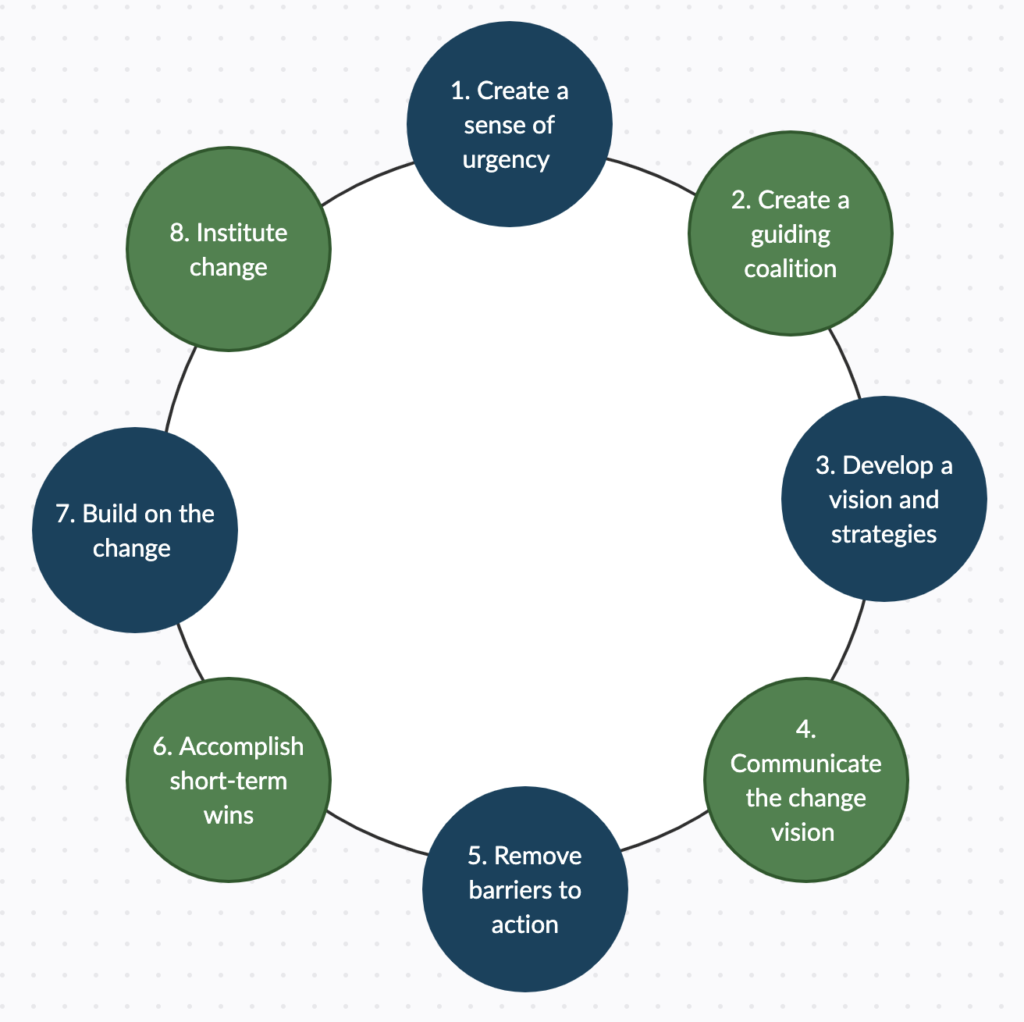
Kotter’s 8-step model is one of the most well-known and widely used change management frameworks. It outlines how to systematically and effectively implement change in an organization.
Dr. John Kotter, a leading expert on change management, introduced his 8-steps change management framework in the 1990s, and it has since become one of the world’s most renowned change models.
In 1996, John Kotter wrote Leading Change, his famous book on change management, in which he detailed a step-by-step model for leading organizational change.
Those steps, according to Dr. Kotter’s institute, have several aims:
Here are the steps in that model:
The process of change should start with establishing a sense of urgency among both managers and employees. Everyone involved should feel the need for change. Without a broad support, it will be difficult to keep the momentum of the change initiative and achieve lasting transformation.
The objective of this step is to prepare the organization for the upcoming change and motivate the employees to offer their contribution.
For this first step to succeed, approximately 75% of the organization’s management should support the change initiative.
Kotter believes that to be successful, a change initiative needs to appeal to both the emotions and the intellect.
The second step of the model focuses on bringing together an effective team with the right skills, qualifications, connections and enough power to influence stakeholders and provide leadership to the efforts.
It should be a cross-functional, diverse team, enabled to work both inside and outside of the traditional hierarchy, and very committed to change.
The Guiding Coalition is, in many ways, the nerve center of the 8-Step Process. It can take many shapes, but must consist of members from multiple layers of the hierarchy, represent many functions, receive information about the organization at all levels and ranks, and synthesize that information into new ways of working.

The objective of this step is to create a vision to achieve change successfully by inspiring and guiding team actions and decisions. It should also define clear and realistic targets to help measure success and engage the company’s stakeholders.
“Vision refers to a picture of the future with some implicit or explicit commentary on why people should strive to create that future. In a change process, a good vision serves three important purposes. First, by clarifying the general direction for change .., it simplifies hundreds or thousand of more detailed decisions. Second, it motivates people to take action in the right direction, even if the initial steps are personally painful. Third, it helps coordinate the actions of different people, even thousands and thousands of individuals, in a remarkably fast and efficient way.” (Leading Change, p. 68-69)
For a vision to be effective, it must be conceivable, desirable, achievable, focused, flexible and communicable. Importantly, an inefficient vision can be more harmful than not having a new vision.

“A great vision can serve a useful purpose even if it is understood by just a few key people. But the real power of a vision is unleashed only when most of those involved in an enterprise or activity have a common understanding of its goal and direction. That shared sense of a desirable future can help motivate and coordinate the kinds of actions that create transformations.” (Leading Change, p. 85)
The vision needs to be shared with those involved. To be successful, they need to be aware of their roles and goals.
This shared sense is what motivates and facilitate the coordination for a major transformation. However, this vision sharing isn’t easy for traditional managers.
Some of the best techniques to facilitate vision communication are simplicity, use of metaphors, analogies and examples, repetition, lead by example, and elimination of inconsistent information.
The goal of effectively communicating the vision is to capture the hearts and minds of the employees; to get them to believe that change is possible and to make sacrifices to support the change.

When implementing organizational changes, obstacles occur frequently. They may come in the form of insufficient processes, resistance to change by employees themselves, disempowering managers, organizational policies, etc.
When this occurs, the guiding coalition and the senior management should work to remove these obstacles that block the organization’s change.
Four main barriers to empowerment that must be eliminated are:
1. Structures: Remove actuation structures that prevent work from being streamlined. Many levels of leadership, for example, can slow down decision making.
2. Skills: Lack of skill is detrimental to development. Provide training for your employees to be 100% qualified.
3. Systems: Correct leadership helps transform the system to align with the new vision.
4. Supervisors: Confront supervisors who are not committed to change, who do not encourage employees, and who are not aligned with the new vision and strategies.
To sustain the effort needed to create a big change, people often need compelling evidence that shows that they are on the right track and that what they are doing is worthwhile. Without this feedback, most people begin to question themselves and what they are doing.
This is why short-term wins are important in a change process.
When we reach those wins, they become fuels for us to continue dedicating ourselves. They reaffirms vision and strategies and prove that our sacrifice is worthwhile, giving us needed positive feedback and keeping the teams united and dedicated to the goals.
Going for a long time without any victories to celebrate may discourage employees.
A short-term win is an improvement that can be implemented within a short period of time. Such win should be highly visible throughout the organization, unambiguous, and related to the change initiative.
In a long process of transformation, the sense of urgency may eventually be lost. Complacency may increase, and old habits and traditions may return to work.
Resistance to change never completely disappears, and progress can fail quickly for two reasons: the corporate culture and the high interdependence created.
The transformation takes place in a series of projects and these projects are made of other smaller projects. With the proper leadership and management, goals can be achieved and excess interdependence diminish.
With less interdependence and more autonomy, decision making speed increases, which makes projects complete faster and transformation becomes more real.
Change must be gradual, and new practices cannot be implemented all at once. This is why culture transformation comes at the end of the transformation.
It’s important to make sure that the team doesn’t declare victory prematurely after a few quick wins.
To continue the momentum of change,
“In many transformation efforts, the core of the old culture is not incompatible with the new vision, although some specific norms will be. In that case, the challenge is to graft the new practices onto the old roots while killing off the inconsistent pieces.” (Leading Change, p. 151)
In this final step, the change leaders work on nurturing a new culture where change can become permanent. This includes changing not only organizational norms and values, but also processes, reward systems, and other infrastructure elements to align everything with the new direction.
In 2014, responding to the changing needs of the business world, Dr. Kotter and his team released a newer version of the 8-step process for accelerating change.
This new model has different objectives:
Both versions of the model are still relevant. They are just designed for different use cases, circumstances, and objectives.
For example, an organization that operates with a traditional hierarchy and wants to implement change linearly will probably use the earlier model, while an organization with a flat hierarchy who wants to continuously implement change will probably use the newer model.
From Kotter’s website:
John Paul Kotter is the Konosuke Matsushita Professor of Leadership, Emeritus, at the Harvard Business School, an author, and the founder of Kotter International, a management consulting firm based in Seattle and Boston. He is a thought leader in business, leadership, and change.
His best-selling book “Leading Change” which discusses mistakes organizations often make when implementing change and an eight-step process for successfully bringing about change, is often referred to by managers as the bible of change across the world.
“Most US corporations today are over-managed and under-led. They need to develop their capacity to exercise leadership.” — John P. Kotter
“Leadership is about setting a direction. It’s about creating a vision, empowering and inspiring people to want to achieve the vision, and enabling them to do so with energy and speed through an effective strategy. In its most basic sense, leadership is about mobilizing a group of people to jump into a better future.” — John P. Kotter
“Leaders establish the vision for the future and set the strategy for getting there.” — John P. Kotter
“The rate of change is not going to slow down anytime soon. If anything, competition in most industries will probably speed up even more in the next few decades.” — John P. Kotter
“Leadership is about coping with change” — John P. Kotter
“Effective leaders help others to understand the necessity of change and to accept a common vision of the desired outcome.” — John P. Kotter
“One of the most common ways to overcome resistance to change is to educate people about it beforehand. Communication of ideas helps people see the need for and the logic of a change. The education process can involve one-on-one discussions, presentations to groups, or memos and reports.” — John P. Kotter
Change Leadership: John Kotter’s 8-Step Model
“Leaders establish the vision for the future and set the strategy for getting there; they cause change. They motivate and inspire others to go in the right direction and they, along with everyone else, sacrifice to get there.” — John P. Kotter
“Leadership defines what the future should look like, aligns people with that vision, and inspires them to make it happen despite the obstacles.” — John P. Kotter
“A leader needs enough understanding to fashion an intelligent strategy.” — John P. Kotter
“We know that leadership is very much related to change. As the pace of change accelerates, there is naturally a greater need for effective leadership.” — John P. Kotter
“Good communication does not mean that you have to speak in perfectly formed sentences and paragraphs. It isn’t about slickness. Simple and clear go a long way.” — John P. Kotter
“Because management deals mostly with the status quo and leadership deals mostly with change, in the next century we are going to have to try to become much more skilled at creating leaders.” — John P. Kotter
“Motivation and inspiration energize people, not by pushing them in the right direction as control mechanisms do but by satisfying basic human needs for achievement, a sense of belonging, recognition, self-esteem, a feeling of control over one’s life, and the ability to live up to one’s ideals. Such feelings touch us deeply and elicit a powerful response.” — John P. Kotter
“People are more inclined to be drawn in if their leader has a compelling vision. Great leaders help people get in touch with their own aspirations and then will help them forge those aspirations into a personal vision.” — John P. Kotter
“What’s really driving the boom in coaching, is this: as we move from 30 miles an hour to 70 to 120 to 180……as we go from driving straight down the road to making right turns and left turns to abandoning cars and getting motorcycles…the whole game changes, and a lot of people are trying to keep up, learn how not to fall.” — John P. Kotter
“Over the years I have become convinced that we learn best – and change – from hearing stories that strike a chord within us … Those in leadership positions who fail to grasp or use the power of stories risk failure for their companies and for themselves.” — John P. Kotter
“In terms of getting people to experiment more and take more risk, there are at least three things that immediately come to my mind. Number one, of course, is role-modeling it yourself. Number two is when people take intelligent, smart risks and yet it doesn’t work out, not shooting them. And number three, being honest with yourself. If the culture you have is radically different from an experiment and take-risk culture, then you have a big change you going to have to make—and no little gimmicks are going to do it for you.” — John P. Kotter
“In the final analysis, change sticks when it becomes the way we do things around here.” — John P. Kotter
“Many years ago, I think I got my first insight on how an incredibly diverse team can work together and do astonishing things, and not just misunderstand each other and fight.” — John P. Kotter
“Good communication is not just data transfer. You need to show people something that addresses their anxieties, that accepts their anger, that is credible in a very gut-level sense, and that evokes faith in the vision.” — John P. Kotter
“Great vision communication usually means heartfelt messages are coming from real human beings.” — John P. Kotter
“In a change effort, culture comes last, not first.” — John P. Kotter
“A culture truly changes only when a new way of operating has been shown to succeed over some minimum period of time.” — John P. Kotter
“Outsiders have the intuitive ability to continually view problems in fresh ways and to identify ineffective practices and traditions.” — John P. Kotter
“Overcoming complacency is crucial at the start of any change process, and it often requires a little bit of surprise, something that grabs attention at more than an intellectual level. You need to surprise people with something that disturbs their view that everything is perfect.” — John P. Kotter
“Anyone in a large organization who thinks major change is impossible should probably get out.” — John P. Kotter
“A higher rate of urgency does not imply ever-present panic, anxiety, or fear. It means a state in which complacency is virtually absent.” — John P. Kotter
“Changing behavior is less a matter of giving people analysis to influence their thoughts than helping them to see a truth to influence their feelings.” — John P. Kotter
“Effective leaders help others to understand the necessity of change and to accept a common vision of the desired outcome.” — John P. Kotter
“Great leaders understand that historical success tends to produce stable and inwardly focused organizations, and these outfits, in turn, reinforce a feeling of contentment with the status quo.” — John P. Kotter
“I’m impatient. Typically people think they know all about change and don’t need help. Their approach tends to be more management-oriented than leadership-oriented. It’s very frustrating.” — John P. Kotter
“In an ever changing world, you never learn it all, even if you keep growing into your 90s.” — John P. Kotter
“Leaders establish the vision for the future and set the strategy for getting there; they cause change. They motivate and inspire others to go in the right direction and they, along with everyone else, sacrifice to get there.” — John P. Kotter
“Leadership defines what the future should look like, aligns people with that vision, and inspires them to make it happen despite the obstacles.” — John P. Kotter
“Leadership is about setting a direction. It’s about creating a vision, empowering and inspiring people to want to achieve the vision, and enabling them to do so with energy and speed through an effective strategy.” — John P. Kotter
“Low lights signal to our senses that the workday may be over and it’s time for sleep, making it hard for an audience to pay careful attention.” — John P. Kotter
“Managers are trained to make incremental, programmatic improvements. They aren’t trained to lead large-scale change.” — John P. Kotter
“Neurologists say that our brains are programmed much more for stories than for abstract ideas. Tales with a little drama are remembered far longer than any slide crammed with analytics.” — John P. Kotter
“People change what they do less because they are given an analysis that shifts their thinking than because they are shown a truth that influences their feelings.” — John P. Kotter
“Producing major change in an organization is not just about signing up one charismatic leader. You need a group – a team – to be able to drive the change.” — John P. Kotter
“The central issue is never strategy, structure, culture, or systems. The core of the matter is always about changing the behavior of people.” — John P. Kotter
“The vast majority of large scale change efforts fail. Which means that the probability that you have actually experienced a failure, and your people know that and are pessimistic, therefore, about trying something again, is very high.” — John P. Kotter
“The world has 6 billion people and counting. We need to help 500 million people become better leaders so that billions can benefit.” — John P. Kotter
“Tradition is a very powerful force.”
“We are always creating new tools and techniques to help people, but the fundamental framework is remarkably resilient, which means it must have something to do with the nature of organizations or human nature.” — John P. Kotter
“We worry about appearing awkward in a presentation. But up to a point, most people seem to feel more comfortable with less-than-perfect speaking abilities.” — John P. Kotter
“Without credible communication, and a lot of it, the hearts and minds of others are never captured.” — John P. Kotter
John Paul Kotter is the Konosuke Matsushita Professor of Leadership, Emeritus, at the Harvard Business School, an author, and the founder of Kotter International, a management consulting firm based in Seattle and Boston. He is a thought leader in business, leadership, and change.
In 2008, he co-founded Kotter International where he currently serves as Chairman. The business consultancy firm applies Kotter’s research on leadership, strategy execution, transformation, and any form of large-scale change.
Since early in his career, Kotter has received numerous awards for his thought leadership in his field from Harvard Business Review, Bloomberg BusinessWeek, and others.
Kotter has authored 19 books. Leading Change (Harvard Business School Press, 1996), which Time selected as one of the 25 most influential business management books ever written, The Heart of Change (with Dan S. Cohen; Harvard Business School Press, 2002), and A Sense of Urgency (Harvard Business Press, 2008) detail and explore his change leadership process.
Kotter also teamed up with Holger Rathgeber and wrote a business parable featuring penguins, Our Iceberg Is Melting (St. Martin’s Press, 2005). Kotter’s latest book, That’s Not How We Do It Here! (Penguin, 2016), is another parable written with Rathgeber.

I have found an interesting article written by Michael Simmons. This is the link to the full article.
Here I share only some of his interesting comments. If you like what you read, go for the full article.
“The greatest CEOs that we ever studied manage for the quarter… century.” ― Jim Collins
According to Simmons, self-made billionaire entrepreneurs like Jeff Bezos, Bill Gates, Warren Buffett, Ray Dalio, and Elon Musk “see in 4D while most people see in 1D:”

Where almost all public company CEOs, not to mention people in general, plan days, weeks, and months ahead, these visionaries think decades or even centuries into the future. And they don’t just plan: They put their money where their mouths are. They make bold bets that won’t pay off anytime soon — and that have a high probability of failure.
Take this Jeff Bezos interview where he makes a very surprising proclamation:
I believe on the longest time frame — and really here I’m thinking of a timeframe of a couple of hundred years — I get increasing conviction with every passing year, that Blue Origin, the space company, is the most important work I’m doing.
Explaining why his space company will be more important than Amazon in the future, he says…
I’m pursuing this work [with Blue Origin] because if we don’t, we will eventually end up with a civilization of stasis, which I find very demoralizing. I don’t want my great grandchildren’s great grandchildren to live in a civilization of stasis.
According to Bezos, the cause of the stasis is an upcoming energy crisis…
But for Bezos here, the word ‘upcoming’ means a few hundred years from now.
As soon as you read these words, you start to realize that Bezos is coming from an entirely different paradigm…
A long-term time horizon is the “decoder” that makes Amazon’s iconoclastic strategy over the years make sense.
Without long-term thinking, Amazon would never have:
But Bezos isn’t alone.
Sam Altman, the former president of Y Combinator, the largest startup accelerator in the world, refers to long-term thinking as “one of the few arbitrage opportunities left in the market.” He adds, “When you’re thinking about a startup, it’s really worthwhile to think about something you’re willing to make a very long-term commitment to because that is where the current void in the market is.”
Warren Buffett is famous for only investing in companies and individuals he could see himself investing in for decades into the future. He has built his whole career on the power of compound interest and compound learning. He has purposely kept his lifestyle expenses low so that his money could compound. In addition, he has spent 80% of his time reading and thinking for his entire career.
In a TED interview, Elon Musk shows that he also thinks about time differently than almost everybody…
I look at the future from a standpoint of probabilities. It’s like a branching stream of probabilities. And there are actions that we can take that effect those probabilities or that accelerate one thing or slow down another thing, introduce something new to the probability stream.
“If everything you do needs to work on a three-year time horizon, then you’re competing against a lot of people. But if you’re willing to invest on a seven-year time horizon, you’re now competing against a fraction of those people because very few companies are willing to do that. Just by lengthening the time horizon, you can engage in endeavors that you could never otherwise pursue.” ― Jeff Bezos
The biggest innovation opportunities take many years to pay off and have low odds of success. Therefore, many traditional CEOs don’t pursue them. This means that Bezos, Musk, and others have less competition for super high-quality investments. This approach has given Amazon, Tesla, and SpaceX several-year huge head starts against other companies.
In other words:
Long-term thinking supports the failure and iteration required for invention, and it frees us to pioneer in unexplored spaces. Seek instant gratification — or the elusive promise of it — and chances are you’ll find a crowd there ahead of you. — Jeff Bezos
In Time Paradox, one of the most recognized psychologists of all time, Stanford professor Philip Zimbardo, concluded that our attitudes toward time have a profound impact on our lives that we seldom recognize. Our time horizons are as invisible to us as water is to fish, but they have everything to do with how we make decisions and how successful we are.
After surveying more than 10,000 people with the Zimbardo Time Perspective Inventory, Zimbardo found that attitudes toward time fall into five categories:
Each of these mindsets is like living in a different world, but…
Future-oriented people tend to be more successful professionally and academically, to eat well, to exercise regularly, and to schedule preventative doctor’s exams. The mantra of a Future is “meet tomorrow’s deadline, complete all the necessary work before tonight’s play.” Futures consider work a source of special pleasure. Tomorrow’s anticipated gains and losses fuel today’s decisions and actions.
When challenged to solve maze puzzles as quickly as they could, present-oriented people responded very differently from future-oriented ones.
The Presents started immediately from the start, moving their pencils through the maze. The Futures did not move at all at first, looking for the goal, then working backwards to the starting point, checking out dead ends along the route. The Futures always won.
Bottom line: Our “time horizons” determine our decisions. Decisions determine our destiny.
Einstein famously called compound interest the eighth wonder of the world. Warren Buffett said that compound interest was one of the top three factors that led to his success.
If we do the right things consistently over a long period of time, the future we want becomes more and more inevitable because our actions compound upon one another over time.
Just as a small snowball being rolled down the hill slowly picks up snow with each rotation and becomes a huge one:
Or how a tiny domino can eventually knock over a huge one if you give the momentum time to compound upon itself:
With both the snowball and the dominoes, the ending is inevitable.
In a TED talk, the late and renowned Harvard Professor Clayton Christensen shares a story that perfectly captures the situation:
As Christensen tells it, when he graduated from Harvard Business School, all of his classmates had ambitious plans to make an impact and be successful. At their early class reunions, everything seemed like it was on track. People were sharing all of their successes.
However, as time passed by, he noticed something surprising. People’s lives got worse and worse on many levels:
Christensen explains why:
Everyone here is driven to achieve. And when you have an extra ounce of energy or an extra 30 minutes of time, instinctively and unconsciously you’ll allocate it to whatever activities in your life give you the most immediate evidence of achievement.
In other words, his classmates got stuck in short-term thinking.
Similarly:
The reason why successful companies fail is that they invest in things that provide the most immediate and tangible evidence of achievement. And the reason why they have such a short time horizon is that they are run by people like you and I [people focused on achievement].
To have the largest impact in the long-term, we necessarily must go slower in the short-term.

The last of the 21 Irrefutable Laws of Leadership by John Maxwell is the Law of Legacy.
According to John Maxwell, the most important question you can ask yourself as a leader might surprise you and is: “What do you want people to say at your funeral?”
As Maxwell says, “a leader’s lasting value is measured by succession.” The accurate measure of your legacy lies in how well you influence the people you leave behind. Your aim should always be to make an intentional impact on future generations of leaders at your organization. Here’s why what you leave behind is just as important as what you accomplish in your organization.
John Maxwell introduces the Law of Legacy with the story of the untimely death of Roberto Goizueta, CEO of Coca-Cola:
In 1997, one of the finest business leaders in the world died. His name was Roberto Goizueta, and he was the chairman and chief executive of the Coca-Cola Company… Making Coca-Cola the best company in the world was Goizueta’s lifelong quest, one he was still pursuing diligently when he suddenly, unexpectedly died. Companies that lose a CEO often go into turmoil, especially if his departure is due to an unexpected death, such as Goizueta’s. Shortly before his death, Goizueta said in an interview with the Atlanta Journal-Constitution that retirement was “not on my radar screen. As long as I’m having the fun I’m having, as long as I have the energy necessary, as long as I’m not keeping people from their day in the sun, and as long as the board wants me to stay on, I will stay on.” Just months after the interview, he was diagnosed with cancer. Six weeks later, he was dead.
THE LEGACY LEFT TO THE COMPANY BY GOIZUETA IS INCREDIBLE. WHEN HE TOOK OVER COCA-COLA IN 1981, THE COMPANY’S VALUE WAS $4 BILLION. UNDER GOIZUETA’S LEADERSHIP, IT ROSE TO $150 BILLION. THAT’S AN INCREASE IN VALUE OF MORE THAN 3,500 PERCENT! COCA-COLA BECAME THE SECOND MOST VALUABLE CORPORATION IN AMERICA,
But high stock value wasn’t the most significant thing Goizueta gave to the Coca-Cola company. Instead it was the way he lived the Law of Legacy. When the CEO’s death was announced, there was no panic among Coca-Cola stockholders. Paine Webber analyst Emanuel Goldman said that Goizueta “prepared the company for his not being there as well as any executive I’ve ever seen.”
The natural progression of leadership, according to Maxwell, is:
The great management guru Peter Drucker once said, “There is no success without a successor.” In other words, lasting achievement is really only achieved if it continues after we’re gone.
Our ability as leaders will not be measured only by what we do or what we build, but also by how well the people we invested in carried on after we are gone.
Just about anybody can make an organization look good for a moment —by launching a flashy new program or product, drawing crowds to a big event, or slashing the budget to boost the bottom line. But leaders who leave a legacy take a different approach. They lead with tomorrow as well as today in mind. They plan to keep leading as long as they are effective, yet they prepare his successor anyway. They always look out for the best interests of the organization and its stockholders. (John C. Maxwell)
Here are five simple yet actionable ideas for preparing your successor:
Accept the fact that you’re not indispensable. The more you act like you are, the more likely you’ll be trapped in your job and leave your organization unprepared for the future that will inevitably come. That’s the glass half empty perspective on it. The glass half full point of view is that if you develop the next generation of leaders, you’ll create more opportunities for yourself and the organization. Preparing strong leaders is how you leave a legacy that outlasts your time in your current leadership role.
Identify the handful of “A” players on your team that show the capacity to get results while building the relationships that make the results sustainable over the long run. Once you’ve identified some high potential candidates, take the next step and identify the experiences they’ll need to be well rounded leaders at the next level.
Include those high potential leaders in conversations and meetings that will expose them to people and issues that they haven’t had a lot of experience with in the past.Stretch your succession candidates by giving them special project assignments or jobs that round out their experience base. If they’ve been the “inside” people previously, put them in roles that will expose them to external constituencies. If they’ve been more focused on the external aspects of the business, give them assignments that will build their operational muscles.
Coach them in their development by asking questions that help them debrief what they’re learning from experience and help them game plan for what’s coming up. If you don’t have the time or inclination to coach them yourself, find someone either external or internal to the organization who is capable of playing that role. Whatever you do, don’t just throw them into the deep end of the pool with no support. Your goal is to develop leaders, not to debilitate them. (Joe Nocera, Talking Business)
The book is divided in 21 main chapters, one for each of the 21 leadership laws. Below are the links to the individual chapters.
ON AMAZON: The 21 Irrefutable Laws of Leadership

The Law of Explosive Growth is the 20th of the 21 Irrefutable Laws of Leadership by John C. Maxwell and it states that: “to add growth, lead followers; to multiply growth, lead leaders.”
According to John C. Maxwell, you can grow by leading followers. But if you want to maximize your leadership and help your organization reach its potential, you need to develop leaders. There is no other way to experience explosive growth.
Leaders who attract followers, but never develop leaders, get tired. Being able to impact only those who you can touch personally is very limiting.
In contrast, leaders who develop leaders impact people far beyond their personal reach. Every time you develop leaders and help them increase their leadership ability, you make them capable of influencing an even greater number of people.
Many leaders are impatient because they want to achieve their vision. However, other people in the organization aren’t always on the same page. How do they close the gap between where they want their team to be and where they are?
Maxwell believes that the answer lies in the Law of Explosive Growth. He writes that there are three critical stages in the leadership journey: leaders can develop themselves and experience personal success; they can grow a team, and their organization will experience growth; or they can develop leaders, so that their organization can achieve explosive growth.
Becoming a great leader is about more than attracting followers. Leaders need to spend time developing other leaders and encouraging strong employees in your company to grow.
In his chapter on the Law of Explosive Growth, John Maxwell writes, “Good leaders lead for the sake of their followers and for what they can leave behind after their time of leadership is completed.” While it’s nice to feel personally needed, leaders limit the potential of their company if they don’t train other leaders in your organization.
If they spend time developing other influential leaders to carry the weight, their company will last longer.
Maxwell explains in The Law of Explosive Growth that usually are the weakest members of the organization that require the most time and attention. If leaders focus on that bottom 20%, they’ll spend 80% of their time trying to help them. However, if they use that time to develop their top 20% of employees instead, their leadership can help carry the weaker employees so that everyone improves overall.

To go to the highest level, you have to develop leaders of leaders…”some leaders want to make followers. I want to make leaders. Not only do I want to make leaders, but I want to make leaders of leaders. And then leaders of leaders of leaders.” Once you are able to follow that pattern, there is almost no limit to the growth of your organization. That’s why I say to add growth, lead followers, but to multiply growth, lead leaders. That’s the Law of Explosive Growth.
BECOMING A LEADER WHO DEVELOPS LEADERS REQUIRES AN ENTIRELY DIFFERENT FOCUS AND ATTITUDE FROM THOSE OF A DEVELOPER OF FOLLOWERS. CONSIDER SOME OF THE DIFFERENCES:
LEADERS WHO DEVELOP FOLLOWERS
LEADERS WHO DEVELOP LEADERS
Developing leaders is difficult because potential leaders are harder to find and attract. They’re also harder to hold on to once you find them because they are energetic and want to grow. Developing leaders is hard work but it’s vital for an organization.
The book is divided in 21 main chapters, one for each of the 21 leadership laws. Below are the links to the individual chapters.
ON AMAZON: The 21 Irrefutable Laws of Leadership

When men or women become leaders only because they desire power or wealth, the consequences for their organizations in the long term are always negative. It happens with CEOs, leaders of political parties, religious organization, countries, and so on. The only way to achieve sustainable success is if the leader is willing to make personal sacrifices for the good of the organization.
John Maxwell describes one of the most incredible turnarounds in American business history to demonstrate the Law of Sacrifice. It is about the Chrysler Corporation in the early 1980s, when Chrysler was in a mess. At one point, in its history, Chrysler had captured 25 percent of the entire domestic automobile market.

The company remained fairly strong through the 1960s, but by the 1970s, the company was declining rapidly. in 1978, its market share was down to 11 percent and the organization was headed for bankruptcy.
Then in November 1978, Chrysler chose a new CEO, Lee Iacocca. In 1970, Iacocca had become the president of the Ford Motor Company, the highest leadership position possible under Chairman Henry Ford II. When he left in 1978, the company was earning record profits.
Iacocca accepted the job with Chrysler, but it required many personal sacrifices. The salary he accepted at Chrysler was a little over half what he had earned as the president of Ford. The next sacrifice came in his family life. To lead Chrysler, Iacocca had to work almost around the clock. Finally, to gather support in U.S. Congress for federally guaranteed loans, and to persuade suppliers, dealers and union workers to make sacrifices to overcome the challenges that Chrysler was facing, Iacocca ended up cutting his salary to $1 a year.

While this example of sacrifice is what John Maxwell describes in his book, I can think of many other leaders who sacrificed a lot more than Iacocca, even their own lives. People like Abraham Lincoln, Martin Luther King, or Jesus the Christ, the greatest of all leaders. But the principle stands true: you have to give up to go up, because the true nature of leadership is really sacrifice (And the greatest unselfish leaders don’t even worry too much about “going up”).
SACRIFICE IS A CONSTANT IN LEADERSHIP. IT IS AN ONGOING PROCESS, NOT A ONE-TIME PAYMENT

John Maxwell writes about four critical aspects of the Law of Sacrifice:
1. There is no success without sacrifice. If we think about some of life’s greatest achievements, things like graduating from college, a successful marriage and family, a brilliant career, and so on, we realize that each off these achievements comes with an equally huge amount of sacrifice. To achieve success, people need to put in long hours and efforts, and sometimes even give up the comforts of a normal life to reach their goals.
2. Leaders are often asked to give up more than others. Maxwell writes, “The heart of leadership is putting others ahead of yourself.” When you have no responsibilities, you can mostly do whatever you want. However, the higher you move up the leadership ladder, the more responsibilities you acquire and the more sacrifices you must make to be an effective leader.
3. You must keep giving up to stay up. Short-term sacrifices are easier to make, but in order to continue growing as a leader, we must continue to make sacrifices. As Maxwell says, “Leadership success requires continual change, constant improvement, and ongoing sacrifice.”
4. The higher the level of leadership, the higher the sacrifice. The Law of Sacrifice demands that the greater the leader, the more he must give up. Think about someone like Martin Luther King Jr. His wife, Coretta Scott King, remarked in My Life with Martin Luther King, Jr., “Day and night our phone would ring, and someone would pour out a string of obscene epithets … Frequently the calls ended with a threat to kill us if we didn’t get out of town. In spite of all the danger, the chaos of our private lives, I felt inspired, almost elate.
The book is divided in 21 main chapters, one for each of the 21 leadership laws. Below are the links to the individual chapters.
ON AMAZON: The 21 Irrefutable Laws of Leadership

“When we are busy, we naturally believe that we are achieving. But busyness does not equal productivity.”
The Law of of Priorities is the seventeenth of the 21 Irrefutable Laws of Leadership by John C. Maxwell.
Our schedule might be full, but if it’s not full of the right things to do, we might be wasting time.
The Law of Priorities states that activity is not necessarily accomplishment.
In the book, The 21 Irrefutable Laws of Leadership, John Maxwell shares the story of why he relocated from San Diego, one of his favorite places, to Atlanta, not the greatest place for him, but a major airline hub.
At that point in his life, living in San Diego was not very productive for John Maxwell. He then decided to relocate, because instead of comfort he wanted more progress in his career.
What about us? Are we choosing comfort over progress?
Many people are taking time management classes but they still have a hard time trying to get the right things done. This because they may be breaking the Law of Priorities.
And truly we cannot really manage time, because time move forward inexorably and we cannot stop it. We can only control how we use it.
Leaders always need to prioritize, whether they’re leading a small group, running a small business, or leading a billion-dollar corporation.
To be an effective leader, you must constantly reevaluate your priorities—your schedule, your commitments, your family life, your goals, your values—to determine what is important.
The best leaders seem to be able to get the Law of Priorities to work for them by satisfying multiple priorities with each activity. This actually enables them to increase their focus while reducing their number of actions
You can use the Pareto Principle to help you decide what are your priorities. This principle, when applied to this situation, shows that if you focus on the 20% most important activities you will have an 80% return on your effort.
The three Rs are requirement, return, and reward. To be effective, according to John C. Maxwell, leaders should order their lives according to these three questions:
These are questions you should ask yourself: “What is required?” “What gives the greatest return?” and “What brings the greatest reward?”
What must I do that nobody else can do for me?
The first thing you want to prioritize is what is required of you. We are all accountable to somebody for the work we do and the question we want to ask ourselves is: what must I do that nobody else can do for me? If we’re doing something that is not absolutely necessary, we should probably eliminate it. If we’re doing something that is necessary but that someone else could do, then we should delegate it.
Just because you can do something doesn’t mean you should do it
After figuring out what we must do that nobody else can do for us, we should list what gives us the greatest return.
As a leader, we should spend most of our time working in our areas of greatest strength. If what we are doing can be done 70-80 percent as well by someone else, then we will be better off delegating it.
If you identify a responsibility that someone else could do, consider developing and training a person to take care of it.
Last, we need to prioritize what brings the greatest reward.
The older we become, the more we realize that life is too short not to do something you love. It is frustrating to work in a job that you don’t like only to pay bills and keep going. There are times when survival is all we can do, but we should try to have a higher purpose and be satisfied with our job.
No matter what else you do, I urge you to make time for what you love, it is important for your personal satisfaction.
Find time to do what you love. Find time to do something you are passionate about. If you cannot do it as a hobby, then do it in the evening. If nobody pays you t do it, do it as a volunteer. The most important thing is that you prioritize what gives you a personal satisfaction.
It is time to reignite your passion, recharge your dreams, and refocus your life. To do that you have to reorder your priorities.
Activity is not necessarily accomplishment. That is the Law of Priorities.
The book is divided in 21 main chapters, one for each of the 21 leadership laws. Below are the links to the individual chapters.
ON AMAZON: The 21 Irrefutable Laws of Leadership

The Law of the Big Mo is the sixteenth of the 21 Irrefutable Laws of Leadership by John C. Maxwell and it states that:
All leaders face the challenge of creating change in an organization. The key is momentum—what I call the Big Mo. Just as every sailor knows that you can’t steer a ship that isn’t moving forward, strong leaders understand that to change direction, you first have to create forward progress—and that takes the Law of the Big Mo. (John C. Maxwell)
Momentum can be defined as “mass in motion.” All objects have mass; so if an object is moving, then it has momentum – it has its mass in motion. The amount of momentum that an object has is dependent upon two variables: how much stuff is moving and how fast the stuff is moving.
For example, a bowling ball (large mass) moving very slowly (low velocity) has less momentum that the same bowling ball moving faster, but it may have the same momentum as a baseball (small mass) that is thrown fast (high velocity).
Starting something new is hard, but remember: wherever there is motion, there is momentum. Motion drives actions and actions drive momentum. It’s a vicious cycle.
Do you have the Big Mo on your side? John Maxwell writes in The 21 Irrefutable Laws of Leadership that “momentum is a leader’s best friend.”
When you have no momentum even the simplest tasks feel impossible and you feel stuck and overwhelmed by failure. Like a train at a dead stop, it’s hard to get moving again.
In contrast, “an organization with momentum is like a train that’s moving at sixty miles per hour. You could build a steel-reinforced concrete wall across the tracks, and the train would plow right through it.” If you can create momentum, you can achieve anything.

When things are going well, momentum makes them even better. When things aren’t going well, momentum makes them seem worse. Momentum is like magnifying glass.
When they’re winning, people are willing to overlook the leader’s shortcomings and forget about their past mistakes.
When leadership is strong and there is momentum in an organization, people are motivated and inspired to perform at higher levels. The Law of Big Mo boosts everyone’s success.
Getting started takes effort and time. But once you’re moving forward, things get easier. The Law of Big Mo tells you that while it’s hard to get going, once you’re moving, you can control more easily where you are going.
With enough momentum, almost any change is possible. People trust leaders with a proven track record and they accept more easily hanges from people who have led them to success before.
To create momentum you need a vision, a good team, and motivation. It is the leader’s responsibility to initiate momentum and keep it going.
Momentum begins within the leader’s vision, passion, and energy. Energy and enthusiasm attracts like-minded people. When the leader motivate his people to achieve, the momentum grows and the belief becomes contagious.
“One way to keep momentum going is to have constantly greater goals” — Michael Korda
The book is divided in 21 main chapters, one for each of the 21 leadership laws. Below are the links to the individual chapters.
ON AMAZON: The 21 Irrefutable Laws of Leadership

The Law of of Victory is the fifteenth of the 21 Irrefutable Laws of Leadership by John C. Maxwell.
LEADERS FIND A WAY FOR THE TEAM TO WIN
“Every leadership situation is different. Every crisis has its own challenges. But I think that victorious leaders share an inability to accept defeat. The alternative to winning seems totally unacceptable to them, so they figure out what must be done to achieve victory, and then they go after it with everything at their disposal. ” – John C. Maxwell

For example, Abraham Lincoln never forgot that the nation’s victory was his highest priority, and that it was more important than his pride, reputation, and personal comfort. This is why he surrounded himself with the best leaders possible, empowered his generals, and was never afraid to give others the credit for the victories the Union gained.
“Jefferson Davis, on the other hand, never seemed to make victory his priority. When he should have been thinking like a revolutionary, he worked like a bureaucrat. When he should have been delegating authority and decision making to his generals—the best in the land—he spent his time micromanaging them. And worst of all, he was more concerned with being right than with winning the war.” -John C. Maxwell

“Crisis seems to bring out the best—and the worst—in leaders.
British prime minister Winston Churchill and U.S. President Franklin Roosevelt during World War II prevented Adolf Hitler from conquering Europe entirely.
Winston Churchill inspired the British people to resist Hitler. Long before he became prime minister in 1940, Churchill spoke out against the Nazis, and he continued to speak out against them, even when Prime Minister Neville Chamberlain and the other leaders of Great Britain did not make a stand against him.
By mid-1940, when most of Europe was under Germany’s power, Winston Churchill became England’s Prime Minister. He refused to give in to the Nazis’ threats, and for more than a year, Great Britain stood alone facing the threat of German invasion. Churchill defied Hitler, and when Germany began bombing England, Churchill inspired the British to remain strong.
“And all the while, Churchill looked for a way to gain victory. CHURCHILL WOULD ACCEPT NOTHING LESS.”
Similarly to Churchill, Franklin Roosevelt had already been practicing the law of victory for decades. He had found a way to achieve political victory while winning over polio and he later pulled the American people out of the great depression.

“Just as the prime minister had rallied England, the president brought together the American people and united them in a common cause as no one ever had before or has since. “
“When the pressure is on, great leaders are at their best.”
Whatever the team or organization, victory is possible as long as you have three components:
Teams succeed only when the players have a unified vision, no matter how much talent or potential there is.
A team or organization needs diversity of skills. A football team cannot have only quarterbacks.
You need leadership to achieve victory. Unity of vision and the building of a team with diversity of talent require a leader, who also need to provide the motivation, empowerment, and direction required to win.
Leaders who practice the Law of Victory believe that anything less than success is unacceptable. And they have no Plan B. That keeps them fighting.
The book is divided in 21 main chapters, one for each of the 21 leadership laws. Below are the links to the individual chapters.
ON AMAZON: The 21 Irrefutable Laws of Leadership