TOP QUOTES

Top 22 Quotes from When: The Scientific Secrets of Perfect Timing By Daniel H. Pink

Daniel H. Pink (born July 23, 1964) is an American author. Four of his books have been featured on the New York Times bestsellers’ list. He was host and co-executive producer of the 2014 National Geographic Channel social science TV series Crowd Control.

His books include the long-running New York Times bestsellers When and A Whole New Mind — as well as the #1 New York Times bestsellers Drive and To Sell is Human. Dan’s books have won multiple awards, have been translated into 40 languages, and have sold more than three million copies. He lives in Washington, DC, with his family.

When: The Scientific Secrets of Perfect Timing

In When: The Scientific Secrets of Perfect Timing Pink sets out to “unearth the hidden science of timing” – to uncover it as a significant but unrecognized player in our lives. He highlights a study of Danish schoolchildren that found that those who took their yearly standardized test in the morning performed better than those who took it in the afternoon. Because of the afternoon slump, you should always try to schedule a doctor’s appointment early in the day.

What can help reduce the slumps are breaks. For example, judges rule in favor of prisoners about 65 percent of the time early in the day, but by late morning, that rate drops to nearly zero. However, after judges take a break, they become more forgiving again.

For teenagers things are different, however. Their changing circadian rhythm make them night owls. This is why early school start times are particularly challenging for them.

Overall, When: The Scientific Secrets of Perfect Timing is a relatively short book with 7 chapters spread across three sections.

The first section covers diurnal patterns like how to arrange our daily life, the benefits of micro naps, etc. The second section covers long terms patterns — how do we start habits, how we are influenced by beginnings and endings, how to deal with mid-life crises, etc. The last section covers how to get into harmony with timings.

Each chapter is also followed by a time hacking section which has practical advice on timing.

Top 22 Quotes from When: The Scientific Secrets of Perfect Timing By Daniel H. Pink

“Afternoons are the Bermuda Triangles of our days. Across many domains, t he trough represents a danger zone for productivity, ethics, and health.”― Daniel H. Pink

“Decisions and negotiations, should be conducted earlier in the day” ― Daniel H. Pink

“If we stick with a task too long, we lose sight of the goal” ― Daniel H. Pink

“If you want a happy ending, that depends, of course, on where you stop your story. —ORSON WELLES” ― Daniel H. Pink

“The typical worker reaches the most unproductive moment of the day at 2:55 p.m.” ― Daniel H. Pink,

“Elite performers have something in common: They’re really good at taking breaks” ― Daniel H. Pink

“Until about ten years ago, we admired those who could survive on only four hours of sleep and those stalwarts who worked through the night. They were heroes, people whose fierce devotion and commitment revealed everyone else’s fecklessness and frailty. Then, as sleep science reached the mainstream, we began to change our attitude. That sleepless guy wasn’t a hero. He was a fool. He was likely doing subpar work and maybe hurting the rest of us because of his poor choices. Breaks are now where sleep was then. Skipping lunch was once a badge of honor and taking a nap a mark of shame. No more. The science of timing now affirms what the Old World already understood: We should give ourselves a break.” ― Daniel H. Pink

“Psychological detachment from work, in addition to physical detachment, is crucial” ― Daniel H. Pink

“Temporal landmarks slow our thinking, allowing us to deliberate at a higher level and make better decisions” ― Daniel H. Pink

“If you’re an educator, know that all times are not created equal:” ― Daniel H. Pink

“High performers, its research concludes, work for fifty-two minutes and then break for seventeen minutes.” ― Daniel H. Pink

“The best endings don’t leave us happy. Instead, they produce something richer—a rush of unexpected insight, a fleeting moment of transcendence, the possibility that by discarding what we wanted we’ve gotten what we need.” ― Daniel H. Pink

“E-mail response time is the single best predictor of whether employees are satisfied with their boss, according to research by Duncan Watts, a Columbia University sociologist who is now a principal researcher for Microsoft Research. The longer it takes for a boss to respond to their e-mails, the less satisfied people are with their leader.” ― Daniel H. Pink

“I call time-outs like these “vigilance breaks”—brief pauses before high-stakes encounters to review instructions and guard against error.” ― Daniel H. Pink

“Breaks are not a sign of sloth but a sign of strength” ― Daniel H. Pink

“Each of us has a “chronotype”—a personal pattern of circadian rhythms that influences our physiology and psychology.” ― Daniel H. Pink

“We simply don’t take issues of when as seriously as we take questions of what” ― Daniel H. Pink

“Frequent short breaks are more effective than occasional ones” ― Daniel H. Pink

“Say it with me now, brothers and sisters: Lunch is the most important meal” ― Daniel H. Pink

“Jobs that offer autonomy but little challenge bore us.” ― Daniel H. Pink

“If you’ve got an extra minute left, send someone—anyone—a thank-you e-mail.” ― Daniel H. Pink

“That sleepless guy wasn’t a hero. He was a fool” ― Daniel H. Pink

Bestselling Books by Daniel H. Pink

Daniel H. Pink is the author of several provocative, bestselling books about business, work, creativity, and behavior.

His books include: (add amazon links)

  • When: The Scientific Secrets of Perfect Timing unlocks the scientific secrets to good timing to help you flourish at work, at school, and at home. When spent four months on the New York Times bestseller list. Several outlets (including Amazon, iBooks, and Goodreads) named it one of the best non-fiction books of 2018.  It is being translated into 32 languages.
  • To Sell is Human: The Surprising Truth About Moving Others, which uses social science to offer a fresh look at the art and science of sales. To Sell is Human was a #1 bestseller on the New York Times, Wall Street Journal, and Washington Post lists and has been translated into 32 languages.

  • Drive: The Surprising Truth About What Motivates US, which draws on 50 years of behavioral science to overturn the conventional wisdom about human motivation. Drive spent 159 weeks on the New York Times  (main and extended) bestseller lists. A national bestseller in Japan and the United Kingdom, the book has been translated into 37 languages.

  • A Whole New Mind: Why Right-Brainers Will Rule the Future, which charts the rise of right-brain thinking in modern economies and describes the six abilities individuals and organizations must master in an outsourced, automated age. A Whole New Mind was on the New York Times (main and extended) bestseller lists for 96 weeks over four years.

  • Free Agent Nation: The Future of Working for Yourself, a Washington Post bestseller that Publishers Weekly says “has become a cornerstone of employee-management relations.” In 2013, the U.S. Department of Labor and the Library of Congress selected Free Agent Nation as one of 100 Books That Shaped Work in America.

Top 32 Quotes from Drive: The Surprising Truth About What Motivates Us by Daniel H. Pink

Daniel H. Pink (born July 23, 1964) is an American author. Four of his books have been featured on the New York Times bestsellers’ list. He was host and co-executive producer of the 2014 National Geographic Channel social science TV series Crowd Control.

His books include the long-running New York Times bestsellers When and A Whole New Mind — as well as the #1 New York Times bestsellers Drive and To Sell is Human. Dan’s books have won multiple awards, have been translated into 40 languages, and have sold more than three million copies. He lives in Washington, DC, with his family.

Top 32 Quotes from Drive by Daniel H. Pink

“Control leads to compliance; autonomy leads to engagement.” ― Daniel H. Pink

“Greatness and nearsightedness are incompatible. Meaningful achievement depends on lifting one’s sights and pushing toward the horizon.” ― Daniel H. Pink,

“The ultimate freedom for creative groups is the freedom to experiment with new ideas. Some skeptics insist that innovation is expensive. In the long run, innovation is cheap. Mediocrity is expensive—and autonomy can be the antidote.”   TOM KELLEY General Manager, IDEO” ― Daniel H. Pink,

“Human beings have an innate inner drive to be autonomous, self-determined, and connected to one another. And when that drive is liberated, people achieve more and live richer lives.” ― Daniel H. Pink,

“The monkeys solved the puzzle simply because they found it gratifying to solve puzzles. They enjoyed it. The joy of the task was its own reward.” ― Daniel H. Pink

“People can have two different mindsets, she says. Those with a “fixed mindset” believe that their talents and abilities are carved in stone. Those with a “growth mindset” believe that their talents and abilities can be developed. Fixed mindsets see every encounter as a test of their worthiness. Growth mindsets see the same encounters as opportunities to improve.” ― Daniel H. Pink

“As Carol Dweck says, “Effort is one of the things that gives meaning to life. Effort means you care about something, that something is important to you and you are willing to work for it. It would be an impoverished existence if you were not willing to value things and commit yourself to working toward them.” ― Daniel H. Pink

“The problem with making an extrinsic reward the only destination that matters is that some people will choose the quickest route there, even if it means taking the low road. Indeed, most of the scandals and misbehavior that have seemed endemic to modern life involve shortcuts.” ― Daniel Pink

“We have three innate psychological needs—competence, autonomy, and relatedness. When those needs are satisfied, we’re motivated, productive, and happy.” ― Daniel H. Pink

“Newtonian physics runs into problems at the subatomic level. Down there–in the land of hadrons, quarks, and Schrödinger’s cat–things gent freaky. The cool rationality of Isaac Newton gives way to the bizarre unpredictability of Lewis Carroll.” ― Daniel H. Pink

“When the reward is the activity itself–deepening learning, delighting customers, doing one’s best–there are no shortcuts.” ― Daniel H. Pink

“Children who are praised for “being smart” often believe that every encounter is a test of whether they really are. So to avoid looking dumb, they resist new challenges and choose the easiest path. By contrast, kids who understand that effort and hard work lead to mastery and growth are more willing to take on new, difficult tasks.” ― Daniel H. Pink

“Living a satisfying life requires more than simply meeting the demands of those in control. Yet in our offices and our classrooms we have way too much compliance and way too little engagement. The former might get you through the day, but the latter will get you through the night.” ― Daniel H. Pink

“Goals that people set for themselves and that are devoted to attaining mastery are usually healthy. But goals imposed by others–sales targets, quarterly returns, standardized test scores, and so on–can sometimes have dangerous side effects.” ― Daniel H. Pink

“Management isn’t about walking around and seeing if people are in their offices,” he told me. It’s about creating conditions for people to do their best work.” ― Daniel H. Pink

“Find what drives us” ― Daniel Pink

“We leave lucrative jobs to take low-paying ones that provide a clearer sense of purpose.” ― Daniel H. Pink

“For artists, scientists, inventors, schoolchildren, and the rest of us, intrinsic motivation—the drive do something because it is interesting, challenging, and absorbing—is essential for high levels of creativity.” ― Daniel H. Pink

“Being a professional,” Julius Erving once said, “is doing the things you love to do, on the days you don’t feel like doing them.” ― Daniel H. Pink

“Why reach for something you can never fully attain? But it’s also a source of allure. Why not reach for it? The joy is in the pursuit more than the realization. In the end, mastery attracts precisely because mastery eludes.” ― Daniel H. Pink

“Intrinsic motivation is conducive to creativity; controlling extrinsic motivation is detrimental to creativity.” ― Daniel H. Pink

“Have you ever seen a six-month-old or a three-year-old who’s not curious and self-directed? I haven’t. That’s how we are out of the box.” ― Daniel H. Pink

“Once we realize that the boundaries between work and play are artificial, we can take matters in hand and begin the difficult task of making life more livable.” ― Daniel H. Pink

“Motivation 1.0 presumed that humans were biological creatures, struggling to obtain our basic needs for food, security and sex.

Motivation 2.0 presumed that humans also responded to rewards and punishments. That worked fine for routine tasks but incompatible with how we organize what we do, how we think about what we do, and how
we do what we do. We need an upgrade.

Motivation 3.0, the upgrade we now need, presumes that humans also have a drive to learn, to create, and to better the world.” ― Daniel H. Pink

“What you decide not to do is probably more important than what you decide to do.” ― Daniel H. Pink

“Rewards do not undermine people’s intrinsic motivation for dull tasks because there is little or no intrinsic motivation to be undermined.” ― Daniel H. Pink

“Nobody “manages” the open source contributors.” ― Daniel H. Pink

“People use rewards expecting to gain the benefit of increasing another person’s motivation and behavior, but in so doing, they often incur the unintentional and hidden cost of undermining that person’s intrinsic motivation toward the activity.” ― Daniel H. Pink

“Lawyers often face intense demands but have relatively little “decision latitude.” Behavioral scientists use this term to describe the choices, and perceived choices, a person has. In a sense, it’s another way of describing autonomy—and lawyers are glum and cranky because they don’t have much of it.” ― Daniel H. Pink

“Goals may cause systematic problems for organizations due to narrowed focus, unethical behavior, increased risk taking, decreased cooperation, and decreased intrinsic motivation. Use care when applying goals in your organization.” ― Daniel H. Pink

Bestselling Books by Daniel H. Pink

Daniel H. Pink is the author of several provocative, bestselling books about business, work, creativity, and behavior.

His books include:

  • When: The Scientific Secrets of Perfect Timing unlocks the scientific secrets to good timing to help you flourish at work, at school, and at home. When spent four months on the New York Times bestseller list. Several outlets (including Amazon, iBooks, and Goodreads) named it one of the best non-fiction books of 2018.  It is being translated into 32 languages.
  • To Sell is Human: The Surprising Truth About Moving Others, which uses social science to offer a fresh look at the art and science of sales. To Sell is Human was a #1 bestseller on the New York Times, Wall Street Journal, and Washington Post lists and has been translated into 32 languages.

  • Drive: The Surprising Truth About What Motivates US, which draws on 50 years of behavioral science to overturn the conventional wisdom about human motivation. Drive spent 159 weeks on the New York Times  (main and extended) bestseller lists. A national bestseller in Japan and the United Kingdom, the book has been translated into 37 languages.

  • A Whole New Mind: Why Right-Brainers Will Rule the Future, which charts the rise of right-brain thinking in modern economies and describes the six abilities individuals and organizations must master in an outsourced, automated age. A Whole New Mind was on the New York Times (main and extended) bestseller lists for 96 weeks over four years.

  • Free Agent Nation: The Future of Working for Yourself, a Washington Post bestseller that Publishers Weekly says “has become a cornerstone of employee-management relations.” In 2013, the U.S. Department of Labor and the Library of Congress selected Free Agent Nation as one of 100 Books That Shaped Work in America.

34 Best Quotes From Thinking, Fast and Slow by Daniel Kahneman

Daniel Kahneman is an Israeli-American psychologist famous for his work on the psychology of judgment and decision-making, as well as behavioral economics, for which he was awarded the 2002 Nobel Memorial Prize in Economic Sciences. He is the author of Thinking Fast and Slow. The book is dedicated to Amos Tversky and has its roots in the joint work of Kahneman with him.

Thinking Fast and Slow is about the two systems in your brain that are constantly fighting over control of your behavior and actions, and explains how this leads to errors in memory, judgment and decisions, and what can be done do about it.

34 Best Quotes From Thinking, Fast and Slow by Daniel Kahneman

“A happy mood loosens the control of [caution and analysis] over our performance: when in a good mood, people become more intuitive and more creative, but also less vigilant and more prone to logical errors.” ― Daniel Kahneman

“We are prone to overestimate how much we understand about the world and to underestimate the role of chance in events.””We can be blind to the obvious, and we are also blind to our blindness.” ― Daniel Kahneman

“Declarations of high confidence mainly tell you that an individual has constructed a coherent story in his mind, not necessarily that the story is true.” ― Daniel Kahneman

“Before an issue is discussed, all members of the committee should be asked to write a very brief summary of their position. This procedure makes good use of the value of the diversity of knowledge and opinion in the group. The standard practice of open discussion gives too much weight to the opinions of those who speak early and assertively, causing others to line up behind them.” ― Daniel Kahneman

“The experiencing self does not have a voice. The remembering self is sometimes wrong, but it is the one that keeps score and governs what we learn from living, and it is the one that makes decisions. What we learn from the past is to maximize the qualities of our future memories, not necessarily of our future experience. This is the tyranny of the remembering self.” ― Daniel Kahneman

“Experts who acknowledge the full extent of their ignorance may expect to be replaced by more confident competitors, who are better able to gain the trust of clients. An unbiased appreciation of uncertainty is a cornerstone of rationality–but it is not what people and organizations want.” ― Daniel Kahneman

“The idea of mental energy is more than a mere metaphor. The nervous system consumes more glucose than most other parts of the body, and effortful mental activity appears to be especially expensive in the currency of glucose.” ― Daniel Kahneman

“A reliable way to make people believe in falsehoods is frequent repetition, because familiarity is not easily distinguished from truth. Authoritarian institutions and marketers have always known this fact.” ― Daniel Kahneman

“Nothing in life is as important as you think it is, while you are thinking about it” ― Daniel Kahneman

“Our comforting conviction that the world makes sense rests on a secure foundation: our almost unlimited ability to ignore our ignorance.” ― Daniel Kahneman

“The psychologist, Paul Rozin, an expert on disgust, observed that a single cockroach will completely wreck the appeal of a bowl of cherries, but a cherry will do nothing at all for a bowl of cockroaches.” ― Daniel Kahneman

“Intelligence is not only the ability to reason; it is also the ability to find relevant material in memory and to deploy attention when needed.” ― Daniel Kahneman

“If you care about being thought credible and intelligent, do not use complex language where simpler language will do.” ― Daniel Kahneman

“The idea that the future is unpredictable is undermined every day by the ease with which the past is explained.” ― Daniel Kahneman

“Odd as it may seem, I am my remembering self, and the experiencing self, who does my living, is like a stranger to me.” ― Daniel Kahneman

“A general “law of least effort” applies to cognitive as well as physical
exertion. The law asserts that if there are several ways of achieving the
same goal, people will eventually gravitate to the least demanding course
of action. In the economy of action, effort is a cost, and the acquisition of
skill is driven by the balance of benefits and costs. Laziness is built deep into our nature.” ― Daniel Kahneman

“This is the essence of intuitive heuristics: when faced with a difficult question, we often answer an easier one instead, usually without noticing the substitution.” ― Daniel Kahneman

“I have always believed that scientific research is another domain where a form of optimism is essential to success: I have yet to meet a successful scientist who lacks the ability to exaggerate the importance of what he or she is doing, and I believe that someone who lacks a delusional sense of significance will wilt in the face of repeated experiences of multiple small failures and rare successes, the fate of most researchers.” ― Daniel Kahneman

“We are prone to overestimate how much we understand about the world and to underestimate the role of chance in events.” ― Daniel Kahneman

“The confidence that individuals have in their beliefs depends mostly on the quality of the story they can tell about what they see, even if they see little.” ― Daniel Kahneman

“Money does not buy you happiness, but lack of money certainly buys you misery.” ― Daniel Kahneman

“we can be blind to the obvious, and we are also blind to our blindness.”
― Daniel Kahneman

“The world makes much less sense than you think. The coherence comes mostly from the way your mind works.” ― Daniel Kahneman

“You are more likely to learn something by finding surprises in your own behavior than by hearing surprising facts about people in general.” ― Daniel Kahneman

“Familiarity breeds liking.” ― Daniel Kahneman

“The illusion that we understand the past fosters overconfidence in our ability to predict the future.” ― Daniel Kahneman

“The easiest way to increase happiness is to control your use of time. Can you find more time to do the things you enjoy doing?” ― Daniel Kahneman

“The test of learning psychology is whether your understanding of situations you encounter has changed, not whether you have learned a new fact.” ― Daniel Kahneman,

“acquisition of skills requires a regular environment, an adequate opportunity to practice, and rapid and unequivocal feedback about the correctness of thoughts and actions.” ― Daniel Kahneman,

“People tend to assess the relative importance of issues by the ease with which they are retrieved from memory—and this is largely determined by the extent of coverage in the media. Frequently mentioned topics populate the mind even as others slip away from awareness. In turn, what the media choose to report corresponds to their view of what is currently on the public’s mind. It is no accident that authoritarian regimes exert substantial pressure on independent media. Because public interest is most easily aroused by dramatic events and by celebrities, media feeding frenzies are common” ― Daniel Kahneman,

“We are prone to blame decision makers for good decisions that worked out badly and to give them too little credit for successful moves that appear obvious only after the fact.” ― Daniel Kahneman

“We focus on our goal, anchor on our plan, and neglect relevant base rates, exposing ourselves to the planning fallacy. We focus on what we want to do and can do, neglecting the plans and skills of others. Both in explaining the past and in predicting the future, we focus on the causal role of skill and neglect the role of luck. We are therefore prone to an illusion of control. We focus on what we know and neglect what we do not know, which makes us overly confident in our beliefs.” ― Daniel Kahneman

“Because we tend to be nice to other people when they please us and nasty when they do not, we are statistically punished for being nice and rewarded for being nasty.” ― Daniel Kahneman

“The premise of this book is that it is easier to recognize other people’s mistakes than our own.” ― Daniel Kahneman

On Amazon: Thinking Fast and Slow

30 Great Quotes From The Power of Habit by Charles Duhigg

Charles Duhigg
Charles Duhigg

The Power of Habit: Why We Do What We Do in Life and Business is a book by Charles Duhigg, a New York Times reporter, published in February 2012. Duhigg takes a unique look into the human mind to explore the science behind habit making. The book reached the best seller list for The New York Times, Amazon.com, and USA Today. It was long listed for the Financial Times and McKinsey Business Book of the Year Award in 2012.

30 Great Quotes From The Power of Habit by Charles Duhigg

“As people strengthened their willpower muscles in one part of their lives—in the gym, or a money management program—that strength spilled over into what they ate or how hard they worked. Once willpower became stronger, it touched everything.”

“But to change an old habit, you must address an old craving. You have to keep the same cues and rewards as before, and feed the craving by inserting a new routine.”

“Champions don’t do extraordinary things. They do ordinary things, but they do them without thinking, too fast for the other team to react. They follow the habits they’ve learned.”

“Change might not be fast and it isn’t always easy. But with time and effort, almost any habit can be reshaped.”

“Companies aren’t families. They’re battlefields in a civil war.”

“Giving employees a sense of control improved how much self-discipline they brought to their jobs.”

“Good leaders seize crises to remake organizational habits.”

“Habits are powerful, but delicate. They can emerge outside our consciousness, or can be deliberately designed. They often occur without our permission, but can be reshaped by fiddling with their parts. They shape our lives far more than we realize—they are so strong, in fact, that they cause our brains to cling to them at the exclusion of all else, including common sense.”

“Habits, scientists say, emerge because the brain is constantly looking for ways to save effort.”

“How are you going to study tonight? What are you going to do tomorrow? How do you know you’re ready for your test?’ It trained me to set goals.”

“If you believe you can change – if you make it a habit – the change becomes real.”

“It is facile to imply that smoking, alcoholism, overeating, or other ingrained patters can be upended without real effort. Genuine change requires work and self-understanding of the cravings driving behaviours.”

“Typically, people who exercise, start eating better and becoming more productive at work. They smoke less and show more patience with colleagues and family. They use their credit cards less frequently and say they feel less stressed. Exercise is a keystone habit that triggers widespread change.”

“The Golden Rule of Habit Change: You can’t extinguish a bad habit, you can only change it.”


“Willpower isn’t just a skill. It’s a muscle, like the muscles in your arms or legs, and it gets tired as it works harder, so there’s less power left over for other things.”

“If you believe you can change – if you make it a habit – the change becomes real.”

“This process within our brains is a three-step loop. First, there is a cue, a trigger that tells your brain to go into automatic mode and which habit to use. Then there is the routine, which can be physical or mental or emotional. Finally, there is a reward, which helps your brain figure out if this particular loop is worth remembering for the future: THE HABIT LOOP”


“This is the real power of habit: the insight that your habits are what you choose them to be.”

“All our life, so far as it has definite form, is but a mass of habits – practical, emotional, and intellectual – systematically organized for our weal or woe, and bearing us irresistibly toward our destiny, whatever the latter may be.” – William James”

“Simply giving employees a sense of agency- a feeling that they are in control, that they have genuine decision-making authority – can radically increase how much energy and focus they bring to their jobs.”

“If you want to do something that requires willpower—like going for a run after work—you have to conserve your willpower muscle during the day,”

“Habits are powerful, but delicate. They can emerge outside our consciousness, or can be deliberately designed. They often occur without our permission, but can be reshaped by fiddling with their parts. They shape our lives far more than we realize—they are so strong, in fact, that they cause our brains to cling to them at the exclusion of all else, including common sense.”

“Self-discipline predicted academic performance more robustly than did IQ. Self-discipline also predicted which students would improve their grades over the course of the school year, whereas IQ did not.… Self-discipline has a bigger effect on academic performance than does intellectual talent.

“there’s nothing you can’t do if you get the habits right.”

“Small wins are exactly what they sound like, and are part of how keystone habits create widespread changes. A huge body of research has shown that small wins have enormous power, an influence disproportionate to the accomplishments of the victories themselves. “Small wins are a steady application of a small advantage,” one Cornell professor wrote in 1984. “Once a small win has been accomplished, forces are set in motion that favor another small win.”

“Small wins fuel transformative changes by leveraging tiny advantages into patterns that convince people that bigger achievements are within reach.”


“Whether selling a new song, a new food, or a new crib, the lesson is the same: If you dress a new something in old habits, it’s easier for the public to accept it.”

“Yet despite this capacity for internecine warfare, most companies roll along relatively peacefully, year after year, because they have routines – habits – that create truces that allow everyone to set aside their rivalries long enough to get a day’s work done.”

“That’s why signing kids up for piano lessons or sports is so important. It has nothing to do with creating a good musician or a five-year-old soccer star,” said Heatherton. “When you learn to force yourself to practice for an hour or run fifteen laps, you start building self-regulatory strength. A five-year-old who can follow the ball for ten minutes becomes a sixth grader who can start his homework on time.”

“This is how willpower becomes a habit: by choosing a certain behavior ahead of time, and then following that routine when an inflection point arrives.”

A Few Ideas from The Power of Habit

The Habit Loop

The Habit loop is a neurological pattern that governs any habit. It consists of three elements: a cue, a routine, and a reward. Understanding these components can help in understanding how to change bad habits or form good ones. The habit loop is always started with a cue, a trigger that transfers the brain into a mode that automatically determines which habit to use. The heart of the habit is a mental, emotional, or physical routine. Finally there is a reward, which helps the brain determine if this particular loop is worth remembering for the future.

Golden Rule of Habit Change

The Golden rule of habit change helps stop addictive habits and replace them with new ones. It states that if you keep the initial cue, replace the routine, and keep the reward, change will eventually occur, although individuals who do not believe in what they are doing will likely fall short of the expectations and give up. Belief is a critical element of such a change. Often people who join groups to change their habits are better off than those who act alone. One of the key examples used by Duhigg in the book is the case of Bill Wilson, a recovering alcoholic whose conversion to the Christian faith led him to create Alcoholics Anonymous.

Keystone Habits

A keystone habit is an individual pattern that is unintentionally capable of triggering other habits in the lives of people. Duhigg uses the example of the company Alcoa, and how its CEO was able to raise the company’s market capitalization by $27 billion by focusing on improving safety. O’Neil later explained, “I knew I had to transform Alcoa, … but you can’t order people to change, that’s not how the brain works. So I decided I was going to start by focusing on one thing. If I could start disrupting the habits around one thing, it would spread throughout the entire company.”

On Amazon: The Power of Habit: Why We Do What We Do in Life and Business

Top 27 Franklin D. Roosevelt Quotes

nklin Delano Roosevelt

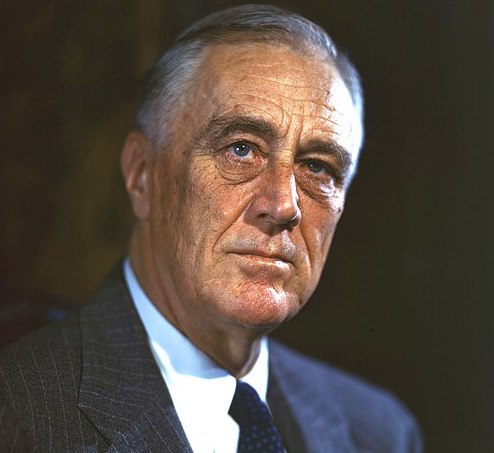
Franklin Delano Roosevelt (1882 – April 12, 1945), often referred to by his initials FDR, was an American politician who served as the 32nd president of the United States from 1933 until his death in 1945. Roosevelt was born to a Dutch American family who was well known especially because of Theodore Roosevelt, the 26th president of the United States.

A member of the Democratic Party, he won a record four presidential elections and became a key political figure in world events during the first half of the 20th century.

FDR led the United States through the Great Depression and World War II, and greatly expanded the powers of the federal government through a series of programs and reforms known as the New Deal

Stricken with polio in 1921, Roosevelt spent much of his adult life in a wheelchair. A whole generation of Americans grew up knowing no other president other than FDR, whose social programs profoundly modified the role of government in Americans’ lives.

His third and fourth terms were dominated by World War II, which ended shortly after he died in office. He is considered by many scholars as one of the three greatest U.S. presidents, along with George Washington and Abraham Lincoln.

Franklin D. Roosevelt Quotes

Chiang Kai-shek, Roosevelt, and Winston Churchill at the Cairo Conference
Chiang Kai-shek, Roosevelt, and Winston Churchill at the Cairo Conference

“The only thing we have to fear is fear itself.” ― Franklin D. Roosevelt

“I ask you to judge me by the enemies I have made.” ― Franklin D. Roosevelt

“When you come to the end of your rope, tie a knot and hang on.” ― Franklin D. Roosevelt

“We cannot always build the future for our youth, but we can build our youth for the future.” ― Franklin D. Roosevelt

“We have always held to the hope, the belief, the conviction that there is a better life, a better world, beyond the horizon.” ― Franklin D. Roosevelt

“The test of our progress is not whether we add more to the abundance of those who have much; it is whether we provide enough for those who have too little.” ― Franklin D. Roosevelt

“Let us never forget that government is ourselves and not an alien power over us. The ultimate rulers of our democracy are not a President and senators and congressmen and government officials, but the voters of this country.” ― Franklin D. Roosevelt

“I’m not the smartest fellow in the world, but I can sure pick smart colleagues.” ― Franklin D. Roosevelt

Churchill, Roosevelt, and Stalin at the Yalta Conference, February 1945, two months before Roosevelt's death
Churchill, Roosevelt, and Stalin at the Yalta Conference, February 1945

“To reach a port we must set sail –
Sail, not tie at anchor
Sail, not drift.” ― Franklin D. Roosevelt

“Democracy cannot succeed unless those who express their choice are prepared to choose wisely. The real safeguard of democracy, therefore, is education.” ― Franklin D. Roosevelt

“In politics, nothing happens by accident. If it happens, you can bet it was planned that way.”― Franklin D. Roosevelt

“The liberty of a democracy is not safe if the people tolerated the growth of private power to a point where it becomes stronger than the democratic state itself. That in its essence is fascism: ownership of government by an individual, by a group, or any controlling private power.” ― Franklin D. Roosevelt

“If civilization is to survive, we must cultivate the science of human relationships – the ability of all peoples, of all kinds, to live together, in the same world at peace.” ― Franklin D. Roosevelt

Roosevelt with Brazilian President Getúlio Vargas and other dignitaries in Brazil, 1936
Roosevelt with Brazilian President Getúlio Vargas in Brazil, 1936

“I think we consider too much the good luck of the early bird and not enough the bad luck of the early worm.”― Franklin D. Roosevelt

“Competition has been shown to be useful up to a certain point and no further, but cooperation, which is the thing we must strive for today, begins where competition leaves off.”― Franklin D. Roosevelt

“Courage is not the absence of fear, but rather the assessment that something else is more important than fear.” ― Franklin D. Roosevelt

“The only limit to our realization of tomorrow will be our doubts of today. Let us move forward with strong and active faith.” ― Franklin D. Rooseveltt

“Happiness is not in the mere possession of money; it lies in the joy of achievement, in the thrill of creative effort.” ― Franklin D. Rooseveltt

“If you treat people right they will treat you right … ninety percent of the time.” ― Franklin D. Roosevelt

“There are many ways of going forward, but only one way of standing still.”
― Franklin D. Roosevelt

United States President Franklin D. Roosevelt signing the declaration of war against Germany,
 President Franklin D. Roosevelt signing the declaration of war against Germany, 

“A smooth sea never made a skilled sailor.” ― Franklin D. Roosevelt

“It is common sense to take a method and try it. If it fails, admit it frankly and try another. But above all, try something.” ― Franklin D. Roosevelt

“Be sincere, Be brief, Be seated.” ― Franklin Delano Roosevelt

“Men are not prisoners of fate, but only prisoners of their own minds.” ― Franklin D. Roosevelt

“We have always known that heedless self interest was bad morals, we now know that it is bad economics.” ― Franklin Delano Rooseveltt

“Repetition does not transform a lie into a truth.” ― Franklin D. Roosevelt

“It isn’t sufficient just to want – you’ve got to ask yourself what you are going to do to get the things you want.” ― Franklin D. Roosevelt

Top 25 Quotes From the Alchemist by Paulo Coelho

All Giza Pyramids
All Giza Pyramids

The Alchemist is an allegorical novel by Brazilian author Paulo Coelho and was first published in 1988. Originally written in Portuguese (O Alquimista), it became a widely translated international bestseller.

The Alchemist follows the journey of an Andalusian shepherd boy named Santiago. Believing a recurring dream to be prophetic, he asks a Gypsy fortune teller in the nearby town about its meaning. The woman interprets the dream as a prophecy telling the boy that he will discover a treasure at the Egyptian pyramids.

Early into his journey, he meets an old king named Melchizedek, or the king of Salem, who tells him to sell his sheep, so as to travel to Egypt, and introduces the idea of a Personal Legend. Your Personal Legend “is what you have always wanted to accomplish. Everyone, when they are young, knows what their Personal Legend is.”

Original Brazilian publication

Early in his arrival to Africa, a man who claims to be able to take Santiago to the pyramids instead robs him of what money he had made from selling his sheep. Santiago then embarks on a long path of working for a crystal merchant so as to make enough money to fulfill his personal legend and go to the pyramids.

Along the way, the boy meets an Englishman who has come in search of an alchemist and continues his travels in his new companion’s company. When they reach an oasis, Santiago meets and falls in love with an Arabian girl named Fatima, to whom he proposes marriage. She promises to do so only after he completes his journey. Frustrated at first, he later learns that true love will not stop nor must one sacrifice to it one’s personal destiny, since to do so robs it of truth.

The boy then encounters a wise alchemist who also teaches him to realize his true self. Together, they risk a journey through the territory of warring tribes, where the boy is forced to demonstrate his oneness with “the soul of the world” by turning himself into a simoom (a strong, dry, dust-laden wind) before he is allowed to proceed. When he begins digging within sight of the pyramids, he is robbed yet again, but accidentally learns from the leader of the thieves that the treasure he sought all along was in the ruined church where he had his original dream.

Coelho wrote The Alchemist in only two weeks in 1987. He explained that he was able to write at this pace because the story was “already written in [his] soul.”

The Alchemist Quotes

“And, when you want something, all the universe conspires in helping you to achieve it.” ― Paulo Coelho

“It’s the possibility of having a dream come true that makes life interesting.” ― Paulo Coelho

“When we love, we always strive to become better than we are. When we strive to become better than we are, everything around us becomes better too.” ― Paulo Coelho

“One is loved because one is loved. No reason is needed for loving.” ― Paulo Coelho

“There is only one thing that makes a dream impossible to achieve: the fear of failure.” ― Paulo Coelho

“So, I love you because the entire universe conspired to help me find you.” ― Paulo Coelho

“At a certain point in our lives, we lose control of what’s happening to us, and our lives become controlled by fate. That’s the world’s greatest lie.” ― Paulo Coelho

“The secret of life, though, is to fall seven times and to get up eight times.” ― Paulo Coelho

“The simple things are also the most extraordinary things, and only the wise can see them.” ― Paulo Coelho

“Every blessing ignored becomes a curse.” ― Paulo Coelho

“Everyone seems to have a clear idea of how other people should lead their lives, but none about his or her own.” ― Paulo Coelho

“Remember that wherever your heart is, there you will find your treasure.” ― Paulo Coelho

“Tell your heart that the fear of suffering is worse than the suffering itself. And that no heart has ever suffered when it goes in search of its dreams, because every second of the search is a second’s encounter with God and with eternity.” ― Paulo Coelho

“There is only one way to learn. It’s through action. Everything you need to know you have learned through your journey” ― Paulo Coelho

“No matter what he does, every person on earth plays a central role in the history of the world. And normally he doesn’t know it.” ― Paulo Coelho

“Don’t give in to your fears. If you do, you won’t be able to talk to your heart.” ― Paulo Coelho

“This is what we call love. When you are loved, you can do anything in creation. When you are loved, there’s no need at all to understand what’s happening, because everything happens within you.” ― Paulo Coelho

“People are capable, at any time in their lives, of doing what they dream of.” ― Paulo Coelho

“We are travelers on a cosmic journey, stardust, swirling and dancing in the eddies and whirlpools of infinity. Life is eternal. We have stopped for a moment to encounter each other, to meet, to love, to share.This is a precious moment. It is a little parenthesis in eternity.” ― Paulo Coelho

“Everything that happens once can never happen again. But everything that happens twice will surely happen a third time.” ― Paulo Coelho

“I don’t live in either my past or my future. I’m interested only in the present. If you can concentrate always on the present, you’ll be a happy man. Life will be a party for you, a grand festival, because life is the moment we’re living now.” ― Paulo Coelho

“When each day is the same as the next, it’s because people fail to recognize the good things that happen in their lives every day that the sun rises.” ― Paulo Coelho

“If you start by promising what you don’t even have yet, you’ll lose your desire to work towards getting it.” ― Paulo Coelho

“You will never be able to escape from your heart. So it’s better to listen to what it has to say.” ― Paulo Coelho

“Intuition is really a sudden immersion of the soul into the universal current of life.” ― Paulo Coelho

Paulo Coelho

Paulo Coelho was born in Rio de Janeiro, Brazil, and attended a Jesuit school. As a teenager, Coelho wanted to become a writer. Upon telling his mother this, she responded, “My dear, your father is an engineer. He’s a logical, reasonable man with a very clear vision of the world. Do you actually know what it means to be a writer?” At 17, Coelho’s introversion and opposition to following a traditional path led to his parents committing him to a mental institution from which he escaped three times before being released at the age of 20. Coelho was born into a Catholic family, and his parents were strict about the religion and faith.

At his parents’ wishes, Coelho enrolled in law school and abandoned his dream of becoming a writer. One year later, he dropped out and lived life as a hippie, traveling through South America, North Africa, Mexico, and Europe and started using drugs in the 1960s.

Upon his return to Brazil, Coelho worked as a songwriter. In 1974, by his account, he was arrested for “subversive” activities and tortured by the ruling military government, who had taken power ten years earlier and viewed his lyrics as left-wing and dangerous. Coelho also worked as an actor, journalist and theatre director before pursuing his writing career.

Coelho married artist Christina Oiticica in 1980.

In 1986 Coelho walked the 500-plus mile Road of Santiago de Compostela in northwestern Spain. On the path, he had a spiritual awakening, which he described autobiographically in The Pilgrimage. Coelho would later leave his lucrative career as a songwriter and pursue writing full-time.

Buy on AMAZON: The Alchemist

Top 60 Quotes From Ralph Waldo Emerson

Ralph Waldo Emerson
Ralph Waldo Emerson

1. “Do not go where the path may lead, go instead where there is no path and leave a trail.” Ralph Waldo Emerson

2. “Good luck is another name for tenacity of purpose.” Ralph Waldo Emerson 

3. “Once you make a decision, the universe conspires to make it happen.” Ralph Waldo Emerson

4. “Write it on your heart that every day is the best day in the year.” Ralph Waldo Emerson

5. “What lies behind us and what lies before us are tiny matters compared to what lies within us.” Ralph Waldo Emerson

6. “The invariable mark of wisdom is to see the miraculous in the common.” Ralph Waldo Emerson

Emerson postage stamp, issue of 1940
Emerson postage stamp, issue of 1940

7. “Don’t waste life in doubts and fears; spend yourself on the work before you, well assured that the right performance of this hour’s duties will be the best preparation for the hours and ages that will follow it.” Ralph Waldo Emerson

8. “Beware what you set your heart upon. For it surely shall be yours.” Ralph Waldo Emerson

9. “The greatest glory is not in never failing, but in rising up every time we fail.” Ralph Waldo Emerson

10. “The only person you are destined to become is the person you decide to be.” Ralph Waldo Emerson

11. “Unless you try to do something beyond what you have already mastered, you will never grow.” Ralph Waldo Emerson

12. “Fear defeats more people than any other one thing in the world.” Ralph Waldo Emerson

13. “Live in the sunshine, swim the sea, drink the wild air.” Ralph Waldo Emerson

14. “Love is a perfume you cannot pour onto others without getting a few drops on yourself.” Ralph Waldo Emerson

15. “To be yourself in a world that is constantly trying to make you something else is the greatest accomplishment.” Ralph Waldo Emerson

16. “Enthusiasm is the mother of effort, and without it nothing great was ever achieved.” Ralph Waldo Emerson

17. “Men succeed when they realize that their failures are the preparation for their victories.” Ralph Waldo Emerson

18. “Don’t be pushed by your problems. Be led by your dreams.” Ralph Waldo Emerson

19. “The reason why the world lacks unity and lies broken and in heaps is because man is disunited with himself.” Ralph Waldo Emerson

20. “All I have seen teaches me to trust the Creator for all I have not seen.” Ralph Waldo Emerson

21. “Nothing can bring you peace but yourself. Nothing can bring you peace but the triumph of principles.” Ralph Waldo Emerson

22. “Cultivate the habit of being grateful for every good thing that comes to you, and to give thanks continuously. And because all things have contributed to your advancement, you should include all things in your gratitude.” Ralph Waldo Emerson

23. “It is one of the blessings of old friends that you can afford to be stupid with them.” Ralph Waldo Emerson

24. “The ancestor of every action is a thought.” Ralph Waldo Emerson

25. “Sorrow looks back. Worry looks around. Faith looks up.” Ralph Waldo Emerson

26. “If we encounter a man of rare intellect, we should ask him what books he reads.” Ralph Waldo Emerson

27. “Always, always, always, always, always do what you are afraid to do. Do the thing you fear and the death of fear is certain.” Ralph Waldo Emerson

28. “When it’s dark enough, you can see the stars.” Ralph Waldo Emerson

29. “Adopt the pace of nature; her secret is patience.” Ralph Waldo Emerson

30. “To appreciate beauty, to find the best in others, to leave the world a bit better, whether by a healthy child, a garden patch, to know even one life has breathed easier because you have lived.” Ralph Waldo Emerson

31. “None of us will ever accomplish anything excellent or commanding except when he listens to this whisper which is heard by him alone.” Ralph Waldo Emerson

32. “A man is what he thinks about all day long.” Ralph Waldo Emerson

33. “It is not the length of life, but the depth of life.” Ralph Waldo Emerson

34. “Without ambition one starts nothing. Without work one finishes nothing. The prize will not be sent to you. You have to win it.” Ralph Waldo Emerson

35. “In my walks, every man I meet is my superior in some way, and in that I learn from him.” Ralph Waldo Emerson

36. “For every minute you remain angry, you give up sixty seconds of peace of mind.” Ralph Waldo Emerson

37. “Common sense is genius dressed in its working clothes.” Ralph Waldo Emerson

38. “When I first open my eyes upon the morning meadows and look out upon the beautiful world, I thank God I am alive.” Ralph Waldo Emerson

39. “Don’t be too timid and squeamish about your actions. All life is an experiment.” Ralph Waldo Emerson

40. “To be great is to be misunderstood.” Ralph Waldo Emerson

41. “The earth laughs in flowers.” Ralph Waldo Emerson

42. “Tomorrow is a new day; begin it well and serenely and with too high spirit to be cumbered with your old nonsense.” Ralph Waldo Emerson

43. “Life is a journey, not a destination.” Ralph Waldo Emerson

44. “Knowledge is an antidote to fear.” Ralph Waldo Emerson

45. “The first wealth is health.” Ralph Waldo Emerson

46. “Self-reliance, the height and perfection of man, is reliance on God.” Ralph Waldo Emerson

47. “Most of the shadows of this life are standing in one’s own sunshine.” Ralph Waldo Emerson

48. “Nothing is more simple than greatness; indeed, to be simple is to be great.” Ralph Waldo Emerson

49. “Laugh as much as you breathe and love as long as you live.” Ralph Waldo Emerson

50. “Whoso would be a man must be a nonconformist.” Ralph Waldo Emerson

51. “What you are comes to you.” Ralph Waldo Emerson

52. “Imagination is not the talent of some men, but the health of every man.” Ralph Waldo Emerson

53. “It is easy in the world to live after the world’s opinion; it is easy in solitude to live after our own; but the great man is he who in the midst of the crowd keeps with perfect sweetness the independence of solitude.” Ralph Waldo Emerson

54. “Be silly. Be honest. Be kind.” Ralph Waldo Emerson

55. “Dare to live the life you have dreamed for yourself. Go forward and make your dreams come true.” Ralph Waldo Emerson

56. I like the silent church before the service begins, better than any preaching. Ralph Waldo Emerson

57. A man must consider what a rich realm he abdicates when he becomes a conformist. Ralph Waldo Emerson

58. “Society everywhere is in conspiracy against the manhood of every one of its members. The virtue in most request is conformity. Self-reliance is its aversion. It loves not realities and creators, but names and customs.” Ralph Waldo Emerson

59. “Finish each day and be done with it. ” Ralph Waldo Emerson

60. “I cannot remember the books I’ve read any more than the meals I have eaten; even so, they have made me.” Ralph Waldo Emerson

Ralph Waldo Emerson

Young Ralph Emerson
Young Ralph Emerson

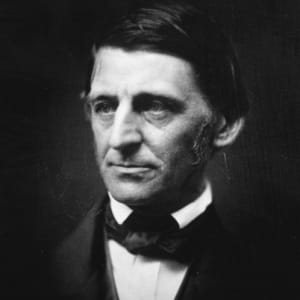
Ralph Waldo Emerson (1803 – 1882) was an American essayist, lecturer, philosopher, and poet who led the transcendentalist movement of the mid-19th century. He was seen as a champion of individualism and a critic of the pressures of society, and he disseminated his thoughts through dozens of published essays and more than 1,500 public lectures across the United States.

Emerson gradually moved away from the religious and social beliefs of his contemporaries, formulating and expressing the philosophy of transcendentalism in his 1836 essay “Nature“.

Emerson wrote most of his important essays as lectures first and then revised them for print. His first two collections of essays, Essays: First Series (1841) and Essays: Second Series (1844), represent the core of his thinking. They include the well-known essays “Self-Reliance“, “The Over-Soul“, “Circles“, “The Poet“, and “Experience.” Together with “Nature“, these essays made the decade from the mid-1830s to the mid-1840s Emerson’s most fertile period.

Emerson wrote on a number of subjects, never espousing fixed philosophical tenets, but developing certain ideas such as individuality, freedom, the ability for mankind to realize almost anything, and the relationship between the soul and the surrounding world.

His work has greatly influenced the thinkers, writers and poets that followed him. “In all my lectures,” he wrote, “I have taught one doctrine, namely, the infinitude of the private man.” Emerson is also well known as a mentor and friend of Henry David Thoreau, a fellow transcendentalist.

18 Insightful Quotes and Brief Summary of “The Myths of Innovation” by Scott Berkun

According to Scott Berkun, author of The Myths of Innovation, the purpose of his book is to

share the truths everyone should know about how big ideas really change the world. Far too much of what we know about creativity isn’t based on facts at all, and my mission is to change this.

The book was heavily researched with 100s of footnotes and references, and these are the main points, the Ten Myth of Innovation:

  1. We mistakenly obsess about flashes of insight (The myth of epiphany). Flashes of insight dominate how creativity is reported, despite how small a role they play in breakthroughs. Epiphanies are a consequence of effort, not just the inspiration for it. And no idea is completely original, as all ideas are made from other ideas.
  2. Technological progress does not move in a straight line (The myth that we know history). We romanticize the past to fit the present, creating traps for creatives who don’t know the true history of their own field. Edison did not invent the lightbulb. Ford did not invent the assembly line. 
  3. Progress, and market success, are inherently unpredictable (The myth of a method). The challenge with creative work, especially in a marketplace, is the many factors beyond your control. You can do everything right and still fail. Most books on creativity make big promises based on history: they cherry pick examples from the past to support their “method”. Methods can be useful but they deny that the present is different from the past. There are too many variables in the present to have certainty.
  4. People resist change, including progress (The myth we love new ideas). While talking about creativity is very popular, actually being creative puts your social status at risk. All great ideas were rejected, often for years or decades. The history of breakthroughs is a tale of persistence against rejection.
  5. We overstate individual contributions and under-recognize teams (The myth of the lone inventor). It’s easier to worship a hero if they are portrayed as superhuman. But even people worthy of the title genius or prodigy like Mozart, Picasso and Einstein had family and teachers who taught them.
  6. Good ideas are everywhere, it’s courage that’s scarce (The myth that good ideas are rare). We are built for creativity. The problem is the conventions of adult life demand conformity and we sacrifice our creative instincts in favor of social status. Unlike a child, adults are supremely and instantly judgmental, killing ideas before they’ve had even a moment to prove their worth.
  7. People in charge often resist change (The myth your boss knows more than you). To rise in power demands good political judgement, yet innovation requires a willingness to defy convention. Convention-defiers are harder to promote in most organizations, yet essential for progress.
  8. The world of ideas is not a meritocracy (The myth the best idea wins). Marketing, politics and timing have tremendous influence on why one idea or its competitors wins. To be successful with ideas demands studying why some lousy ideas have triumphed and some great ones are still on the sidelines.
  9. Defining problems well is as important as solving them (The myth that problems are less interesting than solutions). There are many creative ways to think about a problem, and different ways to look at a situation. The impatient run at full speed into solving things, speeding right past the insights needed to find a great solution.
  10. Unintended consequences are hard to avoid (The myth that innovation is always good). How would you feel about an invention that ends your profession? All innovation is change and all change helps some people and hurts others.

18 Quotes from The Myths of Innovation  

“The best lesson from the myths of Newton and Archimedes is to work passionately but to take breaks. Sitting under trees and relaxing in baths lets the mind wander and frees the subconscious to do work on our behalf. ” ― Scott Berkun

“In a recent survey, innovative people — from inventors to scientists, writers to programmers — were asked what techniques they used. Over 70% believed they got their best ideas by exploring areas they were not experts in”― Scott Berkun

“Howard H. Aiken, a famous inventor, said, “Don’t worry about people stealing your ideas. If your ideas are any good, you’ll have to ram them down people’s throats.” ― Scott Berkun

“Freeman Dyson, a world-class physicist and author (said): “I think it’s very important to be idle…people who keep themselves busy all the time are generally not creative. So I am not ashamed of being idle.” ― Scott Berkun

“The love of new ideas is a myth: we prefer ideas only after others have tested them.” ― Scott Berkun

“Nearly every major innovation of the 20th century took place without claims of epiphany.” ― Scott Berkun

“Professional management was born from the desire to optimize and control, not to lead waves of change.” ― Scott Berkun

“Einstein said, “ Imagination is more important than knowledge,” but you’d be hard-pressed to find schools or corporations that invest in people with those priorities…We reward conformance of mind, not independent thought, in our systems — from school to college to the workplace to the home — yet we wonder why so few are willing to take creative risks.” ― Scott Berkun

“One way to think about epiphany is to imagine working on a jigsaw puzzle. When you put the last piece into place, is there anything special about that last piece or what you were wearing when you put it in? The only reason that last piece is significant is because of the other pieces you’d already put into place. If you jumbled up the pieces a second time, any one of them could turn out to be the last, magical piece. Epiphany works the same way: it’s not the apple or the magic moment that matters much, it’s the work before and after” ― Scott Berkun

“The future never enters the present as a finished product, but that doesn’t stop people from expecting it to arrive that way.” ― Scott Berkun

“The Greeks were so committed to ideas as supernatural forces that they created an entire group of goddesses (not one but nine) to represent creative power; the opening lines of both The Iliad and The Odyssey begin with calls to them. These nine goddesses, or muses, were the recipients of prayers from writers, engineers, and musicians. Even the great minds of the time, like Socrates and Plato, built shrines and visited temples dedicated to their particular muse (or muses, for those who hedged their bets). Right now, under our very secular noses, we honor these beliefs in our language, as the etymology of words like museum (“place of the muses”) and music (“art of the muses”) come from the Greek heritage of ideas as superhuman forces.” ― Scott Berkun

“In this age, being seen as an “expert” may have little bearing on the “expert’s” ability to do the thing she is supposedly an expert in.”
― Scott Berkun

“The chief cause of problems is solutions. — Eric Sevareid” ― Scott Berkun

“It’s natural for people to protect what they know instead of leaping into the unknown, and managers are no exception. Managers might even be worse, as the politics they rely on to survive can make them more entrenched and defensive.” ― Scott Berkun

“Einstein once said, “If I had 20 days to solve a problem, I would take 19 days to define it,” ― Scott Berkun

“By idolizing those whom we honor, we do a disservice both to them and to ourselves…we fail to recognize that we could go and do likewise. — Charles V. Willie” ― Scott Berkun

“Developing new ideas requires questions and approaches that most people won’t understand initially, which leaves many true innovators at risk of becoming lonely, misunderstood characters.” ― Scott Berkun

“Innovating comes at a price: it might be money, time, sanity, friends, or marriages, but there will definitely be one.” ― Scott Berkun

Scott Berkun

Scott Berkun is an American author and speaker. Berkun studied computer science, philosophy, and design at Carnegie Mellon University. He worked at Microsoft from 1994 to 2003 on Internet Explorer 1.0 to 5.0, Windows, MSN, and in roles including usability engineer, lead program manager, and UI design evangelist. He left Microsoft in 2003 with the goal of filling his bookshelf with books he has written.

He has written three best-selling books: Making things happenThe Myths of Innovation, and Confessions of a Public Speaker.

Bibliography

  • The Art of Project Management
  • Making things happen,
  • The Myths of Innovation,
  • Confessions of a Public Speaker,
  • Mindfire: Big Ideas for Curious Minds
  • The Year Without Pants: WordPress.com and the Future of Work,
  • The Ghost of My Father 

20 Best Quotes From Melinda Gates’ New Book “The Moment of Lift”

Melinda and Bill Gates

Melinda Ann Gates (August 15, 1964) is an American philanthropist and a former general manager at Microsoft. In 2000, she co-founded the Bill & Melinda Gates Foundation with her husband Bill Gates, the world’s largest private charitable organization. Gates has consistently been ranked as one of the world’s most powerful women by Forbes.

About the Book

In her first book, The Moment of Lift: How Empowering Women Changes the World, Melinda Gates makes a bold claim: when we lift up women, we lift up humanity.

After years of travel, humanitarian work and extensive research, Melinda introduces us to the women she’s met along the way. Their stories are brutally honest, gut-wrenching, inspiring and triumphant. They show us how, time and time again, empowered women rise up and bring their families and communities with them.

Melinda also shares her own personal journey to achieving equality in her marriage, finding her voice and becoming an advocate for women and girls. She explains how the women she has met have called her to action. And at this critical moment, she calls us to action too—urging us to drive progress in our homes, workplaces and communities. (Evoke.org)

It is a fascinating and eye opening book. I don’t necessarily agree with everything Melinda Gates says or believes, but it doesn’t really matter, because it’s a great book, and I recommend it strongly.

20 Top Quotes From “The Moment of Lift”

ON OUTSIDERS

“Every society says its outsiders are the problem. But the outsiders are not the problem; the urge to create outsiders is the problem. Overcoming that urge is our greatest challenge and our greatest promise. It will take courage and insight, because the people we push to the margins are the ones who trigger in us the feelings we’re afraid of.”

ON LOVE AS A FORCE FOR CHANGE

“Love is the most powerful and underused force for change in the world. … For me, love is the effort to help others flourish — and it often begins with lifting up a person’s self image.”

ON BENEFITS FOR FAMILIES AND SOCIETIES

“As women gain rights, families flourish, and so do societies. That connection is built on a simple truth: Whenever you include a group that’s been excluded, you benefit everyone. And when you’re working globally to include women and girls, who are half of every population, you’re working to benefit all members of every community. Gender equity lifts everyone. Women’s rights and society’s health and wealth rise together.”

ON POVERTY

“Poverty is not being able to protect your family. Poverty is not being able to save your children when mothers with more money could. And because the strongest instinct of a mother is to protect her children, poverty is the most disempowering force on earth.”

ON EXTREME POVERTY

“What extreme poverty really means is that no matter how hard you work, you’re trapped. You can’t get out. Your efforts barely matter. You’ve been left behind by those who could life you up.”

ON WISDOM

“Wisdom isn’t about accumulating more facts; it’s about understanding big truths in a deeper way. Year by year, with the support and insights of friends and partners and people who have gone before me, I see more clearly that the primary causes of poverty and illness are the cultural, financial, and legal restrictions that block what women can do—and think they can do—for themselves and their children.”

ON EMPOWERING WOMEN

“If you want to lift up humanity, empower women. It is the most comprehensive, pervasive, high-leverage investment you can make in human beings.”

ON OPENING UP TO OTHERS

“We have to open up to others. We have to give up the need to be separate and superior.”

ON EMPATHY

“When people can’t agree, it’s often because there is no empathy, no sense of shared experience. If you feel what others feel, you’re more likely to see what they see. Then you can understand one another. Then you can move to the honest and respectful exchange of ideas that is the mark of a successful partnership. That’s the source of progress.”

ON WEALTH

“Great wealth can be very confusing. It can inflate and distort your sense of self — especially if you believe money means merit.”

Melinda Gates said she will address the U.S. maternal death rates in her and husband Bill's annual letter.

ON DIVERSITY AND EQUALITY

Diversity is the best way to defend equality. If people from diverse groups are not making those decisions, the burdens and benefits of society will be divided unequally and unfairly — with the people writing the rules ensuring themselves a greater share of the benefits and a lesser share of the burdens of any society. If you are not brought in, you get sold out.”

ON GENDER IN THE WORKPLACE

“Gender diversity is not just good for women; it’s good for anyone who wants results.”

ON THE SUCCESS OF SOCIAL MOVEMENTS

“Many successful social movements are driven by the same combination — strong activism and the ability to take pain without passing it on. Anyone who can combine those two, finds a voice with moral force.”

ON EMBOLDENING OUR CHILDREN

“One of the biggest challenges in changing the culture is lifting up the self-image of the kids. They’ve had self-doubt planted in their minds by society, the media, even members of their own family.”

ON ABUSIVE CULTURES

“An abusive culture, to me, is any culture that needs to single out and exclude a group.”

ON BULLYING BEYOND CHILDHOOD

“Adults try to create outsiders, too. In fact, we get better at it. And most of us fall into one of the same three groups: the people who try to create outsiders, the people who are made to feel like outsiders, and the people who stand by and don’t stop it. … Overcoming the need to create outsiders is our biggest challenge as human beings.”

ON THE POWER OF STANDING TOGETHER

“… when women are trying to decide whether we should stand up, we don’t know if others will stand with us. It often takes many women, arms linked, to inspire other women to speak.” 

ON ELIMINATING OUTSIDERS

“Savings lives starts with bringing everyone in.”

Melinda Gates said it's time women start being recognized for the unpaid work they do.
Melinda Gates (Photo: Getty Images)

ON FEMINISM

“Being a feminist means believing that every woman should be able to use her voice and pursue her potential, and that women and men should all work together to take down the barriers and end the biases that still hold women back.”

ON SETTING YOUR AGENDA

“If you don’t set your own agenda, somebody else will.” If I didn’t fill my schedule with things I felt were important, other people would fill my schedule with things they felt were important.”

On AMAZON: The Moment of Lift: How Empowering Women Changes the World,

28 Inspiring Quotes From “How Will You Measure Your Life?” by Clayton M. Christensen

Too often, we measure success in life against the progress we make in our careers. But how can we ensure we’re not straying from our values as humans along the way? Clayton Christensen, Harvard Business School professor and world-renowned innovation guru, examines the daily decisions that define our lives and encourages all of us to think about what is truly important.

Follows a brief excerpt from chapter one, of “How Will You Measure Your Life?” by Clayton M. Christensen to introduce the book:

Chapter 1: The Difference Between What to Think and How to Think

There are no easy answers to life’s challenges. The quest to find happiness and meaning in life is not new. Humans have been pondering the reason for our existence for thousands of years.

… There are no quick fixes for the fundamental problems of life. But I can offer you tools that I’ll call theories in this book, which will help you make good choices, appropriate to the circumstances of your life.

I learned about the power of this approach in 1997, before I published my first book, The Innovator’s Dilemma I got a call from Andy Grove, then the chairman of Intel. He had heard of one of my early academic papers about disruptive innovation, and asked me to come to Santa Clara to explain my research and tell him and his top team what it implied for Intel. A young professor, I excitedly flew to Silicon Valley and showed up at the appointed time, only to have Andy say, “Look, stuff has happened. We have only ten minutes for you. Tell us what your research means for Intel, so we can get on with things.”

I responded, “Andy, I can’t, because I know very little about Intel. The only thing I can do is to explain the theory first; then we can look at the company through the lens that the theory offers.” I then showed him a diagram of my theory of disruption. I explained that disruption happens when a competitor enters a market with a low-priced product or service that most established industry players view as inferior. But the new competitor uses technology and its business model to continually improve its offering until it is good enough to satisfy what customers need. Ten minutes into my explanation, Andy interrupted impatiently: “Look, I’ve got your model. Just tell us what it means for Intel.”

I said, “Andy, I still can’t. I need to describe how this process worked its way through a very different industry, so you can visualize how it works.” I told the story of the steel-mill industry, in which Nucor and other steel mini-mills disrupted the integrated steel-mill giants. The mini-mills began by attacking at the lowest end of the market—steel reinforcing bar, or rebar—and then step by step moved up toward the high end, to make sheet steel—eventually driving all but one of the traditional steel mills into bankruptcy.

When I finished the mini-mill story, Andy said, “I get it. What it means for Intel is …” and then went on to articulate what would become the company’s strategy for going to the bottom of the market to launch the lower-priced Celeron processor.

I’ve thought about that exchange a million times since. If I had tried to tell Andy Grove what he should think about the microprocessor business, he would have eviscerated my argument. He’s forgotten more than I will ever know about his business.

But instead of telling him what to think, I taught him how to think. He then reached a bold decision about what to do, on his own.

I Don’t Have an Opinion, the Theory Has an Opinion

That meeting with Andy changed the way I answer questions. When people ask me something, I now rarely answer directly. Instead, I run the question through a theory in my own mind, so I know what the theory says is likely to be the result of one course of action, compared to another. I’ll then explain how it applies to their question. To be sure they understand it, I’ll describe to them how the process in the model worked its way through an industry or situation different from their own, to help them visualize how it works. People, typically, then say,

“Okay, I get it.” They’ll then answer their question with more insight than I could possibly have. A good theory doesn’t change its mind: it doesn’t apply only to some companies or people, and not to others. It is a general statement of what causes what, and why.

28 Best Quotes From “How Will You Measure Your Life?”

“It’s actually really important that you succeed at what you’re succeeding at, but that isn’t going to be the measure of your life.” – ― Clayton M. Christensen

“For many of us, as the years go by, we allow our dreams to be peeled away. We pick our jobs for the wrong reasons and then we settle for them. We begin to accept that it’s not realistic to do something we truly love for a living.Too many of us who start down the path of compromise will never make it back. Considering the fact that you’ll likely spend more of your waking hours at your job than in any other part of your life, it’s a compromise that will always eat away at you.But you need not resign yourself to this fate.”― Clayton M. Christensen

”It is important to address hygiene factors such as a safe and comfortable working environment, relationship with managers and colleagues, enough money to look after your family—if you don’t have these things, you’ll experience dissatisfaction with your work. But these alone won’t do anything to make you love your job—they will just stop you from hating it.”
― Clayton M. Christensen

“It’s easier to hold your principles 100 percent of the time than it is to hold them 98 percent of the time.” ― Clayton M. Christensen

“Intimate, loving, and enduring relationships with our family and close friends will be among the sources of the deepest joy in our lives.”― Clayton M. Christensen

“In your life, there are going to be constant demands for your time and attention. How are you going to decide which of those demands gets resources? The trap many people fall into is to allocate their time to whoever screams loudest, and their talent to whatever offers them the fastest reward. That’s a dangerous way to build a strategy.” ― Clayton M. Christensen

”If we ask the right questions, the answers generally are easy to get.”
― Clayton M. Christensen

“You can talk all you want about having a clear purpose and strategy for your life, but ultimately this means nothing if you are not investing the resources you have in a way that is consistent with your strategy. In the end, a strategy is nothing but good intentions unless it’s effectively implemented.” ― Clayton M. Christensen

“If you defer investing your time and energy until you see that you need to, chances are it will already be too late.” ― Clayton M. Christensen

“As such, there is no one-size-fits-all approach that anyone can offer you. The hot water that softens a carrot will harden an egg.” ― Clayton M. Christensen

“I had thought the destination was what was important, but it turned out it was the journey.” ― Clayton M. Christensen

“In order to really find happiness, you need to continue looking for opportunities that you believe are meaningful, in which you will be able to learn new things, to succeed, and be given more and more responsibility to shoulder. There’s an old saying: find a job that you love and you’ll never work a day in your life.” ― Clayton M. Christensen

“I used to think that if you cared for other people, you need to study sociology or something like it. But….I [have] concluded, if you want to help other people, be a manager. If done well, management is among the most noble of professions. You are in a position where you have eight or ten hours every day from every person who works for you. You have the opportunity to frame each person’s work so that, at the end of every day, your employees will go home feeling like Diana felt on her good day: living a life filled with motivators.” ― Clayton M. Christensen

“Because if the decisions you make about where you invest your blood, sweat, and tears are not consistent with the person you aspire to be, you’ll never become that person.” ― Clayton M. Christensen

“Purpose must be deliberately conceived and chosen, and then pursued.” ― Clayton M. Christensen

“As I look back on my own life, I recognize that some of the greatest gifts I received from my parents stemmed not from what they did for me—but rather from what they didn’t do for me.” ― Clayton M. Christensen

“The only way to be truly satisfied is to do what you believe is great work. And the only way to do great work is to love what you do. If you haven’t found it yet, keep looking. Don’t settle. As with all matters of the heart, you’ll know when you find it. —Steve Jobs”― Clayton M. Christensen

“the only metrics that will truly matter to my life are the individuals whom I have been able to help, one by one, to become better people.” ― Clayton M. Christensen

“Decide what you stand for. And then stand for it all the time.” ― Clayton M. Christensen

“In fact, how you allocate your own resources can make your life turn out to be exactly as you hope or very different from what you intend.” ― Clayton M. Christensen

“Indeed, while experiences and information can be good teachers, there are many times in life where we simply cannot afford to learn on the job. You don’t want to have to go through multiple marriages to learn how to be a good spouse. Or wait until your last child has grown to master parenthood. This is why theory can be so valuable: it can explain” ― Clayton M. Christensen

“Resources are what he uses to do it, processes are how he does it, and priorities are why he does it.” ― Clayton M. Christensen

“you perfect results. What I can promise you is that you won’t get it right if you don’t commit to keep trying.” ― Clayton M. Christensen

“In our lives and in our careers, whether we are aware of it or not, we are constantly navigating a path by deciding between our deliberate strategies and the unanticipated alternatives that emerge.” ― Clayton M. Christensen

“successful companies don’t succeed because they have the right strategy at the beginning; but rather, because they have money left over after the original strategy fails, so that they can pivot and try another approach. Most of those that fail, in contrast, spend all their money on their original strategy—which is usually wrong.” ― Clayton M. Christensen

“When I have my interview with God, our conversation will focus on the individuals whose self-esteem I was able to strengthen, whose faith I was able to reinforce, and whose discomfort I was able to assuage—a doer of good, regardless of what assignment I had. These are the metrics that matter in measuring my life.”― Clayton M. Christensen

“Culture is a way of working together toward common goals that have been followed so frequently and so successfully that people don’t even think about trying to do things another way. If a culture has formed, people will autonomously do what they need to do to be successful.” ― Clayton M. Christensen

“As you go through your career, you will begin to find the areas of work you love and in which you will shine; you will, hopefully, find a field where you can maximize the motivators and satisfy the hygiene factors. But it’s rarely a case of sitting in an ivory tower and thinking through the problem until the answer pops into your head. Strategy almost always emerges from a combination of deliberate and unanticipated opportunities. What’s important is to get out there and try stuff until you learn where your talents, interests, and priorities begin to pay off. When you find out what really works for you, then it’s time to flip from an emergent strategy to a deliberate one.” ― Clayton M. Christensen

“How Will You Measure Your Life?” by Clayton M. Christensen

Best 10 Quotes and Review of “Never Split the Difference” by Chris Voss and Tahl Raz

This is a very interesting book that may help you understand how to best face all the negotiations you may be involved in your life, because, after all

Life is a series of negotiations you should be prepared for: buying a car; negotiating a pay hike; buying a home; renegotiating rent; deliberating with your partner.

In Never Split the Difference: Negotiating As If Your Life Depended On It , Chris Voss, a former international hostage negotiator for the FBI, offers a new and tested approach to high-stakes negotiations. But the principles of the book can be applied to every negotiations of our lives.

After a season policing the streets of Kansas City, Missouri, Chris Voss joined the FBI, where he became a hostage negotiator who had to face many criminals, including bank robbers and terrorists. He later became the FBI’s lead international kidnapping negotiato

The book Never Split the Difference reveals the skills that helped Voss and his colleagues to succeed in saving lives. The book is a practical guide in which he shares the nine effective principles—counterintuitive tactics and strategies—that can be used to become more persuasive in both professional and personal life.

According to Voss,

“Everything we’ve previously been taught about negotiation is wrong: people are not rational; there is no such thing as ‘fair’; compromise is the worst thing you can do; the real art of negotiation lies in mastering the intricacies of No, not Yes.

Voss draws on his experiences in truly life-or-death situations to illustrate these negotiation techniques, and offers many examples of how they can be applied into our lives.

Because we spend most of our days at work and in our personal lives negotiating for something, it is extremely valuable to understand the most successful and crisis-tested approaches to the negotiation process.

What sets the strategies in this book apart from other negotiation theories (like those which approach negotiation as logical and sequential problems to be solved) is the injection of emotional intelligence and empathy into the negotiation process. This was the game-changer for the FBI, according to Voss.

10 Quotes from “Never Split the Difference”

“He who has learned to disagree without being disagreeable has discovered the most valuable secret of negotiation.” 

“Conflict brings out truth, creativity, and resolution.” 

“The Rule of Three is simply getting the other guy to agree to the same thing three times in the same conversation. It’s tripling the strength of whatever dynamic you’re trying to drill into at the moment. In doing so, it uncovers problems before they happen. It’s really hard to repeatedly lie or fake conviction.” 

“Hope is not a strategy” 

“Negotiate in their world. Persuasion is not about how bright or smooth or forceful you are. It’s about the other party convincing themselves that the solution you want is their own idea. So don’t beat them with logic or brute force. Ask them questions that open paths to your goals. It’s not about you.” 

“Playing dumb is a valid negotiating technique, and” 

“I was employing what had become one of the FBI’s most potent negotiating tools: the open-ended question. Today,” 

“If you approach a negotiation thinking the other guy thinks like you, you are wrong. That’s not empathy, that’s a projection.” 

“Psychotherapy research shows that when individuals feel listened to, they tend to listen to themselves more carefully and to openly evaluate and clarify their own thoughts and feelings.” 

“Research shows that the best way to deal with negativity is to observe it, without reaction and without judgment. Then consciously label each negative feeling and replace it with positive, compassionate, and solution-based thoughts. One”

Praise for Never Split The Difference 

“Chris Voss’s NEVER SPLIT THE DIFFERENCE is a different kind of business book —one that emphasizes the importance of emotional intelligence without sacrificing deal-making power. It comes from the pen of a former hostage negotiator — someone who couldn’t take no for an answer — which makes it fascinating reading. But it’s also eminently practical. In these pages, you will find the techniques for getting the deal you want.”   —Daniel H. Pink, author of TO SELL IS HUMAN and DRIVE

“This book blew my mind.  It’s a riveting read, full of instantly actionable advice—not just for high-stakes negotiations, but also for handling everyday conflicts at work and at home.” —Adam Grant, Wharton professor and New York Times bestselling author of ORIGINALS and GIVE AND TAKE

“Former FBI Hostage Negotiator Chris Voss has few equals when it comes to high stakes negotiations. Whether for your business or your personal life, his techniques work.”   —Joe Navarro, FBI Special Agent (Ret.) and author of the international bestseller, What Every BODY is Saying.

“Your business, basically your entire life, comes down to your performance in crucial conversations, and these tools will give you the edge you need. . . It’s required reading for my employees because I use the lessons in this book every single day, and I want them to, too.“   —Jason McCarthy, CEO of GORUCK

Summary of Never Split the Difference

Chapter 1: The New Rules

How to Become the Smartest Person…in Any Room

Negotiators must be active listeners in order to gain the trust of the other party.

Humans want to be accepted and understood. By being active listeners, we demonstrate empathy and show a sincere desire to better understand what the other side would possibly experience.

Chapter 2: Be a Mirror

How to Quickly Establish Rapport

Good negotiators should learn how to practice empathy with the other party so they can uncover obstacles and gain trust

People often view negotiation as a battle of arguments and soon become overwhelmed by the voices in their head. But negotiation isn’t a battle, instead it is an act of discovery and the objective is to uncover as much information as is available.

If you want to conquer the voices in your head, the best strategy is to focus on the other party and what they have to say. You need to make sure you understand what the other party actually needs and help them feel safe enough to talk about what they really want. Negotiation starts with listening to the other party, validating their concerns and emotions, building trust and creating a safety net that allows for real conversations.

The Summary Will Continue In The Next Blog Post

The Infinite Game by Simon Sinek: Videos and 10 Great Quotes

“Sinek rarely casts his ideas as mere opinions. You will hardly ever hear him give the other side of the story or cite a scientific finding that doesn’t support his argument. Not only does he proclaim ideas with utter confidence, he conveys them as immutable laws of nature.

Do like Sinek. If you’re a reasonable human being, there’s a good chance you have some doubts about some of your ideas. Keep them to yourself. If you want to build a feverishly dedicated following, talk about your offer as if it is the one and only answer to the problems your clients and customers face. Combined with a healthy dose of so-called science and verbal jujitsu, this tactic will ensure your business grows like crazy—even if you didn’t start with why. (Author Simon Sinek Is Full Of Hot Air (And Other Reasons You Should Follow His Lead) by Michael Schein)

I have found the above comments about Simon Sinek interesting and somewhat appropriate. Watching the following videos about his new book, THE INFINITE GAME, may perhaps confirm Schein’s assessment. What do you think?

Why I Wrote “The Infinite Game”

Simon Sinek says that he wrote “The Infinite Game” to rally those who are ready to challenge that status quo and replace it with a reality that is vastly more conducive to our deep-seated human need to feel safe, to contribute to something bigger than ourselves and to provide for ourselves and our families.

It’s a call to action. And one of the steps we need to take is to learn what it means to lead in the Infinite Game.

How to lead in The Infinite Game | THE 5 PRACTICES

The goal isn’t to beat your competition, it’s to outlast them. There are 5 practices that leaders must enact in order to transform their mindset to an infinite one.

1. Just Cause | THE 5 PRACTICES

Organizations have to offer their employees a Cause so Just that they would be willing to sacrifice their own interests to advance it.

2. Trusting Teams | THE 5 PRACTICES

How do we create an environment in which our people can work at their natural best? Leaders are not responsible for results, they’re responsible for the people who are responsible for the results.

3. Worthy Rival | THE 5 PRACTICES

A worthy rival is another player in the game that’s worthy of comparison. They reveal our weaknesses that are opportunities to improve ourselves.

4. Existential Flexibility | THE 5 PRACTICES

If you’re not willing to blow up your own company, the market will do it for you. You must have the capacity to make a profound strategic shift in order to advance your Cause.

10 Great Quotes From The Infinite Game

THE INFINITE GAME by Simon Sinek

“The true value of an organization is measured by the desire others have to contribute to that organization’s ability to keep succeeding, not just during the time they are there, but well beyond their own tenure.” –Simon Sinek, The Infinite Game

“Finite players play to beat the people around them. Infinite players play to be better than themselves.” –Simon Sinek, The Infinite Game

“No matter how successful we are in life, when we die, none of us will be declared the winner of life.” –Simon Sinek, The Infinite Game

“Great leaders are the ones who think beyond “short term” versus “long term.” They are the ones who know that it is not about the next quarter or the next election; it is about the next generation.” –Simon Sinek, The Infinite Game

“When we lead with an infinite mindset in an infinite game, it leads to all kinds of problems, the most common of which include the decline of trust, cooperation and innovation.” –Simon Sinek, The Infinite Game

“The game of business fits the very definition of an infinite game.”  –Simon Sinek, The Infinite Game

 “We achieve more when we chase the dream instead of the competition.”–Simon Sinek, The Infinite Game

“Despite the fact that companies are playing in a game that cannot be won, too many business leaders keep playing as if they can.” –Simon Sinek, The Infinite Game

Players with an infinite mindset want to leave their organizations in better shape than they found them.” –Simon Sinek, The Infinite Game

“An infinite perspective frees us from fixating on what other companies are doing, which allows us to focus on a larger vision.” –Simon Sinek, The Infinite Game

ON AMAZON: THE INFINITE GAME by Simon Sinek

Top 37 Quotes From The Element: How Finding Your Passion Changes Everything by Sir Ken Robinson

Sir Ken Robinson
Sir Ken Robinson

Sir Ken Robinson is an internationally recognized leader in the development of creativity, innovation and human resources. He has worked with national governments in Europe and Asia, international agencies, Fortune 500 companies, national and state education systems, non-profit organizations and some of the world’s leading cultural organizations. He was knighted in 2003 for his contribution to education and the arts.

His TED Talk “Do schools kill creativity?” is the most popular TED Talk of all times with more than 17 million views

In this talk Sir Ken Robinson makes an entertaining and profoundly moving case for creating an education system that nurtures (rather than undermines) creativity.

The Element: How Finding Your Passion Changes Everything

The Element: How Finding Your Passion Changes Everything is about the point where natural talent meets personal passion. The author explores the conditions that lead us to live lives filled with passion, confidence, and personal achievement.

We are all born with tremendous natural capacities, but we lose touch with many of them as we spend more time in the world, including while going through school. The author uses stories of people from a wide variety of fields which entertain and inspire.

Top 37 Quotes From The Element: How Finding Your Passion Changes Everything

“If you’re not prepared to be wrong, you’ll never come up with anything original.” ― Ken Robinson, The Element: How Finding Your Passion Changes Everything

“The fact is that given the challenges we face, education doesn’t need to be reformed — it needs to be transformed. The key to this transformation is not to standardize education, but to personalize it, to build achievement on discovering the individual talents of each child, to put students in an environment where they want to learn and where they can naturally discover their true passions.” ― Ken Robinson, The Element: How Finding Your Passion Changes Everything

“For most of us the problem isn’t that we aim too high and fail – it’s just the opposite – we aim too low and succeed.” ― Ken Robinson, The Element: How Finding Your Passion Changes Everything

“When my son, James, was doing homework for school, he would have five or six windows open on his computer, Instant Messenger was flashing continuously, his cell phone was constantly ringing, and he was downloading music and watching the TV over his shoulder. I don’t know if he was doing any homework, but he was running an empire as far as I could see, so I didn’t really care.” ― Ken Robinson, The Element: How Finding Your Passion Changes Everything

“Our task is to educate their (our students) whole being so they can face the future. We may not see the future, but they will and our job is to help them make something of it.” ― Ken Robinson, The Element: How Finding Your Passion Changes Everything

“What you do for yourself dies with you when you leave this world, what you do for others lives on forever.” ― Ken Robinson, The Element: How Finding Your Passion Changes Everything


“The Element is about discovering your self, and you can’t do this if you’re trapped in a compulsion to conform. You can’t be yourself in a swarm.” ― Ken Robinson, The Element: How Finding Your Passion Changes Everything

“young children are wonderfully confident in their own imaginations … Most of us lose this confidence as we grow up” ― Ken Robinson, The Element: How Finding Your Passion Changes Everything

“Never underestimate the vital importance of finding early in life the work that for you is play. This turns possible underachievers into happy warriors.” ― Ken Robinson, The Element: How Finding Your Passion Changes Everything

“We are all born with extraordinary powers of imagination, intelligence, feeling, intuition, spirituality, and of physical and sensory awareness. ” ― Ken Robinson, The Element: How Finding Your Passion Changes Everything

“To be creative you actually have to do something.” ― Ken Robinson, The Element: How Finding Your Passion Changes Everything

“One of the essential problems for education is that most countries subject their schools to the fast-food model of quality assurance when they should be adopting the Michelin model instead. The future for education is not in standardizing but in customizing; not in promoting groupthink and “deindividuation” but in cultivating the real depth and dynamism of human abilities of every sort.” ― Ken Robinson, The Element: How Finding Your Passion Changes Everything

“One Size Does Not Fit All Some of the most brilliant, creative people I know did not do well at school. Many of them didn’t really discover what they could do—and who they really were—until they’d left school and recovered from their education.” ― Ken Robinson, The Element: How Finding Your Passion Changes Everything

“As the physicist John Wheeler said, “If you don’t kick things around with people, you are out of it. Nobody, I always say, can be anybody without somebody being around.” ― Ken Robinson, The Element: How Finding Your Passion Changes Everything

“One of the enemies of creativity and innovation, especially in relation to our own development, is common sense.” ― Ken Robinson, The Element: How Finding Your Passion Changes Everything

“Creative teams are dynamic.” ― Ken Robinson, The Element: How Finding Your Passion Changes Everything

“Great creative teams are diverse. They are composed of very different sorts of people with different but complementary talents.” ― Ken Robinson, The Element: How Finding Your Passion Changes Everything

“The most powerful method of improving education is to invest in the improvement of teaching and the status of great teachers.” ― Ken Robinson, The Element: How Finding Your Passion Changes Everything

“A FEW YEARS AGO, I heard a wonderful story, which I’m very fond of telling. An elementary school teacher was giving a drawing class to a group of six-year-old children. At the back of the classroom sat a little girl who normally didn’t pay much attention in school. In the drawing class she did. For more than twenty minutes, the girl sat with her arms curled around her paper, totally absorbed in what she was doing. The teacher found this fascinating. Eventually, she asked the girl what she was drawing. Without looking up, the girl said, “I’m drawing a picture of God.” Surprised, the teacher said, “But nobody knows what God looks like.” The girl said, “They will in a minute.” ― Ken Robinson, The Element: How Finding Your Passion Changes Everything


“The dominant Western worldview is not based on seeing synergies and connections but on making distinctions and seeing differences.” ― Ken Robinson, The Element: How Finding Your Passion Changes Everything

“You create your own life by how you see the world and your place in it;” ― Ken Robinson, The Element: How Finding Your Passion Changes Everything

“Ironically, Alfred Binet, one of the creators of the IQ test, intended the test to serve precisely the opposite function. In fact, he originally designed it (on commission from the French government) exclusively to identify children with special needs so they could get appropriate forms of schooling. He never intended it to identify degrees of intelligence or “mental worth.” In fact, Binet noted that the scale he created “does not permit the measure of intelligence, because intellectual qualities are not superposable, and therefore cannot be measured as linear surfaces are measured.” Nor did he ever intend it to suggest that a person could not become more intelligent over time. “Some recent thinkers,” he said, “[have affirmed] that an individual’s intelligence is a fixed quantity, a quantity that cannot be increased. We must protest and react against this brutal pessimism; we must try to demonstrate that it is founded on nothing.” ― Ken Robinson, The Element: How Finding Your Passion Changes Everything

“As soon as we have the power to release our minds from the immediate here and now, in a sense we are free. We are free to revisit the past, free to reframe the present, and free to anticipate a whole range of possible futures. Imagination is the foundation of everything that is uniquely and distinctively human. It is the basis of language, the arts, the sciences, systems of philosophy, and the all the vast intricacies of human culture.” ― Ken Robinson, The Element: How Finding Your Passion Changes Everything

“Outside of school, though, we were often defined by our disabilities. We were “handicapped”—a bit like a species. Often when people have a disability, it’s the disability that other people see rather than all the other abilities that coexist with their particular difficulty. It’s why we talk about people being “disabled” rather than “having a disability.” One of the reasons that people are branded by their disability is that the dominant conception of ability is so narrow. But the limitations of this conception affect everyone in education, not just those with “special needs.” These days, anyone whose real strengths lie outside the restricted field of academic work can find being at school a dispiriting experience and emerge from it wondering if they have any significant aptitudes at all.” ― Ken Robinson, The Element: How Finding Your Passion Changes Everything

“Although mindfulness does not remove the ups and downs of life, it changes how experiences like losing a job, getting a divorce, struggling at home or at school, births, marriages, illnesses, death and dying influence you and how you influence the experience. . . . In other words, mindfulness changes your relationship to life.” ― Ken Robinson, The Element: How Finding Your Passion Changes Everything

“Education is the system that’s supposed to develop our natural abilities and enable us to make our way in the world. Instead, it is stifling the individual talents and abilities of too many students and killing their motivation to learn. There’s a huge irony in the middle of all of this.” ― Ken Robinson, The Element: How Finding Your Passion Changes Everything

“If you are considering earning your living from your Element, it’s important to bear in mind that you not only have to love what you do; you should also enjoy the culture and the tribes that go with it.” ― Ken Robinson, The Element: How Finding Your Passion Changes Everything

“The second role of a mentor is encouragement. Mentors lead us to believe that we can achieve something that seemed improbable or impossible to us before we met them. They don’t allow us to succumb to self-doubt for too long, or the notion that our dreams are too large for us. They stand by to remind us of the skills we already possess and what we can achieve if we continue to work hard.” ― Ken Robinson, The Element: How Finding Your Passion Changes Everything

“One of the strongest signs of being in the zone is a sense of freedom and of authenticity.” ― Ken Robinson, The Element: How Finding Your Passion Changes Everything

“Languages are the bearers of the cultural genes. As we learn a language, accents, and ways of speaking, we also learn ways of thinking, feeling, and relating.” ― Ken Robinson, The Element: How Finding Your Passion Changes Everything

“When people are in their Element, they connect with something fundamental to their sense of identity, purpose, and well-being.” ― Ken Robinson, The Element: How Finding Your Passion Changes Everything

“Perhaps the most important attitude for cultivating good fortune is a strong sense of perseverance.” ― Ken Robinson, The Element: How Finding Your Passion Changes Everything

“The word amateur derives from the Latin word amator, which means lover, devoted friend, or someone who is in avid pursuit of an objective. In the original sense, an amateur is someone who does something for the love of it.” ― Ken Robinson, The Element: How Finding Your Passion Changes Everything

“Too many feel that what they’re good at isn’t valued by schools. Too many think they’re not good at anything.” ― Ken Robinson, The Element: How Finding Your Passion Changes Everything

“What we think of ourselves and of the world makes us who we are and what we can be.” ― Ken Robinson, The Element: How Finding Your Passion Changes Everything

Lucky people tend to maximize chance opportunities.” ― Ken Robinson, The Element: How Finding Your Passion Changes Everything

“Richard Felder is co-developer of the Index of Learning Styles. He suggests that there are eight different learning styles. Active learners absorb material best by applying it in some fashion or explaining it to others. Reflective learners prefer to consider the material before doing anything with it. Sensing learners like learning facts and tend to be good with details. Intuitive learners like to identify the relationships between things and are comfortable with abstract concepts. Visual learners remember best what they see, while verbal learners do better with written and spoken explanations. Sequential learners like to learn by following a process from one logical step to the next, while global learners tend to make cognitive leaps, continuously taking in information until they “get it.” ― Ken Robinson, The Element: How Finding Your Passion Changes Everything


Top 30 Quotes From Start With Why by Simon Sinek

Simon Sinek
Simon Sinek

Start with Why

Start with Why: How Great Leaders Inspire Everyone to Take Action is a great book about leaders and leadership by Simon Sinek.

Why certain leaders or companies are successful, and others are not? Because “people don’t buy what you do; they buy why you do it.” It’s a simple idea but it carries important consequences, if you believe in it. Said in other words, it means that why you do something is a lot more important than what you do or even how you do it. Only the Why can inspire people to follow you or buy your products.

Simon Sinek explains in the preface of his book that he “discovered” the importance of WHY at a time when he had fallen out of love with his work. It may have happened to you at some point in your life also. But then, the discovery of the WHY, he says, “Changed my view of the world and … restored my passion to a degree multiple times greater than at any other time in my life”. 

How to be an inspiring leader, according to Sinek, can be learned, it is not limited to “natural-born leaders”. If we learn to start with the WHY, and we are disciplined, we can all become inspiring leaders, or at least this is what Sinek tell us in his book.

Start with Why: How Great Leaders Inspire Everyone to Take Action
Start with Why

Top 30 Quotes from Start with Why: How Great Leaders Inspire Everyone to Take Action

“There are only two ways to influence human behavior: you can manipulate it or you can inspire it.” — Simon Sinek, Start with Why: How Great Leaders Inspire Everyone to Take Action

“People don’t buy WHAT you do, they buy WHY you do it.” — Simon Sinek, Start with Why: How Great Leaders Inspire Everyone to Take Action

“Happy employees ensure happy customers. And happy customers ensure happy shareholders—in that order.” — Simon Sinek, Start with Why: How Great Leaders Inspire Everyone to Take Action

“Trust is maintained when values and beliefs are actively managed. If companies do not actively work to keep clarity, discipline and consistency in balance, then trust starts to break down.”— Simon Sinek, Start with Why: How Great Leaders Inspire Everyone to Take Action

“You don’t hire for skills, you hire for attitude. You can always teach skills.”— Simon Sinek, Start with Why: How Great Leaders Inspire Everyone to Take Action

“All organizations start with WHY, but only the great ones keep their WHY clear year after year.” — Simon Sinek, Start with Why: How Great Leaders Inspire Everyone to Take Action

“Great companies don’t hire skilled people and motivate them, they hire already motivated people and inspire them.” — Simon Sinek, Start with Why: How Great Leaders Inspire Everyone to Take Action

“The role of a leader is not to come up with all the great ideas. The role of a leader is to create an environment in which great ideas can happen.” — Simon Sinek, Start with Why: How Great Leaders Inspire Everyone to Take Action

“When you compete against everyone else, no one wants to help you. But when you compete against yourself, everyone wants to help you.” — Simon Sinek, Start with Why: How Great Leaders Inspire Everyone to Take Action


“Leadership requires two things: a vision of the world that does not yet exist and the ability to communicate it.” — Simon Sinek, Start with Why: How Great Leaders Inspire Everyone to Take Action

“Some in management positions operate as if they are in a tree of monkeys. They make sure that everyone at the top of the tree looking down sees only smiles. But all too often, those at the bottom looking up see only asses.” — Simon Sinek, Start with Why: How Great Leaders Inspire Everyone to Take Action

“Henry Ford summed it up best. “If I had asked people what they wanted,” he said, “they would have said a faster horse.” — Simon Sinek, Start with Why: How Great Leaders Inspire Everyone to Take Action

“Working hard for something we do not care about is called stress, working hard for something we love is called passion.” — Simon Sinek, Start with Why: How Great Leaders Inspire Everyone to Take Action

“All organizations start with WHY, but only the great ones keep their WHY clear year after year.” — Simon Sinek, Start with Why: How Great Leaders Inspire Everyone to Take Action

“Passion alone can’t cut it. For passion to survive it needs structure. A why without how has little probability of success.” — Simon Sinek, Start with Why: How Great Leaders Inspire Everyone to Take Action

“Innovation is not born from the dream, innovation is born from the struggle.” — Simon Sinek, Start with Why: How Great Leaders Inspire Everyone to Take Action

“That’s the problem with love; we only know when we’ve found it because it “just feels right.” — Simon Sinek, Start with Why: How Great Leaders Inspire Everyone to Take Action

“Great leaders are those who trust their gut. They are those who understand the art before the science. They win hearts before minds. They are the ones who start with WHY.” — Simon Sinek, Start with Why: How Great Leaders Inspire Everyone to Take Action

“Great leaders and great organizations are good at seeing what most of us can’t see. They are good at giving us things we would never think of asking for.” — Simon Sinek, Start with Why: How Great Leaders Inspire Everyone to Take Action

“Instead of asking, “WHAT should we do to compete?” the questions must be asked, “WHY did we start doing WHAT we’re doing in the first place, and WHAT can we do to bring our cause to life considering all the technologies and market opportunities available today?” — Simon Sinek, Start with Why: How Great Leaders Inspire Everyone to Take Action

“Charisma has nothing to do with energy; it comes from a clarity of WHY. It comes from absolute conviction in an ideal bigger than oneself. Energy, in contrast, comes from a good night’s sleep or lots of caffeine. Energy can excite. But only charisma can inspire. Charisma commands loyalty. Energy does not.” — Simon Sinek, Start with Why: How Great Leaders Inspire Everyone to Take Action

“Very few people or companies can clearly articulate WHY they do WHAT they do. By WHY I mean your purpose, cause or belief – WHY does your company exist? WHY do you get out of bed every morning? And WHY should anyone care?” — Simon Sinek, Start with Why: How Great Leaders Inspire Everyone to Take Action

“Leading is not the same as being the leader. Being the leader means you hold the highest rank, either by earning it, good fortune or navigating internal politics. Leading, however, means that others willingly follow you—not because they have to, not because they are paid to, but because they want to.” — Simon Sinek, Start with Why: How Great Leaders Inspire Everyone to Take Action

Start with Why: How Great Leaders Inspire Everyone to Take Action
(#AD) Start with Why

“We are drawn to leaders and organizations that are good at communicating what they believe. Their ability to make us feel like we belong, to make us feel special, safe and not alone is part of what gives them the ability to inspire us.” — Simon Sinek, Start with Why: How Great Leaders Inspire Everyone to Take Action

“For values or guiding principles to be truly effective they have to be verbs. It’s not “integrity,” it’s “always do the right thing.” It’s not “innovation,” it’s “look at the problem from a different angle.” Articulating our values as verbs gives us a clear idea – we have a clear idea of how to act in any situation.”— Simon Sinek, Start with Why: How Great Leaders Inspire Everyone to Take Action

“Being the leader means you hold the highest rank, either by earning it, good fortune or navigating internal politics. Leading, however, means that others willingly follow you—not because they have to, not because they are paid to, but because they want to.” — Simon Sinek, Start with Why: How Great Leaders Inspire Everyone to Take Action

“This is important because our behavior is affected by our assumptions or our perceived truths. We make decisions based on what we think we know.” — Simon Sinek, Start with Why: How Great Leaders Inspire Everyone to Take Action

“Regardless of WHAT we do in our lives, our WHY—our driving purpose, cause or belief—never changes.” — Simon Sinek, Start with Why: How Great Leaders Inspire Everyone to Take Action

“If the leader of the organization can’t clearly articulate WHY the organization exists in terms beyond its products or services, then how does he expect the employees to know WHY to come to work?” — Simon Sinek, Start with Why: How Great Leaders Inspire Everyone to Take Action

“Studies show that over 80 percent of Americans do not have their dream job. If more knew how to build organizations that inspire, we could live in a world in which that statistic was the reverse – a world in which over 80 percent of people loved their jobs. People who love going to work are more productive and more creative. They go home happier and have happier families. They treat their colleagues and clients and customers better. Inspired employees make for stronger companies and stronger economies.”
Simon Sinek, Start with Why: How Great Leaders Inspire Everyone to Take Action

Simon Sinek

Sinek was born in Wimbledon, London, and as a child lived in Johannesburg, South Africa, London, and Hong Kong before the family settling in the United States. He studied law at London’s City University, but left law school to go into advertising. He received a BA in cultural anthropology from Brandeis University.

Sinek began his career at the New York ad agencies Euro RSCG and Ogilvy & Mather. He later launched his own business, Sinek Partners.

Sinek has written five books. Start With Why, was his first book, and it was published October 2009. His second book, titled Leaders Eat Last, appeared on the bestseller lists of the Wall Street Journal and The New York Times.

Simon Sinek’s TED Talk Start with Why is now the 3rd most watched TED talk of all times, with more than 30 million views, but reading the book is absolutely worthwhile.

BUY ON AMAZON: Start with Why: How Great Leaders Inspire Everyone to Take Action

Other Book Reviews and Quotes


Effective Decisions by Peter F. Drucker

Decision making is a vital part of any organization, and even of the daily life of people. Decisions that are made at any level can have good or bad outcomes, but is making effective decisions an “art” or a “science”?

In other words, is there a specific approach that decision makers should follow in order to guarantee (or at least highly increase the chances of) success, or should creativity be the most important element?

I believe that in most situations strategy and logic alone are nor enough to make good decisions. Creativity is also needed to produce a range of possible solutions. Options ‘outside the box’ may need to be explored before finalizing a decision. Although the “science” of decision making helps to analyze correctly the information available, it is also important to allow creativity to be part of the decision making process.

Peter Drucker’s famous 1967 article on decision making in The Harvard Business Review gives us some great insight on the logic and strategy behind decision making but it also includes elements of its “art”.

Less is More

First, we should focus on what is most important:

“Effective people do not make a great many decisions. They concentrate on the important ones. They try to think through what is strategic and generic, rather than “solve problems.” They try to make the few important decisions on the highest level of conceptual understanding. They try to find the constants in a situation. They are, therefore, not overly impressed by speed in decision-making.” –Peter F. Drucker

Degenerated into Work

Second, we need to remember that the most time consuming step of a decision is its implementation:

“Effective people know … that the most time-consuming step in the process is not making the decision but putting it into effect. Unless a decision has “degenerated into work,” it is not a decision; it is at best a good intention. This means that, while the effective decision itself is based on the highest level of conceptual understanding, the action to carry it out should be as close as possible to the working level and as simple as possible.–Peter F. Drucker

THE ELEMENTS OF DECISION MAKING

Peter Drucker
Peter Drucker

Every decision is a risk-taking judgment, but Peter Drucker believes that by following a sequence of steps, the decision maker will be more successful.

Sequential Steps

1. The first questions the effective decision-maker asks are: Is this a generic situation or an exception? Is this something that underlies a great many occurrences? Or is the occurrence a unique event that needs to be dealt with as such? The generic always has to be answered through a rule, a principle. The exceptional can only be handled as such and as it comes. 

2. The second major element in the decision process is clear specifications as to what the decision has to accomplish. What are the objectives the decision has to reach? What are the minimum goals it has to attain? What are the conditions it has to satisfy? In science these are known as “boundary conditions.” A decision, to be effective, needs to satisfy the boundary conditions. It needs to be adequate to its purpose. 

3. One has to start out with what is right rather than what is acceptable (let alone who is right) precisely because one always has to compromise in the end. But if one does not know what is right to satisfy the specifications and boundary conditions, one cannot distinguish between the right compromise and the wrong compromise—and will end up by making the wrong compromise. 

4. Converting the decision into action is the fourth major element in the decision process. While thinking through the boundary conditions is the most difficult step in decision-making, converting the decision into effective action is usually the most time-consuming one. Yet a decision will not become effective unless the action commitments have been built into the decision from the start. 

5. Finally, a feedback has to be built into the decision to provide a continual testing, against actual events, of the expectations that underlie the decision. Decisions are made by human beings who are fallible; at their best their works do not last long. Even the best decision has a high probability of being wrong. Even the most effective one eventually becomes obsolete. 

Opinions Rather Than Facts 

I found this to be one of the most interesting parts of Drucker’s article. Opinions come before facts. Opinions need to be corroborated by testing, but it all starts with opinions, not with facts.

“Most books on decision-making tell the reader: First find the facts. But executives who make effective decisions know that one does not start with facts. One starts with opinions.”

“These are, of course, nothing but untested hypotheses and, as such, worthless unless tested against reality. To determine what is a fact requires first a decision on the criteria of relevance, especially on the appropriate measurement. This is the hinge of the effective decision, and usually its most controversial aspect.”

“The only rigorous method, the only one that enables us to test an opinion against reality, is based on the clear recognition that opinions come first—and that this is the way it should be. 

Develop Disagreement 

This is another counter-intuitive argument, or at least it was in 1967 …

Decisions of the kind the executive has to make are not made well by acclamation. They are made well only if based on the clash of conflicting views, the dialogue between different points of view, the choice between different judgments. The first rule in decision-making is that one does not make a decision unless there is disagreement. 

Since we need creativity in the decision making process:

Above all, disagreement is needed to stimulate the imagination. One does not, to be sure, need imagination to find the right solution to a problem. But then this is of value only in mathematics. In all matters of true uncertainty such as the executive deals with—whether his sphere is political, economic, social, or military—one needs “creative” solutions that create a new situation. And this means that one needs imagination—a new and different way of perceiving and understanding. 

The effective decision-maker, therefore, organizes disagreement. This protects him against being taken in by the plausible but false or incomplete. It gives him the alternatives so that he can choose and make a decision, but also so that he is not lost in the fog when his decision proves deficient or wrong in execution. And it forces the imagination—his own and that of his associates. Disagreement converts the plausible into the right and the right into the good decision. 

error

Enjoy this blog? Please spread the word :)